
Call 01582 935272

Ware · 29 road miles east

Roofers in Ware

Ware, a Hertfordshire town 28.5 road miles east of Dunstable, has Grade I buildings that include a priory and a grotto, a scheduled friary and a conservation area; hips, ridges and gutters are surveyed before a written total.

Get a written quote

Call 01582 935272WhatsApp us

Council
East Herts
Road miles
29
Conservation area
Ware
Building control
Hertfordshire BC Ltd

Roofs round The Priory and Place House

Ware's Church of St Mary carries a Grade I listing (entry 1217410, first listed 8 May 1950) and belongs to the Church of England. Place House holds Grade I too (entry 1275417, 8 May 1950), as do The Priory, now the Ware Town Council Offices and Community Centre (entry 1237950, 8 May 1950), and Scott's Grotto (entry 1238171). Ware Friary is a scheduled monument (entry 1017519), and East Hertfordshire District Council has designated a Ware conservation area. At the 2021 Census, Ware parish had 19,627 usual residents. For any address near these, the list entry is the first thing to read.

East Herts Council takes the planning decisions in Ware. In East Herts, building control is provided by Hertfordshire Building Control Ltd, which East Herts Council owns jointly with other Hertfordshire local authorities (operations team 01438 879990). Hips and ridges are covered under roof repairs, the roofline under guttering, soffits and fascias and whole slopes under pitched roofing; the permitted development tests are in the planning guide.

  1. 01Ware parish churchEntry 1217410, Grade I, held by the Church of England; its roof repairs follow its own faculty regime.
  2. 02Place HouseEntry 1275417, Grade I. The listing is consulted before anyone talks about a covering for the roof.
  3. 03The PrioryEntry 1237950, Grade I, in use as council offices and a community centre. Its roof is surveyed like any other, then priced.
  4. 04Scott's GrottoEntry 1238171, Grade I. For any listed structure, consent turns on whether work alters the character the listing protects.
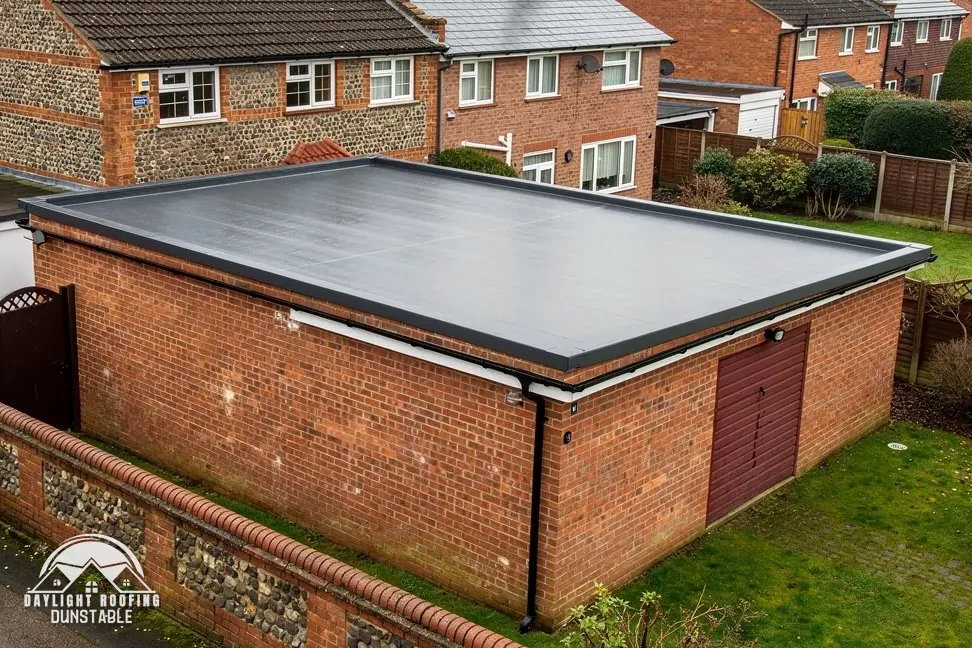
A brick garage with a new flat roof in a back garden

The roof, in plain words

Hip
The diagonal rib of tiles running from ridge to eaves at a roof corner.
Ridge
The crest of a pitched roof, capped by a row of angled tiles.
Hopper
The funnel at the head of a downpipe that catches the gutter's flow.
Bracket
The clip or arm that holds a gutter against the fascia.

The plain-as-day roof check

Corners, crests and gutters across Ware roofs

4 checks about 3 minutes to read

  1. Hips at the corners
  2. The crest of the roof
  3. Gutters, hoppers and downpipes
  4. Working from a Ware street

01 Hips at the corners

Seen from across the street, a hip reads as a diagonal rib of tiles from the ridge to the eaves at a corner of the roof. Hip tiles cap the joint where two slopes meet. They are either bedded in mortar or fixed dry with clips and screws, and BS 8612:2018, which is current, deals with the dry alternative. Mortar that has cracked can leave a tile loose, and wind can then work on the tiles beside it, so a loose hip tile is a call for a survey.

Along a hip, look for tiles that have shifted out of line, a gap showing at the joint, or broken bits of bedding lying in the gutter underneath. A hip that has moved needs the bedding or the fixings looked at, and the survey says whether that is a repair of a few tiles or a longer run. A hip's price is set by its length and condition, which only a survey establishes, so a written total follows it. Hips are one of the places a roof can fail without a stain showing indoors.

02 The crest of the roof

Sight along the ridge from across the road, with the sky behind it. Marley says that since the 2015 amendments mortar "could no longer be relied upon as the only means of securing the roof covering", and the ridge, which caps the top of the roof, is one place where that matters. A ridge that has dipped between two points suggests something amiss in the timbers underneath, and a tile that has slid shows as a notch against the sky.

Neither is a prompt to climb up. Both are things to photograph from the same spot, and to describe: where along the ridge, how long the dip, whether the gap has grown. A photograph sent to 07880 284133 on WhatsApp reaches the people who will survey the roof. A mortar-only ridge is a point to raise with any roofer. The roof repairs page describes the fixing, and what happens to the bedding.

03 Gutters, hoppers and downpipes

Water runs from the slope into the gutter, along it to an outlet, through a hopper and down a downpipe to the drain. Brett Martin publishes a fall of 1mm along every 600mm of run. A gutter that sags between brackets loses that fall and holds a pool, a hopper that has filled with leaves sends water over the edge, and a joint gone loose drips onto the wall below, so one fault can look like another from the ground, and the repair is chosen only after a closer look.

Staining down a wall below a gutter is one sign to look for from the pavement, and plants growing from a joint are another. Each fault has its own repair, from clearing a hopper to refixing a bracket to replacing a length, and the owner is told plainly which one the gutter needs. The guttering, soffits and fascias page explains the parts, from the fascia that carries them to the soffit beneath. Gutters on a built-up street also discharge onto the pavement, which is one more reason to fix an overflow.

04 Working from a Ware street

Putting scaffold on a public footway or carriageway takes a licence from the highway authority, which for Ware is Hertfordshire County Council, not East Herts Council. Hertfordshire County Council's licence costs £134 for 14 days and £59 for every week after, and the council says "It usually takes 3 weeks to process an application." Its conditions include 1.2 m of walkway left clear for pedestrians. We arrange the licence with our scaffolder. The scaffold itself comes under the written quote, which covers it in full.

In a town centre, the scaffold, a skip and deliveries all compete for the same pavement, so access is part of the survey. A Grade I building such as The Priory, used by the public as council offices and a community centre, adds its own constraints, and a scaffold wholly inside a property boundary needs no highway licence at all. The survey establishes which case a Ware roof is, and notes where a skip could stand, since a skip on the highway has rules of its own.

The dashed ring takes in the nearest towns and villages we cover around Ware. Map tiles © Esri; map data © OpenStreetMap contributors.

Ware roofs: hips, ridges, gutters and listings

01What does a slipped hip tile on a Ware roof point to?

It points to failed bedding mortar or loosened fixings, since a tile does not slide from a sound bed. The open joint then lets rain into the corner between two slopes, and wind can work on the next tile in line. Dry-fixed hips under BS 8612:2018 rely on mechanical fixings instead of mortar. A survey of the whole hip tells whether only a handful of tiles need refixing or the line must be redone, and the owner is told plainly which, along with the state of the ridge beside it. One tile out of place is reason enough to look along the whole hip.

02How can a Ware owner tell whether a ridge has dipped?

Stand across the road in daylight, with the sky behind the roof, and look along the ridge. A straight line is what to expect; a visible sag between two points, or a notch where a tile has slid, is worth photographing from the same spot, with a note of where along the ridge it sits. A sag can mean something in the timbers beneath, and a householder can check from the loft hatch for a split or damp rafter below that spot. WhatsApp the photographs to 07880 284133 or call 01582 935272, and say which elevation faces the road.

03Why does a Ware gutter overflow at one spot only, and what is done about it?

The cause is local to that spot: a hopper full of leaves, a joint gone loose, or a stretch that has sagged between brackets so water pools. Brett Martin's fall of 1mm along every 600mm disappears when a run sags. The repair follows the cause, from clearing the hopper to refixing the bracket to replacing a length of gutter, so the survey identifies which before a written total is given, and the fascia behind is looked at too, since a gutter hangs from it. A downpipe that has split can mimic a leaking joint.

04What does a stained wall below a Ware gutter suggest?

That water has been spilling over or leaking through a joint for some time and running down the brickwork. Look at the gutter above for a sag, a dripping joint or a blocked outlet, and at the downpipe for a split. Damp that reaches the wall can reach the fascia and the rafter ends as well. Photograph the stain with a coin beside it, send it with the survey request, and after the survey you hear plainly what was wrong with the gutter and how it can be mended.

05Can a Ware owner mend a Grade I roof in matching material unasked?

Not without checking. A listing reaches the entire building, roof and all, and whether a repair alters what the listing protects is measured against works "in any manner which would affect its character as a building of special architectural or historic interest". Place House (entry 1275417), The Priory (entry 1237950), Scott's Grotto (entry 1238171) and the Church of St Mary (entry 1217410) are all Grade I. East Herts Council is where the answer for a given repair comes from, and a reply on paper belongs in the file with the quote and the photographs.

06Who authorises roof work on The Priory, Ware's council offices?

The Priory is listed Grade I (entry 1237950, first listed 8 May 1950) and houses the Ware Town Council Offices and Community Centre. It needs listed building consent for works that would alter its character, and planning permission follows separate tests set by East Herts Council. Its roof is surveyed like any other, and the written total follows. Because the public use the building, scaffold and access are planned around them, and the survey looks at the route onto the roof and the spot for a hoist, plus anything on the roof such as aerials or vents.

07Which route covers repairs at Ware's St Mary's church?

St Mary's (entry 1217410) is a Grade I Church of England church. Where a church is in use and sits within the faculty jurisdiction of the Church of England, the faculty route takes the place of listed building consent. East Herts Council still answers on planning for work to the outside of the building. The parish's advisers are the first to consult, and any roofer's quote waits for them, so the order of approvals is clear first, with nothing priced or booked ahead of it, and the roof is not left open to the weather.

08Does the scheduled friary affect roof work on a house in Ware?

Only if the house, or a scaffold or skip for it, stands on or touches the scheduled area. Ware Friary (entry 1017519) is a scheduled monument, which puts it under a separate system: authorisation is needed for works, and applications go to Historic England. The list entry maps the scheduled area, so an address can be checked against it, and any request for consent quotes the entry number. For a house away from the friary the entry has no bearing on the roof, and the ordinary planning rules apply, with the conservation area as a further layer, if the house lies inside it.

09Does the Ware conservation area change how a house is re-roofed?

East Hertfordshire District Council has designated a Ware conservation area, and the council can tell an owner whether a given house falls inside its boundary. An Article 4 direction can remove further permitted development rights, so we check with the council first. For a re-roof, the planning guide holds the ordinary tests. A written reply from the council belongs with the quote, and it answers a question a buyer's solicitor may ask, so it is worth obtaining before work begins and filing with the deeds.

Get a written price for your roof

10-year workmanship guarantee, in writing

Tell us about your roof

Call WhatsApp Written quote