
Call 01582 935272

Brickendon · 27 road miles south-east

Roofers in Brickendon

Brickendon is a Hertfordshire village with a listed farmhouse, listed cottages and a conservation area, lying 26.6 road miles south-east of Dunstable; roof work touching wildlife, chimneys or the weight of a covering starts from a survey.

Get a written quote

Call 01582 935272WhatsApp us

Council
East Herts
Road miles
27
Conservation area
Brickendon
Building control
Hertfordshire BC Ltd

Roofs near Fanshaws Farmhouse and Bentleys Cottage

Three of Brickendon's listed buildings can be named here. Little Farden is Grade II (entry 1101701, first listed 14 June 1988), Fanshaws Farmhouse is Grade II (entry 1176893, listed 24 November 1966) and Bentleys Cottage is Grade II (entry 1176904). East Hertfordshire District Council has designated a Brickendon conservation area. Brickendon Liberty parish had 711 usual residents at the 2021 Census. For any of these addresses the list entry is the document that shows what is protected, and the council confirms how it applies to a roof.

Planning questions in Brickendon go to East Herts Council. For building control the contact is Hertfordshire Building Control Ltd (operations team 01438 879990), a company East Herts Council owns jointly with other Hertfordshire local authorities. Chimney stacks are covered under chimney repairs, the metal at their base under lead roofing and leadwork and a new covering under roof replacement; the permitted development tests are in the planning guide.

  1. 01Little FardenGrade II (entry 1101701). The entry decides what is protected, so a roof change here begins with reading it.
  2. 02Fanshaws FarmhouseGrade II (entry 1176893). A farmhouse roof can carry outbuildings and lean-tos, each of which the list entry may or may not cover.
  3. 03Bentleys CottageGrade II (entry 1176904). Consent turns on the building's character, so a new covering is put to the council first.
  4. 04Conservation areaEast Hertfordshire District Council has designated a Brickendon conservation area, and the council confirms whether an address sits inside it.
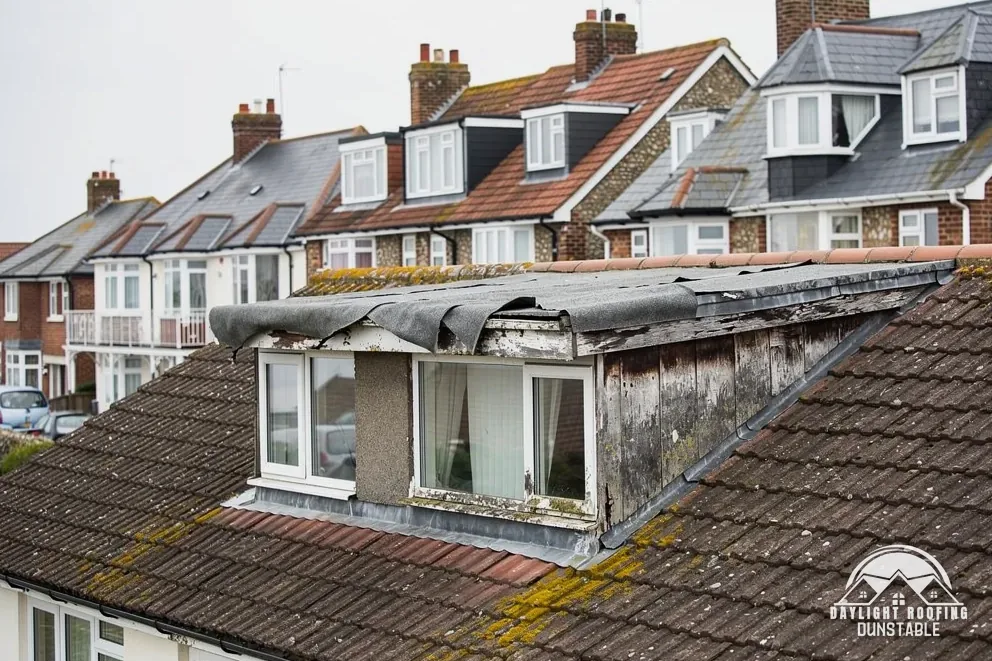
The worn felt roof and cheeks of a box dormer on a chalet bungalow

The roof, in plain words

Chimney breast
The section of a stack that projects into a room from the wall.
Flashing
A strip of metal, such as lead, sealing the join between roof and wall.
Natural England licence
Permission for roof work that would affect bats or their roosts.
Roof loading
The load a roof structure bears, including the covering.

The plain-as-day roof check

Wildlife, stacks and weight in Brickendon roofs

4 checks about 3 minutes to read

  1. Nests and roosts under tiles
  2. Taking out a chimney breast
  3. Lead round the stack
  4. A heavier covering

01 Nests and roosts under tiles

Wild birds and bats use roofs, and the law protects both. Section 1 of the Wildlife and Countryside Act 1981 makes it an offence to act intentionally against a wild bird's nest: it reaches anyone who "takes, damages or destroys the nest of any wild bird while that nest is in use or being built". An occupied nest, or one being built, in a roof edge therefore delays work on that edge until it is empty, and the delay is a matter of law, not of the roofer's preference.

For bats the rule is firmer. Regulation 43(1)(d) of the Habitats Regulations 2017 reaches anyone who "damages or destroys a breeding site or resting place of such an animal", and it carries no word about intent. GOV.UK says "All bat species, their breeding sites and resting places are fully protected by law", and it names "repairing or replacing a roof" as one activity that can need a Natural England licence. A bat found in a roof space is a reason to stop and take advice from the licensing body.

02 Taking out a chimney breast

A chimney breast belongs to a building's structure, and the Planning Portal says "Building regulations approval will always apply when removing chimney breasts". A breast on a party wall brings a notice to the neighbour as well. MyJobQuote says "The average cost of removing a chimney breast is around £2,500." and "the average price for removing the entire chimney stack with the breast is around £3,000 to £3,500" (page dated 3 November 2026).

Those are national averages from one source. The stack above the roofline has to be supported or taken down, the roof repaired where it stood and the rooms below made good, so a quote for a Brickendon house treats stack, roof and ceilings as a single job. Repointing a stack is priced after a survey, since what it costs turns on how much of the brickwork has failed and how high the stack stands above the roof. A stack that is shared with the next house adds the neighbour to the planning of the work, and to the party wall notice.

03 Lead round the stack

At the foot of a stack, the lead is a spot where an otherwise sound chimney can let water in. MyJobQuote says that "A chimney lead flashing patch repair typically costs around £200, while a full replacement averages around £570." It also gives between £350 and £920 for a full leadwork replacement (page dated 22 September 2026). The figures are for chimney leadwork only, and they say nothing about lead on a flat roof, a bay or a valley.

The same source says correctly installed lead flashing can last for over 80 years, so a patch repair on lead that is otherwise sound is a different job from replacing flashing that has split. A stain on the chimney breast inside, below the roof, may point to water passing the flashing. The lead roofing and leadwork page describes how the metal is dressed against the brick, and how a step flashing differs from the apron at the front of the stack.

04 A heavier covering

Changing a covering can change the load on the rafters. The Planning Portal's guide lists, among the cases needing approval, one where "You use a new covering material which increases the weight of the roof covering by 15 per cent or more." Approved Document A says "A significant change in roof loading is when the loading upon the roof is increased by more than 15%." The two thresholds are worded differently, and each comes from its own document.

The Planning Portal adds that "you are advised to check with a structural engineer or surveyor before commencing with works". Which material is heavier depends on the product and on how it is laid, so no covering is named as lighter or heavier here. The survey of a Brickendon roof identifies the existing covering, so that a proposed one can be compared on weight by someone qualified to do it, before the order is placed.

The dashed ring takes in the nearest towns and villages we cover around Brickendon. Map tiles © Esri; map data © OpenStreetMap contributors.

Brickendon roofs: wildlife, chimneys and weight

01What should be done if a bat is seen in a Brickendon roof space?

Stop work on that area and take advice before anything is disturbed. GOV.UK says "All bat species, their breeding sites and resting places are fully protected by law", and roof work can need a Natural England licence. It is an offence for anyone who "damages or destroys a breeding site or resting place of such an animal", whatever the intent. A roof survey can look at where droppings or bats have been seen, but what is allowed is a question for Natural England's licensing, and any quote waits for that answer. A bat is never moved by a roofer on their own judgement, and roof work resumes only once the licensing question is answered.

02Can nests under the eaves delay roof work in Brickendon?

They can. The offence under the Wildlife and Countryside Act 1981 is for anyone who intentionally "takes, damages or destroys the nest of any wild bird while that nest is in use or being built". An occupied nest, or one under construction, therefore holds up work on that stretch of the roof edge until the birds have gone, and an empty nest delays nothing. On a Brickendon roof the owner is told plainly which sections are affected, so that it is clear what is waiting and why, and the work can be arranged around the birds.

03What does it cost to remove a chimney breast in Brickendon?

MyJobQuote's average for removing a chimney breast is around £2,500, and for removing the entire stack with the breast around £3,000 to £3,500 (page dated 3 November 2026). Those are outside national figures. A Brickendon price depends on the stack's height and condition, the roof repair where it stood and the rooms below, and it comes in writing as a single total once a survey has been done. Building regulations approval will always apply, and a party wall notice goes out when the breast sits on a party wall, so both are planned in before work starts, with the notice period allowed for.

04What do outside guides say chimney lead repairs cost?

According to MyJobQuote, a chimney lead flashing patch repair typically costs around £200, while a full replacement averages around £570; it gives £350 to £920 for a full leadwork replacement (page dated 22 September 2026). Those figures apply to chimney leadwork only. A written total for a Brickendon stack follows a survey of the flashing, the pointing and the pots, and the owner is told plainly whether the lead needs a patch or a new flashing. A patch on sound lead and a new flashing round a split one are different jobs.

05Does a heavier covering on a Brickendon roof need a structural check?

The Planning Portal's guide lists a new covering material that increases the weight of the roof covering by 15 per cent or more among the cases that need Building Regulations approval, and it recommends a word with a structural engineer or surveyor first. Approved Document A calls an increase of more than 15% a significant change in roof loading. The comparison is made on the actual roof, so the survey identifies the old covering before anything is proposed in its place, and the owner can pass that to the engineer. The result goes into the written total.

06What does a farmhouse listing in Brickendon cover?

Fanshaws Farmhouse (entry 1176893) is listed Grade II, first listed 24 November 1966. The list entry names what is protected, and for roof work the question is whether a change would affect the building's character as a building of special architectural or historic interest. Consent is judged on that test, so a repair in matching material and a change of covering are different cases. East Herts Council is the body to ask, and quoting the entry number helps it answer for a specific roof, outbuilding or lean-to. Little Farden (entry 1101701) and Bentleys Cottage (entry 1176904) are treated the same way.

07Is a Brickendon house in a conservation area?

East Hertfordshire District Council has designated a Brickendon conservation area, and which side of its boundary an address sits on is for the council to confirm. An Article 4 direction can remove further permitted development rights, so we check with the council first. The tests for re-roofing are in the planning guide. The council's reply, kept in writing with the quote, is the document a buyer's solicitor will ask to see, and it is easier to get while the owner is still planning the work, and before any scaffold goes up.

08Who licenses scaffolding on a Brickendon road, and for how much?

Hertfordshire County Council is the highway authority for Brickendon, and it licenses scaffolding at £134 for 14 days and £59 for each further week. It states "It usually takes 3 weeks to process an application", and keeping 1.2 m of footway clear is a condition. We arrange the licence with our scaffolder; the written quote carries the scaffold. A scaffold wholly inside the property boundary needs no highway licence, and the survey shows which case applies to a Brickendon house, as well as how the stack and the roof are reached.

09Can a photo of a Brickendon stack help before a survey?

It helps a great deal when it shows the whole stack from the ground and then the base where the lead meets the brick. Send it on WhatsApp to 07880 284133, or call 01582 935272. A photo shows leaning, missing pointing and lifted lead, but not the state of the flue or the roof timbers, so it narrows what is looked at and does not replace the survey. The written total comes after the survey, and it reports what the roof showed, other faults included. Dated photographs of any damp patch indoors are useful beside it.

Get a written price for your roof

10-year workmanship guarantee, in writing

Tell us about your roof

Call WhatsApp Written quote