
Call 01582 935272

Great Horwood · 21 road miles west

Roofers in Great Horwood

Roof repairs, re-roofing and chimney work for Great Horwood and Singleborough, with the roof looked at in person first and the price put in writing as one total.

Get a written quote

Call 01582 935272WhatsApp us

Council
Buckinghamshire
Road miles
21
Conservation area
Great Horwood
Building control
Buckinghamshire Council

Roofs round Great Horwood and Singleborough

Great Horwood sits in Buckinghamshire, 21 road miles from Dunstable going west, around 32 minutes behind the wheel. The parish had 1,102 usual residents at the 2021 Census. The village has a conservation area designated by Buckinghamshire Council, and a second one, Singleborough, lies in the area round it, so the council's planning team is the first call when work would change how a roof looks from the street. A roof job in a village can reach beyond the roof: gutters, fascias and chimney pointing sit within reach of the same scaffold, so they are looked at together.

The listed buildings include the Church of St James and Manor Farmhouse, both Grade II*, and The Old Bakehouse and The Old Post House at Grade II. A survey comes before any quote from us. The findings, including any further defect seen on the way, are explained plainly and then written up as a single total. Whether the job is a chimney repair or a longer stretch of slate roofing, that order does not change.

  1. 01Church of St JamesGrade II* (list entry 1213275) within the Church of England, so its roof repairs run on the faculty system and need no listed building consent.
  2. 02Manor FarmhouseGrade II* (entry 1213486), first listed 4 June 1952. Roof changes there are weighed against what makes the house special.
  3. 03The Old BakehouseGrade II (entry 1213272), listed on 19 August 1959, with The Old Post House (entry 1289130) also Grade II.
  4. 04Singleborough areaA conservation area in the area round the village, designated by Buckinghamshire Council, so ask the council before changing a roof's appearance.
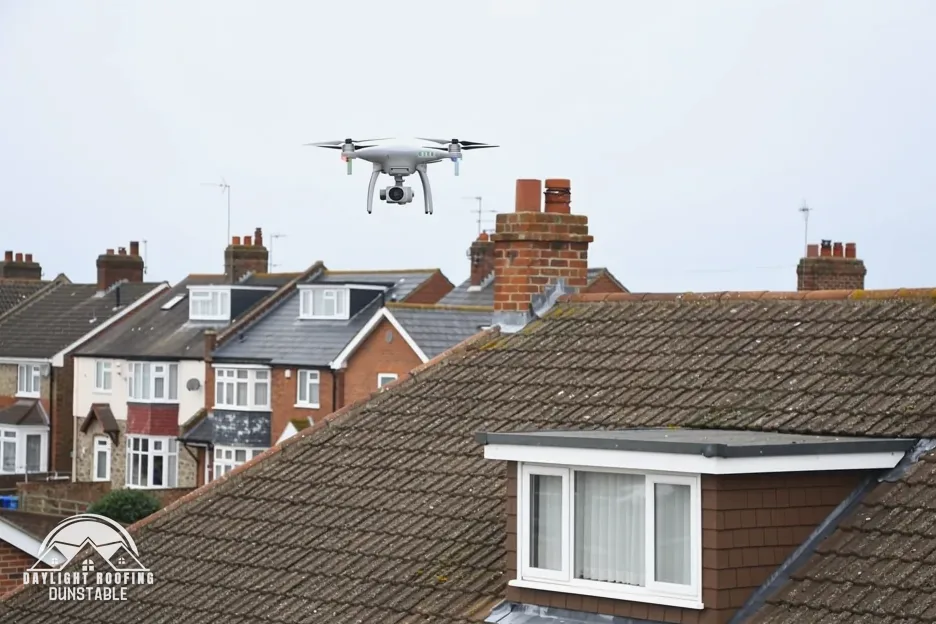
A small grey drone hovering above the tiled roof of a chalet bungalow

Great Horwood in plain words

Flaunching
The sloped mortar cap on a chimney stack that holds the pots in place.
Conservation area
An area the council protects, where outside changes can need extra permission.
Soaker
A small piece of metal woven under tiles or slates beside a wall or chimney.
Listed building consent
A second consent needed when roof work touches what makes a listed building special.

The plain-as-day roof check

Four details worth checking on a Great Horwood house

4 checks about 3 minutes to read

  1. Chimney stack and pots
  2. Slate and its fixings
  3. Porch and lean-to roofs
  4. Lead round a bay window

01 Chimney stack and pots

A chimney is a tall, narrow structure standing in the wind and the rain on all four faces, which is why its upper section weathers faster than the walls below. From the ground, check the brick joints for crumbling mortar, the pots for tilt or cracks, and the mortar cap on top for splits that show as a dark line of damp running down the brick. Binoculars from the lawn show a good deal of this without a ladder.

If a stack is no longer used, the flues are capped and ventilated rather than sealed airtight, because trapped moisture rots the brick from inside. Where there is a gas appliance or a stove, a flue liner and a sound cap matter for safety as well as for the weather. A stack that is in use belongs in the hands of a qualified chimney sweep. Never light a fire in a flue that has not been checked and swept, because a blocked or cracked flue is a danger to the whole house.

02 Slate and its fixings

If the covering is slate, each slate hangs from a pair of nails or a hook, and the nails can be where it gives way. A slate that has slipped a few centimetres down its course, or a thin line of daylight at a lap, shows a nail that has rusted through. Cupa's slate guidance says hooks should not be used on any pitch under 25 degrees, so the slope of a Great Horwood roof is measured before a fixing is chosen. A slate roof reads course by course from the eaves upward, and a gap in one row stands out against the pattern of the rows around it.

A slipped slate can be re-fixed with a metal tingle, a strip that holds the slate in place, but if the nails are failing in neighbouring courses a patch only moves the problem along the roof. The survey looks at how far the fixings have corroded and says plainly whether repair or re-slating is the sensible route for your roof, and a photo of the slipped slate sent beforehand helps. Where slates in the matching size or colour are no longer made, the survey says so and a close alternative is chosen, which counts where the roof can be seen from the street.

03 Porch and lean-to roofs

A small porch, lean-to or rear outbuilding has its own roof, which can be a shallow pitch with a different covering from the main house, and a junction where its upper edge meets the wall of the house. That junction is sealed by a flashing, and if the flashing lifts, water runs down behind the render or brickwork instead of onto the roof.

Look at the sheets or tiles for slipped fixings, and check the wall above for damp tracing the flashing's line. A shallow lean-to roof also sheds water slowly, so leaves and silt on its surface hold damp against the covering. Clearing a small roof like this takes minutes, and it shows what condition the covering is in before anyone decides what to do. If the lean-to roof is tiled, the tiles hang from battens, and a rotten batten shows as a sag across several tiles at once.

04 Lead round a bay window

A bay window carries a small roof of its own, which may be covered in lead, with lead flashings where it meets the main wall. Look for a sheet split along one of its folds, lead slipped down its fixings, or a bubble in the metal that points to trapped water. Stains inside, on the ceiling or the window head, follow the same line as the fault outside. Soft, wrinkled lead near a gutter edge can also mean it has been walked on or has crept with the heat.

Rolled lead sheet is made to BS EN 12588 in codes 3 to 8, and code 4, for example, is 1.80 mm thick. Which code goes where is decided by the written specification for every detail, so a bay roof and a chimney flashing need not share one. Our lead roofing page explains what the work involves, and the repair is quoted with the rest of the roof. A bay roof is small enough for the whole lead covering to be renewed in one go; patching an old sheet leaves the weakest fold in place.

The dashed ring takes in the nearest towns and villages we cover around Great Horwood. Map tiles © Esri; map data © OpenStreetMap contributors.

Great Horwood roofing questions, one at a time

01How do you trace a damp patch below a Great Horwood chimney stack?

Water that enters a stack does not always show where it got in. A dark patch on the chimney breast inside can come from the flashing, the pointing, the flaunching or the pot itself, and the survey tests every one separately from the roof. Once the entry point is found, the repair is matched to it, and anything else noticed along the way is reported back to you. A photo of the stain on WhatsApp, with the room it is in, helps us start from the right place. If the house has a gas fire or a stove, mention it, since that affects how the flue is looked at.

02How far does the Great Horwood conservation area reach into roof choices?

Buckinghamshire Council designated the Great Horwood Conservation Area, and the Singleborough Conservation Area lies in the area round the village. Where each boundary runs is shown on the council's own maps, so the line past a particular cottage is for Buckinghamshire Council to confirm. Repairing with matching materials is a lighter matter than changing the covering, and whether a given house sits inside either area is something its planning officers can answer. Our planning permission guide gives the wider picture. If the repair really is like for like, the conversation with the council is short.

03Who signs off roof repairs at St James, Great Horwood?

St James, the village's parish church, is Grade II* (list entry 1213275, first listed 19 August 1959) and in Church of England use, so while it is in use the faculty system applies, which takes the place of listed building consent, and where roof lead is replaced like for like the archdeacon's written notice can stand in for a full faculty. Planning permission for work to the outside remains a separate question. Roofers do not choose the route: the church and the council settle it before any work is planned. A village group raising funds for repairs should ask both bodies what they require before anyone books a scaffold.

04What do the Grade II* and Grade II listings in the village mean for roofs?

Manor Farmhouse is listed Grade II* (list entry 1213486, first listed 4 June 1952), The Old Bakehouse is Grade II (entry 1213272) and The Old Post House is Grade II (entry 1289130). Where work would be done "in any manner which would affect its character as a building of special architectural or historic interest", listed building consent is required. Swapping the covering for a different material raises that question; a faithful repair may not. Buckinghamshire Council is the body that answers it for a given roof. Neither grade removes the ability to carry out repairs; each only sets the question to be asked first.

05What will a Great Horwood scaffold licence set me back?

The highway authority here is Buckinghamshire Council, which issues scaffold licences to registered scaffolding companies, at £402.78 for 28 days. Buckinghamshire Council lists a renewal at £69.09 and a retrospective licence at £777.63. A licence is needed only where scaffolding obstructs the pavement or road, and a scaffold wholly inside your own garden does not need one. We arrange the licence with our scaffolder, so you will not be filling in the council's application form yourself. The 28 days run from the licence, so a long job may need the renewal, and that is worth settling at the survey.

06Which council checks Building Regulations on a roof in Great Horwood?

Buckinghamshire Council has its own building control service, and its contact details are on its building control page. Instead of the council, a registered building control approver can take the job on. Council building control issues a completion certificate; a registered approver issues a final certificate. Because a whole re-roof is beyond the 50 per cent roof limit in the Planning Portal's re-roofing test, we check the route with the council before the work starts, and you can ask the same question yourself. Use the number on that page, not one copied from elsewhere.

07Does a loft conversion in Great Horwood need a protected stair?

Not in every case, because the rule allows a choice. Where a loft conversion creates a storey more than 4.5 m above ground, Approved Document B paragraph 2.5 calls for either a protected stairway or an alternative escape route. For storeys no higher than 4.5 m, an escape window does the job, and paragraph 2.23 allows a sprinkler-based option for open-plan layouts. Ask building control which one fits your plans; a roof window in the new slope is a separate matter. An escape window must open to a clear area of at least 0.33 m2, with a minimum height and width of 450 mm and its bottom edge no more than 1100 mm above the floor.

08What does it cost to re-roof an average house near Great Horwood?

Which? Trusted Traders put replacing the whole roof of an average three-bedroom house at £7,000 to £21,000 excluding VAT, from a survey of 11 traders in November 2025. That is a national range, not a price for your roof. Size, access, the type of covering and whatever the survey turns up all move the figure, and our own quote is one written total price given after the survey of your roof. For smaller jobs the same Which? survey gives £75 to £400 for replacing one to six broken or missing standard roof tiles.

09Is jet washing a good way to clear moss from a roof here?

Marley advises against using high-powered jet washes on a roof, as they can damage a tile's or slate's surface and shorten its life. Checkatrade says roof cleaning typically costs £8.50 to £14 per square metre (April 2026), a per-metre figure only. A coat of moss thick enough to hold water against the covering is more than a cosmetic problem, and that kind of roof is worth having surveyed before anything is scrubbed or sprayed. Checkatrade gives no VAT basis for that figure, so treat it as a guide to scale rather than a price for your roof.

Get a written price for your roof

10-year workmanship guarantee, in writing

Tell us about your roof

Call WhatsApp Written quote