
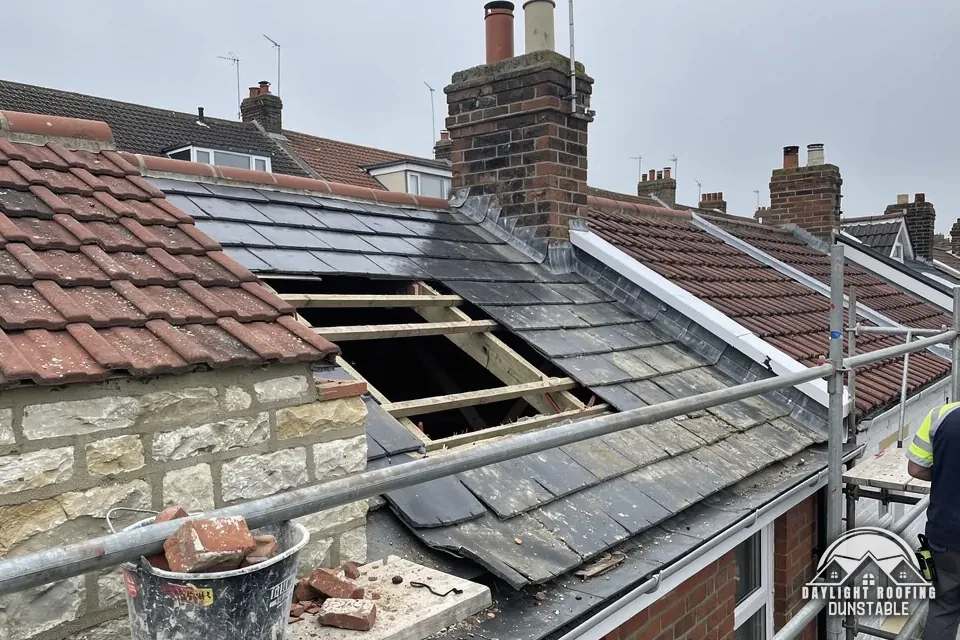
Why a chimney breast is structural work
Where a wall juts into the room and carries the flue up toward the stack on the roof, that projection is the chimney breast. Where two houses share a wall, the breast on one side and the breast on the other may sit back to back, built into the same party wall. Taking one out is therefore building work on a structure that belongs, in part, to the neighbour's side as well.
The Planning Portal puts the position in one sentence: "Building regulations approval will always apply when removing chimney breasts as they are part of the building's structure." That structural character is also the reason for the Party Wall Act step, covered below. Both steps come before any breast is cut away, and neither is a formality that can be left until the work is under way.
This post is about Luton, so it names Luton Council's own building control service and the rules for a Luton address. What follows suits a terrace or a semi with a breast built into a wall that two households own jointly, and it suits a detached house too, where the structure is the owner's alone and only the Building Regulations step applies. Which case a house falls into is worth settling at the start, since it decides whether a neighbour needs to be told at all.
Two separate steps
- Building Regulations approval
- Party Wall Act notice
- Support for the structure above
- The stack and roof made good
Building Regulations approval through Luton Council
Building control is carried out by the council's building control team or by a registered building control approver. Luton Council runs its own building control service, and its telephone line is 01582 546607, with an answerphone message service available round the clock. The council's main switchboard, 01582 546000, is a different line and is answered between 9am and 5pm, Monday to Friday.
At the close of compliant work the council's team gives out a completion certificate, while the registered approver's version carries the name final certificate. Either is worth keeping. When the house is sold, a buyer's conveyancer may ask to see it, and a property where the chimney breast is gone and no certificate is on file prompts questions that take time to settle.
Approval comes first, and a council officer can say what drawings or details it needs. It would be a mistake to take down a breast on the strength of a plan alone and apply afterwards. Planning permission is another regime altogether, and one cannot replace the other. Anyone who wants to remove a breast in a conservation area or a listed house has a planning or consent question on top, and the chimney breast removal regulations guide sets out how the pieces fit together for a house of that kind.
The Party Wall Act: who serves notice
The Party Wall etc. Act 1996 deals with work to a wall that is shared with the house next door. Serving the notice falls to the building owner, which means whoever is having the work done. The neighbour does not. Section 2(2)(g) covers exactly this job and gives the right "to cut away from a party wall, party fence wall, external wall or boundary wall any footing or any projecting chimney breast, jamb or flue".
Notice for work of that kind is a party structure notice, and section 3 says it must "be served at least two months before the date on which the proposed work will begin". A shorter period applies elsewhere in the Act: a new boundary wall needs notice "at least one month before he intends the building work to start", and digging close to a neighbour's building needs notice at least one month before the excavation begins.
A notice is a written document that gives the owner's name, the address and a description of the proposed work, and it goes to every adjoining owner. A party wall question goes to a party wall surveyor and not to building control. The council's building control team answers questions about the Building Regulations, which is a separate regime with its own approval and its own certificate, and which does not decide the neighbour's rights.
Two months, 14 days and the surveyor
After the notice lands, the neighbour has a choice. The work may go ahead with "the consent in writing of the adjoining owners and of the adjoining occupiers", which can let it start earlier than two months. With no consent, a dispute arises. Under section 5 the neighbour has fourteen days to reply, and one who stays silent is "deemed to have dissented from the notice".
GOV.UK warns that "You cannot assume that no response means they agree to the works." It also says "You must appoint a surveyor if you and your neighbour cannot agree." Dissent sends the parties to section 10's surveyor route, under which an agreed surveyor, or one for each side, settles the terms. It does not give the neighbour a veto, and it does not mean the work cannot go ahead. That is why a calm early conversation with the neighbour helps both sides.
| Step | Period | Section |
|---|---|---|
| Notice to cut away a projecting breast | At least 2 months ahead | 3 |
| Reply from the neighbour | 14 days | 5 |
| Boundary wall built from new | At least 1 month ahead | 1 |
| Excavation near a neighbour's building | At least 1 month ahead | 6 |
Fourteen days is the time to reply and is not the lead time. The lead time is two months. Mixing the two up leaves a building owner with a notice that has not been served for long enough, and the work then has to wait.
The stack and the roof above
Taking the breast out of a room is one job. The stack above the roof line is another, and a roofer's work meets the chimney there. When the whole chimney comes down, the roof covering has to be made good where the stack stood, with the opening closed, the structure under it supported and the tiles or slates around it relaid. If only the breast goes and the stack stays, the stack needs support, which makes it a structural matter for the Building Regulations approval.
Planning is a separate question again. The permitted development order words Class C as "Any other alteration to the roof of a dwellinghouse", and the government's guidance counts re-roofing among them, but Class C excludes "the installation, alteration or replacement of a chimney, flue or soil and vent pipe". So Class C does not settle a stack. The council decides whether planning permission is needed, and the planning guide for chimney removal covers the tests.
Where a stack stays, its condition matters. Correctly installed lead flashing, according to MyJobQuote, can last for over 80 years, and a failed flashing lets water into the roof. MyJobQuote's figures for chimney leadwork, from a page last updated 22 September 2026, are for chimneys only and are separate from anything on this page about removal.
- BreastThe wall projection in a room that carries the flue.
- StackThe chimney part above the roof line.
- FlashingLead sealing the joint between stack and roof.
- Party structureWall or floor owned jointly by neighbours.
What the published cost figures say
Published cost guides give an idea of scale, and each one is a third party's figure, not a price for any house. MyJobQuote, on a page last updated 3 November 2026, says "The average cost of removing a chimney breast is around £2,500." It adds that "the average price for removing the entire chimney stack with the breast is around £3,000 to £3,500". Those figures are averages from one source, and they carry no VAT basis.
MyJobQuote's chimney lead figures, last updated 22 September 2026, are narrower: "A chimney lead flashing patch repair typically costs around £200, while a full replacement averages around £570." It also puts a full leadwork replacement "between £350 and £920, depending largely on whether scaffolding is required". Treat the lead figures as applying to chimney leadwork alone.
A cost guide does not include the neighbour's side. Where a party wall surveyor is appointed, the surveyor's fees are a separate matter between the owners, and nothing here puts a figure on them. The costs of the work itself, the supports, the stack and the roof made good, are brought together into one written total once a surveyor of our own has looked at the roof, since each house is built differently.
For a wider look at what sets chimney prices, the chimney repair and removal costs guide goes through them.
Getting a written price for the roof side
A roofer does not take the place of the party wall surveyor or building control, and this post has been clear about which questions go where. What a roofer does is survey the roof, describe the stack and its flashing, and give one written total for the roof work. That survey also shows whether the stack needs repair even when it is staying, and whether the flashing around it is sound.
At the survey the stack, its flashings and the slopes around it are examined, and any other fault noticed gets a plain description. To get a first view, WhatsApp a picture to 07880 284133 and the picture gets a look. A scaffold on a Luton pavement or road is licensed by Luton Council, and we arrange the licence with our scaffolder.
The page on chimney repairs covers the other work we do on stacks, from rebuilding to flaunching and repointing. Whichever way the project goes, the order is the same: approval first, the notice served in good time, and the written price once the survey is done. Telling the neighbour early, before the notice arrives, makes that conversation easier, and a stack taken down changes the roofline next door sees as well.
One written total
What sets the price
The size of the stack, the work needed to make the roof good, the way the stack is reached and the survey's findings decide the figure. One written total follows the survey.