
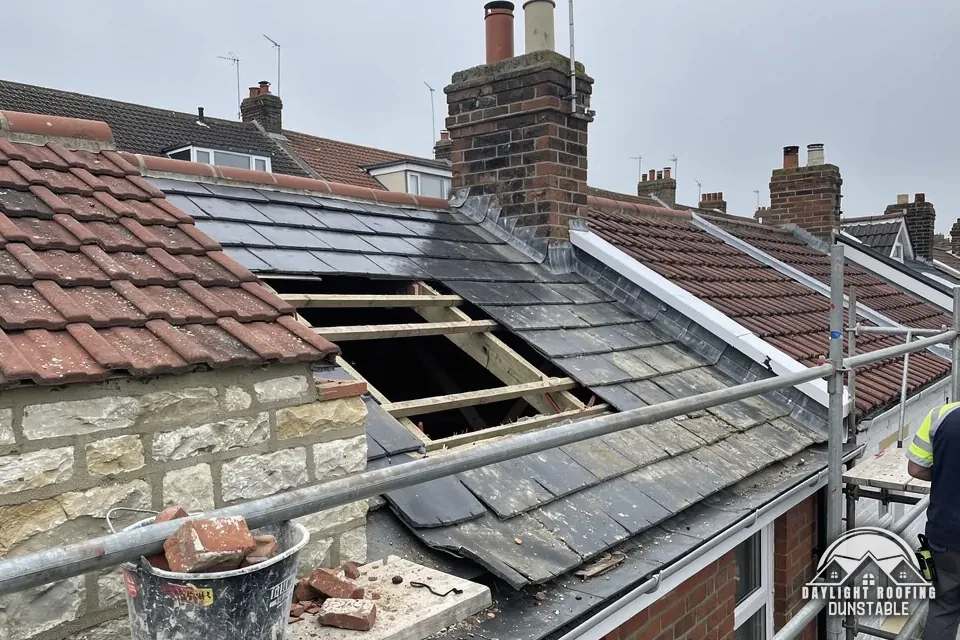
What sets the price of chimney work
A chimney price is built from the job and the building, and the same repair can cost different amounts on two houses. The size and height of the stack matter, and so does the way the roof around it is reached. A stack on a low rear extension can be reached more simply than one rising from a ridge three storeys up.
The condition of the stack matters as well. Pointing that has worn back by a few millimetres is a smaller job than brickwork that has loosened, and a flashing lifted at a single corner is less work than lead that has thinned all round. Only a survey shows which of these a particular chimney needs, so a figure given before it is a guess, and a published average is a guide to scale.
The number of repairs counts too. A stack that needs its lead, its flaunching and its pointing attended to is one set of access arrangements, where three separate trips would repeat the access each time. Whatever the survey settles, the price is given in writing as one total.
Published figures leave out as much as they include. They carry the date of the page they came from, and several carry no VAT basis, so they are read as dated third-party guides and not as prices that apply to a chosen house. Two quotes for what looks like the same job can differ because one stack is taller, steeper or harder to reach than the other.
One written total
What moves a chimney price
Stack height, the route onto the roof, the condition of the brick, lead and mortar, and whether the stack stays or comes down all shape the figure. The survey settles each of these before the price is written down.
Removing a chimney breast: published averages
MyJobQuote's page on chimney breast removal (last updated 3 November 2026) averages the breast on its own at around £2,500, and the entire stack taken down with the breast at around £3,000 to £3,500. The page states no VAT basis for either figure, and neither is a price for any one house.
| Job | Published average | Page updated |
|---|---|---|
| Removing a chimney breast | Around £2,500 | 3 November 2026 |
| Removing the whole stack with the breast | Around £3,000 to £3,500 | 3 November 2026 |
A breast does not come out as a simple trade job. The Planning Portal says: "Building regulations approval will always apply when removing chimney breasts as they are part of the building's structure." A Party Wall Act notice is needed as well where the breast sits on a shared wall. The application, any structural design and a party wall surveyor's fees are separate from the roof work, and the published averages do not say whether they are inside the figure.
If the whole stack comes down, the roof has to be made good where it stood, with the opening closed and the covering relaid around it. That is the part a roofer prices. The guide to chimney breast removal regulations explains both the approval and the notice.
Leadwork: patch and replacement figures
The leadwork page on MyJobQuote, last updated on 22 September 2026, is the source here. It reads: "A chimney lead flashing patch repair typically costs around £200, while a full replacement averages around £570." It puts a full chimney leadwork replacement at £350 to £920. These figures describe chimney leadwork only. They are not figures for lead on flat roofs, bays or valleys.
| Work | What it says |
|---|---|
| Lead flashing patch | Typically around £200 |
| Lead flashing replaced in full | Averages around £570 |
| Full leadwork replacement | £350 to £920 |
A patch and a replacement differ in the amount of lead and labour involved, and the survey decides which one a chimney needs. The same guide says correctly installed lead flashing can last for over 80 years, a statement of what is possible and not a promise about any roof. A patch can suit a lifted corner or a small split, and a full replacement can suit lead that has thinned or has failed in several places. In each case the price is for the work the survey finds, set down as one total.
The guide to chimney flashings and leadwork covers the lead codes, the parts of a flashing and the signs that one is failing.
Repointing, flaunching and pots: priced after a survey
Repointing is priced after a survey. What drives its price is something a survey can measure: how much of the stack is affected, how deep the old mortar has weathered, how high the stack stands and how the stack is reached. A short stack with shallow wear is a small job, and a tall one with loose brick is a larger one.
Flaunching and pots follow the same rule: the price comes after the survey. The flaunching is the mortar bed on top of the stack, and a repair can be a patch where it has cracked, or a new bed across the whole top with the pots reset in it. A cracked pot or cap is another item again, and each of these ranges from a small task to a larger one.
A stack that needs more than one of these jobs does not need a visit for each. The survey examines the whole stack and the owner hears in plain terms what was found before the one written price is given. Whatever turns up is reflected in that total, and nothing is left to be agreed afterwards as a separate extra.
Any figure offered for these jobs before the stack has been looked at has nothing behind it. A quote for repointing that arrives without a visit is worth questioning: ask how the figure was reached.
Published storm and emergency figures
A chimney damaged in bad weather raises a different question, because the first job can be to make the stack safe before anything is repaired. MyJobQuote's emergency page, last updated 22 October 2026, reads: "Emergency roofer call-out costs typically range from £150 to £300, while extensive storm damage repairs can cost £1,200 or more."
Both figures are for roofing emergencies in general. They are not chimney prices, and they carry no VAT basis. The £1,200 figure is for extensive storm damage repairs, and it is not a price for a chimney repair or for any particular storm repair. A reader who sees it quoted for a small chimney job should treat it as a different category.
If the damage may be an insurance matter, photographs of it, taken where it lies, come first. Whether an insurer pays is a matter of the policy wording, and the Financial Ombudsman Service handles disputes on 0800 023 4567. The guide to chimney repairs sets out the full range of stack work, and the price for any of it is set after a survey.
A quote for storm repair should name the stack and the work. A figure that covers storm damage without saying which part of the house it concerns is not a price for the chimney.
Scaffold, access and the licence
Access shapes a chimney price, because the work is at the highest point of the house. Where a stack cannot be reached from a ladder or a low roof, scaffold is needed, and the written quote carries it. The price of scaffold hire depends on the access the survey finds.
Section 169 of the Highways Act 1980 requires a licence for a scaffold standing on a public highway, issued by the authority that looks after that road or pavement. We arrange the licence with our scaffolder. It is arranged separately from the building work and adds to the planning of a job, which is one more reason the survey comes before any price.
A house on a narrow or busy road can need more scaffold planning than one on a cul-de-sac, and that planning is part of why the survey comes first.
Some stacks are reached from a flat roof or an extension roof below them, which can give a footing without scaffold, while others stand on a steep pitch with nothing beside them. The survey establishes which case applies, and whatever access the stack needs sits inside the written quote. Where several roofs meet round a stack, the access can need more thought still.
Reading a quote against published figures
A third-party average gives a sense of scale and cannot replace a price for a particular stack. When a quote arrives, check that it names the work: which sides of the lead, how much pointing, whether the flaunching is a patch or a new bed, whether the stack stays or comes down. A quote that says only chimney repair leaves the reader unable to compare it with anything.
Check what it covers, too. Advice about another firm's quote is simple to follow: ask whether it covers access to the stack, the making good of the roof around it and any structural support. A quote that is clear on those points is easier to compare than one that is silent. Where a quote is silent, ask.
Check the dates and the basis of any figure being compared. A published average carries the date of its page and, in several cases, no VAT basis, and a per-square-metre rate is never a total. Dates matter because prices move, and a figure from an earlier year may not describe work done now.
The guide to repairing, rebuilding or removing a chimney stack helps decide which job the chimney needs, which is worth settling before any prices are compared.