
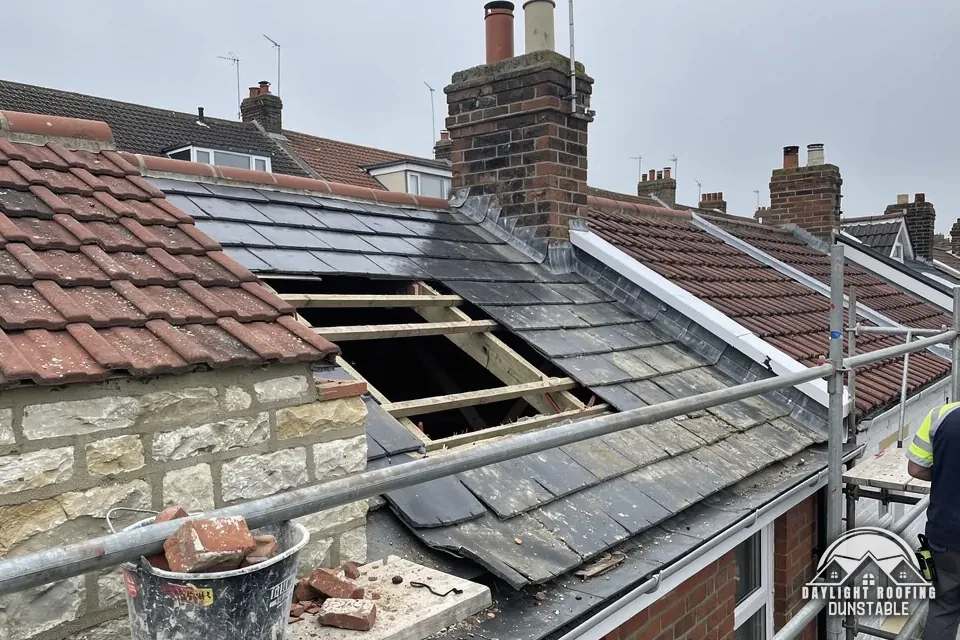
Where a chimney sits in a buildings policy
A chimney stack is part of the building, so damage to one is a question for buildings insurance and not for a contents policy. The stack, its pots, the cap, the flaunching on top and the lead round its base all belong to the structure of the house. Pots, a cap or the lead can come away in a single night, and the stack itself can fail over the years; both land on the same insurer's desk. Whether a particular policy pays for any of them is settled by that policy's wording, and nobody outside the insurer can tell you the answer in advance.
Three questions sit behind a chimney claim. What happened to the stack, when did it happen, and which cause does the policy name? A storm that brought pots down is a different event from mortar that has crumbled over a long period, and a policy can treat the two differently.
Insurance is the insurer's decision, so no claim can be promised. Reading the policy for its storm definition and its exclusions is the first job, and the later sections say what to look for. Where a claim is refused, the complaint route is open to the policyholder.
Parts of the stack
- Pots and the chimney cap
- Flaunching on the stack top
- Brickwork and its pointing
- Flashing at the roof joint
How the ombudsman defines a storm
The Financial Ombudsman Service gives its own test for a storm, which reads: "a storm usually involves violent winds, usually with rain, hail or snow". The ombudsman adds that "Rain, hail or snowfall by itself can constitute a storm", and the Beaufort Scale counts among the things it weighs. That wording leaves room for a wet, windy night as well as a gale. A claim is therefore not ruled out only because the wind was modest, and the word storm still has to be backed by evidence of the weather on the day.
A chimney makes the dating question important. Pots or a cap found on the ground the morning after a night of rain and wind are easier to link to a date than a stack that has lost mortar over a long time. Writing down the date the damage was noticed, and what the weather was doing, gives the insurer and the ombudsman a place to start.
The ombudsman's page is about complaints, so it describes the dispute stage and not the first claim. It still shows how a storm is judged, which is worth knowing before the first call to the insurer, because the same evidence helps at every stage: dated photographs and a clear account of the weather. Anything else that fixes the date, such as a neighbour's picture or a message sent that morning, adds to it.
You might hear
Only a gale counts as a storm.
Plain as day
The ombudsman says rain, hail or snowfall by itself can constitute a storm.
Photograph the damage before anything moves
The ombudsman's page says it will "usually look at expert reports and photos" when it considers the condition of a property, and adds: "Your insurer will normally ask a surveyor to write a report." That is the reason to take photographs early. They record what the stack looked like before anyone tidied it up. Missing pointing and a cap that has slid off are different things to an insurer's surveyor, and a clear picture shows which one it is.
Take pictures standing on the lawn or at an upstairs window, and keep off the roof. Start with a wide view that shows the whole house with the stack in place, then move to close views of each area that looks damaged. Leave fallen bricks, pots and pieces of pointing where they landed until they have been photographed, then keep them. A date and time stamp on each picture adds weight. Water stains on a ceiling or on the breast wall are worth a picture too, with a coin or a ruler beside them for scale, and so is the same spot a day later if the stain has spread.
A photo sent on WhatsApp (07880 284133) gets a look from the roofing team, and it also leaves a second copy for your own records. Keep the originals on the phone, since a screenshot loses the detail an insurer's surveyor may want.
Pictures worth taking
- The whole house with the stack
- Each damaged area, close up
- Fallen pieces where they landed
- Any water marks in the loft
Wear and tear, and who has to prove it
Insurance policies can carry exclusions for damage caused in certain ways, and the ombudsman names two: gradual damage and wear and tear. A chimney can be argued either way. Pointing, flaunching and flashing all weather over the years, and a storm can also damage them in a single night, so the cause is the point in dispute.
When an insurer rejects a claim for one of those reasons, the ombudsman's position is stated in one sentence: "The insurer has to prove that the exclusion applies - for example, with an inspection report." The burden sits with the insurer, and an inspection report is the kind of evidence the ombudsman names.
That puts the weight of the argument on the stack itself. A policyholder with dated photographs and notes on when the damage came to light is in a position to ask the insurer what its report found and why it points to wear. Dated photographs of the stack, taken before any wear was disputed, are worth more than a recollection of what it used to look like.
The condition of the lead and the mortar is a roofing question, covered in the guide to chimney flashings and leadwork, and it is the same condition an insurer's report would describe.
When a claim is refused
A refused claim is not the end of the road. A policyholder complains to the insurer first, and the insurer then has time to answer: "For most complaints, a business has up to 8 weeks to consider a complaint." When that time has passed, or when a final response arrives that the policyholder disagrees with, the complaint can go to the Financial Ombudsman Service. The excess, the date of the loss and the policy number belong in the first letter, since a short, dated account is easier for a complaints team to act on than a long one. Ask the insurer to name the exclusion it is relying on and to send the inspection report it holds.
The time limit for taking it on runs from the final response, and not from the original refusal. The ombudsman gives 6 months from the date on the final response, which is why the letter's date matters. The two periods are separate: eight weeks is the insurer's time to consider the complaint, and six months is the window that opens with its final response.
| Stage | Time limit | Dealt with by |
|---|---|---|
| Complaint to the insurer | For most complaints, up to 8 weeks | The insurer |
| Complaint to the ombudsman | 6 months, counted from the final response letter's date | Financial Ombudsman Service |
The Financial Ombudsman Service helpline is 0800 023 4567. It looks at the cause of the damage, the policy wording and the evidence, so a folder holding the dated photographs, the insurer's letters and any written report is what goes with a complaint.
Lines to read in the policy itself
Nobody outside the insurer can say what a policy covers, so it helps to read the relevant lines before ringing. These four are worth finding:
- how the policy defines a storm;
- whether gradual damage and wear and tear are excluded;
- what the excess is on a buildings claim;
- whether the stack and its pots fall under the wording about the structure of the house.
A chimney repair that is not an emergency is better agreed with the insurer than started in a hurry, since the insurer may want its own surveyor to look at the damage first. Where water is coming into the house, the policyholder can ask the insurer straight away what temporary protection it will accept.
A chimney that has been leaking for a time is a different case from one hit by a single event. Staining that spreads on a breast wall after rain, or a flashing that has lifted, are covered in the guide to chimney leaks in wet weather, and the date those signs first appeared is worth writing down.
A roofing firm gives a written price after a survey, and Daylight Roofing's is one total price. That price describes the repair. Whether the insurer pays for it is for the insurer to say, and the policy wording decides.
What published repair figures show
Cost guides show the scale of chimney work, and each figure comes from a third party's page with its own date. For chimney lead flashing, MyJobQuote gives a patch repair as typically costing around £200 and a full replacement as averaging around £570, on a page last updated 22 September 2026. The same site puts removing a chimney breast at an average of around £2,500, on a page last updated 3 November 2026.
Its emergency page says "extensive storm damage repairs can cost £1,200 or more" (22 October 2026). That figure covers storm repairs in general, not chimneys, and none of these figures states a VAT basis.
Set any published figure beside the written price after the survey, and compare like with like. A patch to a flashing and a rebuild of the stack are separate jobs with separate prices, so a figure for one says little about the other, and a settlement from an insurer is worked out on the policy, not on either.
An insurer's settlement and a roofer's price are separate matters: the first depends on the policy, the second on the survey. The guide to chimney repair and removal costs goes through what sets the price of each kind of chimney job, and the page on chimney repairs covers the work itself.
One written total
What sets the repair price
The size of the stack, how the roof is reached, the condition of the brickwork and the lead, and what the survey finds decide the figure. The survey is what turns those factors into a number, set down as a single total.