
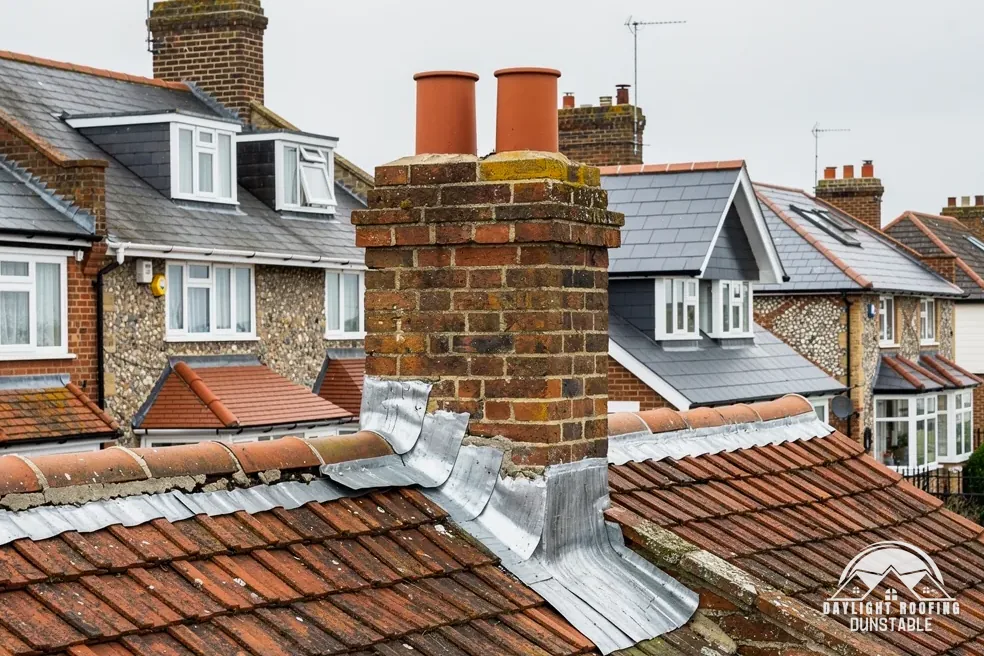
What a chimney flashing does
Where a stack rises through a roof, the brickwork meets the tiles or slates on four sides. Every one of those edges is a joint with rainwater running towards it. A flashing is the sheet metal that covers the joint: its upper edge goes into the mortar of the stack, and its lower edge sits over or under the roof covering. Water running down the brick is then carried out across the slope, not behind it.
Because each side of the stack meets the roof differently, the flashing is made of separate pieces. The low side, facing down the slope, takes an apron. The two sides that run along the slope take stepped pieces that follow each course of tile or slate. The high side takes a back gutter, a small channel that turns water round the stack towards the sides.
Lead is the metal associated with the job because it can be dressed by hand into the shape of the joint and holds that shape once formed. The fit decides part of the result too: a neat chase, lead dressed tight to the brick and a clean overlap with the covering decide how well the joint keeps water out.
How well a flashing does that over the years comes down to the lead itself, how it was dressed and fixed, and whether a worn piece is repaired or renewed in time.
- ApronLead across the low side of the stack.
- Step flashingStepped lead pieces along the sloping sides.
- Back gutterA channel behind the stack carrying water round it.
- SoakerA small lead piece laid under each tile or slate course.
Lead and the codes it comes in
Rolled lead sheet is made to BS EN 12588 in codes 3 to 8. A code is a thickness, and the thicker codes weigh more per square metre. The specification gives a code for every detail, and code 4, for example, is 1.80 mm thick. That means the lead for an apron and the lead for a back gutter are chosen for those parts and are not assumed to match.
Calder and Ecobat, two makers of rolled lead sheet, give slightly different weights for some codes. Calder lists code 3 at 14.97 kg/m² and code 6 at 30.05 kg/m²; Ecobat lists them at 15.0 and 30.10. The table gives both makers side by side, so the difference is visible and neither is quoted alone.
| Code | Thickness (mm) | Calder (kg/m²) | Ecobat (kg/m²) |
|---|---|---|---|
| 3 | 1.32 | 14.97 | 15.0 |
| 4 | 1.80 | 20.41 | 20.41 |
| 5 | 2.24 | 25.40 | 25.40 |
| 6 | 2.65 | 30.05 | 30.10 |
| 7 | 3.15 | 35.72 | 35.72 |
| 8 | 3.55 | 40.26 | 40.26 |
A code number on a quote tells the reader which sheet is being fitted. It does not say which code suits a particular stack, since that is a matter for the specification written after the survey. Weights in the table are as each maker publishes them, so a quote that names the code and the maker can be checked against the chart.
How long lead lasts
MyJobQuote's cost guide for chimney leadwork says lead flashing that is correctly installed can last for over 80 years. The words "correctly installed" and "can" matter. The figure describes what is possible when the work is done well, and it makes no promise for a given roof.
Lead is one component of the joint. The flashing is held at its top edge by the mortar in the stack, and at its bottom edge by the roof covering, so a failed mortar joint or a slipped tile can let the lead down long before the metal itself wears out. The sheet can outlast the things holding it.
Lead also moves a little as the stack and the roof warm and cool. Fixings and joints that allow for that movement give the metal a long life, and a rigid joint that does not allow for it can crack. That movement is why the whole junction gets looked at and not the lead alone.
A flashing can look sound from the lawn and still have a lifted edge round the back of the stack, so the lead is judged close up, from the roof, and not from a picture taken at a distance.
You might hear
Once lead is fitted it never needs another look.
Plain as day
Lead flashing that is correctly installed can last for over 80 years, says MyJobQuote.
Signs a flashing is failing
A flashing that has failed lets water into the roof beside the stack, and the signs show in two places: on the outside of the stack and inside the house. From the garden, a pair of binoculars or the phone's zoom is enough to look for the things in the list.
Inside the house, the signs appear on the ceiling beside the breast and on the breast wall after rain. They are worth a look from the loft side as well, if the loft is safe to enter. A brown stain that spreads, and a patch of damp that comes back after drying, point towards the roof around the stack. Damp in a breast can also come from other causes, which the guide to chimney leaks in wet weather sorts through.
None of these signs proves the flashing is to blame, because pointing, flaunching, a cracked cap and a failed roof covering can all admit water in the same place. Close inspection on the roof tells them apart. A photo sent to WhatsApp 07880 284133 is looked at by the roofing team before a survey is booked, which helps when the reader is unsure what is being seen, and a clear picture of the stack from the garden is enough to start with.
Signs to look for
- A lifted or gapped lead edge
- Splits or holes in the lead
- Lead that has slid down the slope
- Loose mortar where lead is tucked in
- Stains on the ceiling or breast wall
Patch, repair or full replacement
A small split or a lifted corner can sometimes be dealt with as a patch. A flashing that has thinned, or one that has had several patches already, is judged for replacement instead. A patch leaves the old lead in place, so the surveyor must be satisfied that the metal around it is sound. Replacement means new lead dressed round the whole stack, with the old lead taken away and the chase pointed up afterwards.
MyJobQuote's guide to chimney leadwork was last updated on 22 September 2026. It reads: "A chimney lead flashing patch repair typically costs around £200, while a full replacement averages around £570." The same guide gives £350 to £920 for a full chimney leadwork replacement. These apply to chimney leadwork only, and no VAT basis is stated.
| Job | Figure | Page updated |
|---|---|---|
| Patch repair | Around £200 | 22 September 2026 |
| Full replacement, average | Around £570 | 22 September 2026 |
| Full replacement, range | £350 to £920 | 22 September 2026 |
A third party's average shows the scale of the job and nothing more. A price for a particular stack depends on its size, its height above the ground and what the lead turns out to be like, and the owner receives it in writing, as a single total, when the survey is complete.
Flashing, flaunching and pointing: three joints
Three separate repairs share the same part of the roof and are easy to confuse. The flashing is the lead round the foot of the stack. The flaunching is the mortar bed across the head of the stack, where it holds the pots or cap and sheds water outward. The pointing is the mortar between the bricks in the stack's sides. The three sit within a hand's width of each other, so a single close look can take them together.
Each of the three can let water in, and a leak at the stack is not always the lead. A roofer who is shown only a stained ceiling has to look at all three before saying which one is responsible, and sometimes more than one has failed. Treating only the lead while crumbling pointing above it goes unchecked leaves the stack open to the same problem.
The page on what chimney flaunching is describes the top of the stack, and the page on what chimney repointing is covers the brickwork joints. Repointing is priced after a survey.
| Part | Made of | Position |
|---|---|---|
| Flashing | Lead sheet | Foot of the stack |
| Flaunching | Mortar | Top of the stack |
| Pointing | Mortar | Between the bricks |
What a survey covers on a stack
A roofer surveys the roof before giving any price. At a chimney, that means looking at the lead on all four sides, the mortar holding the lead's upper edge, the pointing, the flaunching, the pots and the covering close to the stack. Whatever else shows up on the roof during the visit is reported to the owner in plain words.
Some stacks need scaffold, and any scaffold on the public highway has to be licensed under section 169 of the Highways Act 1980. We arrange the licence with our scaffolder. Any scaffold the stack needs is costed into the written quote for the chimney work, so the access sits with the leadwork it serves.
The survey looks at the foot of the stack and all around it. If the lead needs replacing but the flaunching is sound, the owner is told so. Where the survey finds several faults, one written total follows, and the owner is told what each fault is in plain words.
Other chimneys can be reached from a low roof without it, and the survey says which case applies. A reader who wants to see the range of chimney jobs can go to the page on chimney repairs.