
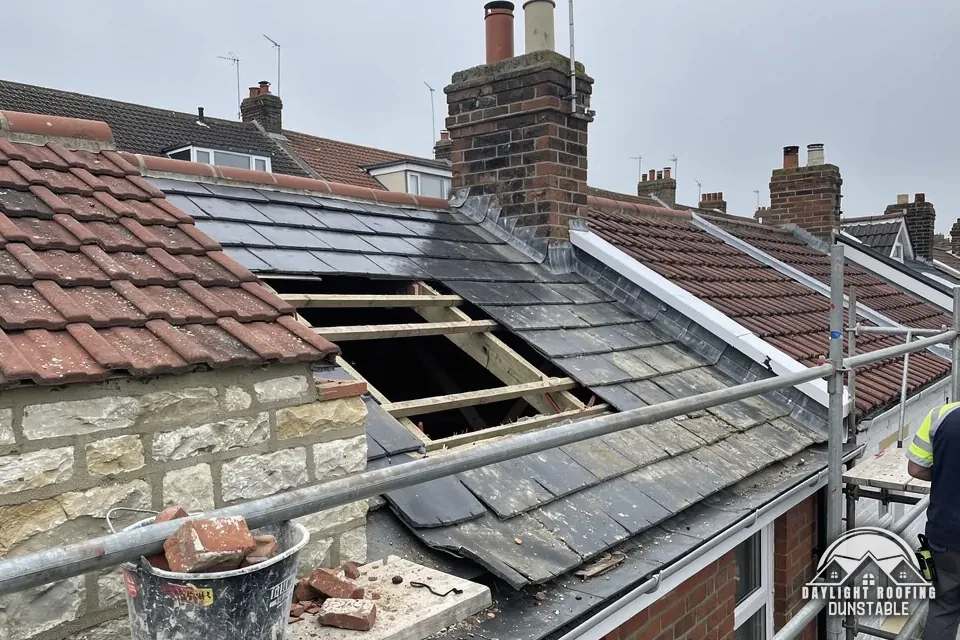
Where rain can get in at a chimney
A chimney stack stands up into the weather on every side, and it carries several joints. Each joint is a place where rainwater can pass through if the material has failed. Brick takes in some water and gives it back as the stack dries, so the problem cases are the ones where a joint, a seal or a covering has opened up.
Water that enters at the top of the stack runs down inside it and can show as damp on the breast wall in the room beneath. Water that enters at the foot of the stack, where it meets the slope, runs onto the roof timbers and can show as a stain on a ceiling beside the breast. The two look different indoors and have different causes outside.
Rain driven sideways by wind can reach faces of the stack that stay dry in still weather, so a leak can seem to appear only in certain storms. Several faults can be present together, which is why a stained ceiling alone does not name the cause. Flashing, flaunching, the pots and cap, and the brickwork each fail in their own way and leave their sign in a different part of the house.
| Entry point | What can go wrong | Where it can show |
|---|---|---|
| Flashing | Lifted, split or slipped lead | Ceiling beside the breast |
| Flaunching | Cracked or crumbling mortar bed | Breast wall or flue |
| Pots and cap | Open or damaged top | Fireplace or breast |
| Brickwork | Worn pointing or cracked bricks | Breast wall, higher up |
Flashings and flaunching in the rain
The flashing is the lead that seals the foot of the stack against the roof covering. When a corner lifts or a seam splits, rain running down the brick drops behind the lead and onto the timbers. The stain that results can sit some way from the stack, because water can follow a rafter or a batten before it reaches the ceiling. The guide to chimney flashings and leadwork describes the parts and the signs of failure.
The flaunching is the mortar bed that slopes from the pots to the edge of the stack. Its job is to throw water outward, away from the flues. A bed that has cracked, or has come away from a pot, can pass water down into the stack, and a crack that is only hairline in dry weather can open in a frost. Rain landing on the stack top runs along that crack and into the brick.
Neither fault is visible from inside the house until the water has travelled. For that reason a survey looks at the top of the stack and its base together, even when a stain on a ceiling seems to point at one of them. A stain can also be old, with the roof since dried out, so its age is worth noting.
Caps, pots and open flues
A flue is an open channel from the room to the sky. Rain falls straight into an uncovered pot, runs down the flue and can wet the breast, the hearth and any lining. A cap over the pot, or a pot that is fitted with a cowl, stops most of that rain from entering, and it also keeps birds and debris out of the flue.
A cap can crack, shift or fall, and a pot can loosen in its bedding. Either leaves the flue open in a way that can pass unnoticed from the lawn. Damp that appears on a breast only after steady rain, and that dries again in a dry spell, is one of the patterns that points to an open or damaged top.
Pots that are in use for a fire or a stove are a separate question from a stack with no appliance connected. The flue serving a living appliance should not be capped without advice, because a capped flue that is still in use has no way to carry smoke out. A survey looks at which flues are in use, and the owner knows which they are better than any outsider does.
Disused flues are different: a closed top with a vent allows air through the flue while keeping rain out. The shape of the cap depends on how the flue is used, and no single type fits every stack.
Damp or a leak? Telling them apart
A leak and damp are not the same thing, though both leave marks. A leak is water entering from outside through a defect, and it can appear after rain and ease when the weather dries. Damp can come from the roof, from the brickwork itself, from moisture produced inside the house or from a ground-level cause, and it can persist through a dry week.
That is why a damp breast cannot be diagnosed from one visit to one wall. Where the mark sits, whether it moves with the weather and whether the stack's flashing, flaunching and cap are sound all bear on the answer. The page on why a chimney breast is damp goes through the causes one by one.
A moisture reading from a meter can confirm that a wall is wet, but it cannot say where the water entered. Water seen entering the loft beside the stack after rain, a wet batten near the flashing or a stained rafter is stronger evidence of a roof leak than a patch of paint that has blistered.
Frost can turn a small gap into a larger one. Water that has soaked into a crack expands as it freezes, which is how a stack that seemed sound in autumn can show damage after a cold spell, and why a wet patch that appears in winter is worth looking at promptly.
You might hear
Every damp chimney breast is a roof leak.
Plain as day
Damp in a chimney breast can come from the roof, the stack or the inside of the house.
What to do during a wet spell
Stay off the roof, and keep ladders away from a wet stack. A slick surface and a loose pot are a poor mix. The useful work is observation from the garden and from indoors, and it can be done safely in the rain.
Stand a bucket under each drip, and move furniture and electrical items clear of the wet area. If water is reaching a light fitting or a socket, switch the circuit off at the consumer unit rather than touching the fitting. Write down when the water began, and photograph the stain at the same spot over several days to show whether it moves.
A torch from the loft hatch shows whether a rafter or a batten beside the stack is wet. Stay on the hatch ladder or the boards and never step between the joists, since the ceiling below will not take a person's weight.
The list gives the order to follow. WhatsApp 07880 284133 takes photos for a look by the roofing team, and a call to 01582 935272 is the other way in. If the damage looks like storm damage, the guide to chimney damage and home insurance covers the photographs to take before anything is moved.
In the wet, in this order
- Stay off the roof and ladders
- Catch the drip and clear belongings
- Photograph the stain with a date
- Look at the loft beside the stack
- Send the pictures for a look
Rain, wind and roof work
Work on a wet roof depends on conditions on the day. A slick slope, a gusting wind and mortar that cannot set in a downpour all limit what a roofer can do safely and properly, and a roofer who judges the conditions unsuitable moves the visit. A survey is a different matter, since much of a stack can be examined without disturbing it.
Wet weather also hides faults. Pointing that is soaked looks darker and sound, and a dry survey day shows the true state of the joints.
Mortar for flaunching and pointing needs a spell without heavy rain to set, because water washed over fresh mortar weakens it. Lead is dressed and fixed by hand, and it needs a dry surface to sit tight against the brick. These are the reasons a repair is planned around the weather and not squeezed into any gap.
A temporary measure can keep water out until the weather allows a repair, and the choice depends on what the survey finds. Sheeting a stack and fixing a cover over a damaged pot are examples. They are not a repair, and the permanent fix follows the survey. Scaffold, where the job needs it, sits inside the written quote, and we arrange the licence with our scaffolder.
What a survey finds and what published figures say
The survey covers the stack from the base to the pots, the lead, the flaunching, the pointing and the covering round it. The owner hears what turned up, in plain words, and a total in writing follows as one figure.
Third-party figures show the scale. MyJobQuote's guide to chimney leadwork (page updated 22 September 2026) reads: "A chimney lead flashing patch repair typically costs around £200, while a full replacement averages around £570." Its emergency page reads: "Emergency roofer call-out costs typically range from £150 to £300, while extensive storm damage repairs can cost £1,200 or more." (22 October 2026). None of the figures states a VAT basis.
Where a stack has leaked more than once, all of its joints are worth examining together, because patching one while another is failing leaves the cause unsolved. The written total then follows for the work the owner chooses after being told what was found.
The call-out range and the storm figure are for roofing emergencies in general, not for chimneys. The guide to chimney repairs covers the work in more detail, and a price for one stack depends on what the survey finds. A figure for one stack says little about another, since height and access differ.