
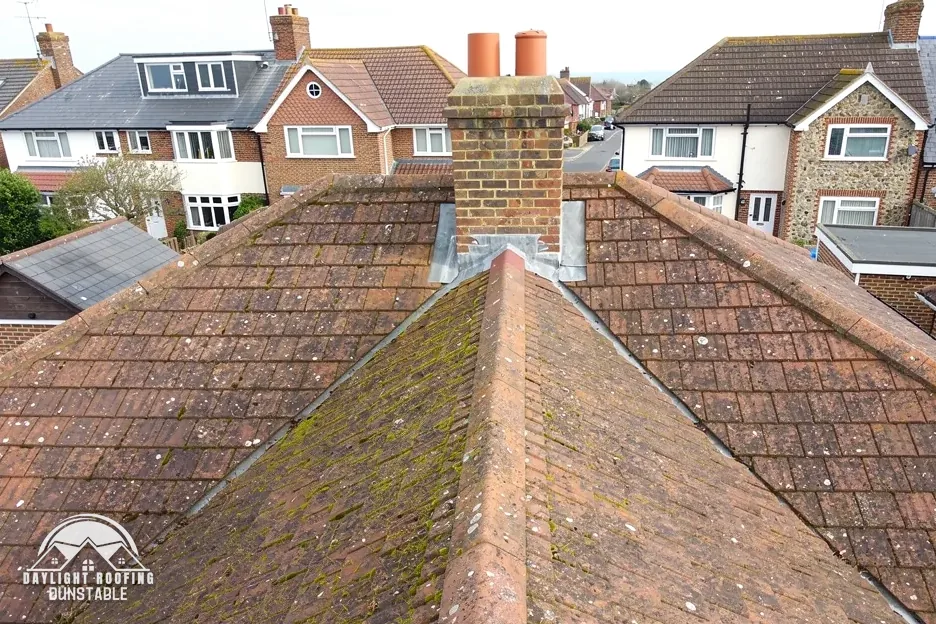
Start from the ground, then look closer
A chimney stack can be checked from the garden or the pavement with nothing more than a pair of binoculars, so there is no reason to climb for a first look. Move back until the entire stack is outlined against the sky, then read it from the top down: the pot and the mortar around it, the brick below, the joint lines, and the point where the stack meets the slope. Do the same indoors, on the chimney breast in each room it passes through.
Each entry works the same way: the sign, the meaning it can carry, and the step that follows. The word can matters. A hairline crack in mortar is a sign, not a diagnosis, and only a survey from the roof can say whether it is a surface mark or a gap that lets water into the brick. Photograph anything that worries you from the same spot and in the same light, so a change over a few weeks shows plainly.
| Sign | Where to look | What it can mean |
|---|---|---|
| Cracked mortar cap | Top of the stack | Rain reaching the brick |
| Sandy or empty joints | Stack brickwork | Mortar has worn away |
| Lean or bulge | Whole stack, against the sky | Movement needing a survey |
| Lifted or split lead | Where stack meets slope | A gap for rain at the roof line |
| Brown stain indoors | Breast and ceiling beside it | Water arriving from above |
Anything that has fallen is a sign in itself. Brick fragments, mortar crumbs or a piece of pot in a gutter or on the lawn came from somewhere, and that place deserves a closer look. Nobody, human or animal, should stand beneath the stack until it has been checked.
Cracked flaunching and a loose pot
Flaunching is the mortar slope around the base of the pot. It holds the pot in its seat and throws rain outward, off the brick. Nothing sits above it, so every shower lands on it directly, and it is worth a look whenever a stack is being checked. The page on what chimney flaunching is describes the part in more detail.
What you see: hairline cracks across the mortar, a rim breaking up where it meets the pot, a visible gap between pot and mortar, or a pot that sits at a slightly different angle from its neighbours. What it can mean: rain runs into the crack and reaches the brick underneath, and a pot that can move in its bed may shift further in strong weather. What to do: do not climb up to poke at it. Photograph it from the ground and arrange a survey, so the whole cap can be judged on the roof itself.
A pot or cap can also hold a bird's nest. It is an offence to intentionally take, damage or destroy a wild bird's nest while it is in use or being built, so if birds are using a pot, work on it has to wait. Bats are protected too: damaging or destroying a bat roost is an offence whatever the intent, and a roof job that disturbs bats can be one that needs a Natural England licence.
Birds are not the only reason a pot is left alone. A pot with a cowl or cap fitted over it may be there to keep rain or birds out, so what looks like a fault can be a deliberate fitting. A survey checks which it is before anyone decides to take it off.
Open mortar joints in the brickwork
Mortar between the bricks keeps water out of the wall, much as the tiles do for the roof. When it wears away, joints look sandy, recessed or empty, and the edges of the bricks start to take in water. Repointing is the repair: loose mortar is raked out and new mortar is packed into the joint. How much of a stack needs it can be judged only from the roof, so the price of repointing is set after the survey.
- Sand or grit collecting on the roof slope or in the gutter below the stack
- Joints that look hollow or set back from the brick face
- Brick faces that flake, peel or crumble
- White salt marks on the brick, which show that water has been moving through it
- Plants or moss rooted in the joints
Weather works on a stack from every side at once, and the upper courses take the most direct rain, so a stack can be sound low down and worn near the top. That is the reason a survey looks at the whole height and not just the part visible from the road. Open joints near the top of a stack can also let rainwater into the flue, so a damp smell in a fireplace belongs on the list of signs even when the outside looks tidy.
Looking is enough at this stage. Cleaning, sealing or painting the brick to see how bad it is can wait until the survey has said what is wrong.
A leaning or bulging stack
A stack that tilts against the sky, a bulge in one face, or a diagonal crack that steps through the brickwork all point to movement. The movement may be in the stack itself, in the mortar bed it stands on, or in the roof structure beneath it. From the ground there is no way to tell which, and the safest reading is that the stack needs to be surveyed in person.
What to do: keep people and animals clear of the ground beneath it, stop using the fireplace until someone has looked, and send a photograph on WhatsApp (07880 284133). We will look at it. A photograph is a way to start, and the survey from the roof comes before any price. Repair, rebuild and removal are the three routes that follow a survey.
The routes differ in what the rules say. The Planning Portal says "Building regulations approval will always apply when removing chimney breasts as they are part of the building's structure." A breast shared with a neighbour brings in the Party Wall etc. Act 1996, which has the building owner give the neighbour a notice to "be served at least two months before the date on which the proposed work will begin" when a breast is to be cut away. Party wall questions go to a party wall surveyor, not to building control.
A stack that is rebuilt or taken down above the roof line counts as a different job to a repair, and it is priced after the survey like any other. Whichever route is chosen, you receive one written total price.
Lead flashings that have lifted or split
Lead flashing is sheet lead dressed into a cut in the mortar joint and over the roof covering, so rain passes over the join and not into it. It is the part that links the stack to the slope, and a fault in it shows indoors long before it shows from the road. The page on chimney flashing and leadwork goes into the detail.
What you see: lead standing proud of the brickwork, an open line along its upper edge, splits or tears in the sheet, a cracked mortar fillet at the tuck-in, or a mark on the plaster near the breast below. What it can mean: a gap at the roof line that rain can reach, however the rest of the stack looks. What to do: note whether the stain grows after rain, and have the flashing looked at from the roof.
Lead has a long life. MyJobQuote says correctly installed lead flashing can last for over 80 years, and that phrase describes flashing that is correctly installed, so it is no promise about any particular roof. Sheet lead for flashings follows BS EN 12588 and comes in codes 3 to 8; code 4 measures 1.80 mm. Which code a given detail gets is decided by the specification.
A stack over a pavement or road can mean scaffolding on the highway, and that takes a Highways Act 1980 scaffold licence from the highway authority. We arrange the licence with our scaffolder, and the scaffold is part of what the written total covers.
A damp chimney breast indoors
The breast is the chimney's mass inside the house, where it passes through the rooms and into the loft. A brown stain, peeling paint, bubbling plaster or a salty bloom on the breast, or a patch on the ceiling next to it, can mean water is arriving from above. Rain that enters at the cap, the joints or the lead can run down inside the brickwork and show itself some distance below the fault.
Water is not always the chimney's doing. Condensation, a leaking gutter or a failed slate elsewhere on the same slope can produce a similar stain, so the cause is traced from the roof down and not guessed from the mark. Why a chimney breast gets damp explains the routes water can take.
- Note the date of each stain and whether it followed rain
- Photograph it, with a coin or tape in the picture for scale
- Look at the stack from the loft after rain, with a torch, if you can reach it safely
- Mention any damp smell in the fireplace
Those four notes let a surveyor match what is happening indoors to a point on the stack. Where the house is thatched, the thatch guide from the local fire and rescue services says to "Have the chimney swept regularly by a qualified chimney sweep." Sweeping deals with the flue from the inside. The roofer works on the outside.
What to do next: a survey, access and the rules
The next step is a roof survey, ahead of any figure. When it is done, you hear what the roof showed, including any other faults, and you receive one written total price. Repair, rebuild and removal each follow from what the survey shows, and the chimney repairs hub describes all three.
- Photograph the stack from the ground and the stain indoors
- Send the pictures on WhatsApp (07880 284133), or email info@daylightroofingdunstable.co.uk
- Keep people and pets clear of anything that is leaning or shedding brick
- Wait for the survey before any cleaning, sealing or painting of the brick
Access matters here. A stack at the front of a terrace over a pavement is reached differently from a stack in the middle of a roof, and that affects the scaffold and the price, which is another reason the figure waits for the survey. A stack standing entirely on private land needs no highway licence, and if a licence is called for we arrange it with our scaffolder.
None of the signs above is a reason to panic, and each is a reason to ask. A cracked cap, an open joint or a stained breast can be dealt with while it is small, and the survey says which of them you have.