
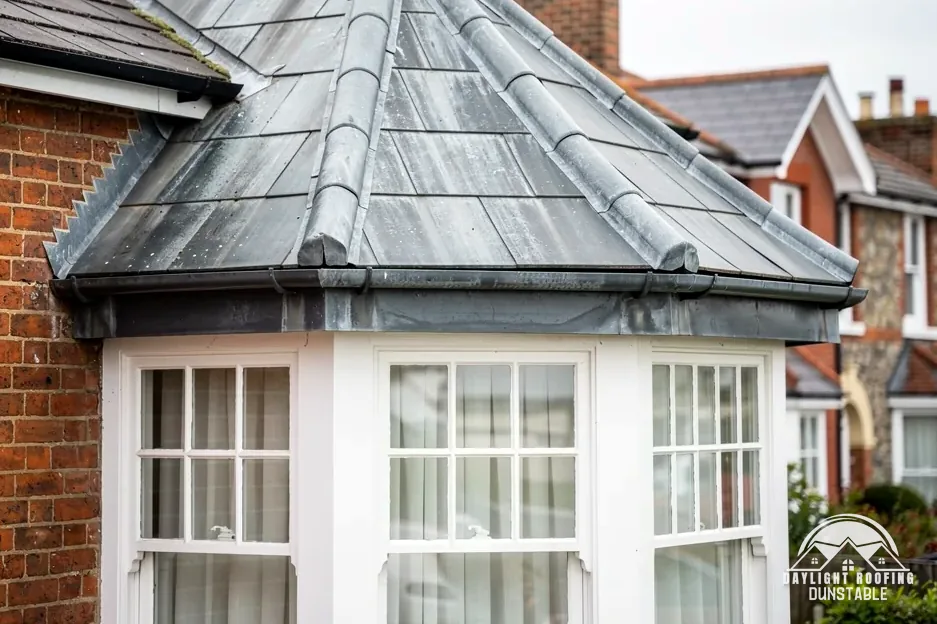
Church roof lead: the consent comes first
Lead does hard work on a church roof. It lines valleys, forms the gutters behind parapets, and weathers the joins where a roof meets a tower or a wall. When it splits, lifts or slips, rain reaches the timbers below, and a repair is wanted. For a listed building that is also a place of worship, though, the question of what permission the work needs has to be answered before the question of price.
For a listed house or shop the answer is listed building consent from the council. A church in use for worship is treated differently, and that difference is the subject of this page. The Ecclesiastical Exemption (Listed Buildings and Conservation Areas) Order 2010 says: "The ecclesiastical exemption is retained for church buildings within the faculty jurisdiction of the Church of England." In plain terms, a Church of England church in use goes through the faculty system rather than listed building consent.
This page is written for the Diocese of St Albans, which describes itself as "the Church of England in Bedfordshire, Hertfordshire, Luton and Barnet". A church's own record settles which diocese it belongs to. The county line alone does not, and a church close to a diocesan boundary is confirmed with the church itself. The diocese is also the first place to ask about the lead on a roof in its area, since it sets out how its faculty process runs for the parishes it serves.
The faculty system in plain terms
A faculty is the permission that the Church of England's own system grants for building work at a church where services are still held. Work waits until the right permission is in place. It stands in place of listed building consent, which does not apply to a church building that is used for ecclesiastical purposes. Each diocese has a consistory court, and the judge of that court is the chancellor. The court sits at the top of the process, and the Faculty Jurisdiction Rules 2015 set out the lower steps.
The system exists because the exemption has to be replaced by something. A church that is used for worship is outside listed building control, so the Church of England runs its own control, with its own rules and its own officers. A roofer meets it as a consent question that sits above the quote: work waits until the right permission is in place, however sound the quote may be.
A roofer does not decide which route a job takes, and a customer should not hear one named casually. The route follows from the church's denomination, its listing and the nature of the work. A church warden or a diocesan officer can say which applies, and the roofer's survey is what describes the lead that needs work, including how far the damage runs and what sits underneath it.
What List B says about roof lead
Not every piece of work needs a full faculty. The Faculty Jurisdiction Rules 2015 list works in schedules, and List B includes "The like for like replacement of roof lead or other material covering the roof of a listed building". Work on that list does not call for a full faculty; the archdeacon's written notice is what it needs, and nothing heavier.
That is a real difference in weight. A full faculty goes through the court process. List B work is handled by written notice from the archdeacon, who is a senior clergy officer of the diocese. For a church roof where lead has failed and the repair replaces it with the same material, List B is the route that the Rules themselves name.
The phrase to hold on to is "like for like". A repair that replaces lead with lead sits inside the wording. A job that changes the material, the pattern of the roof or the look of a slope is a different question, and the diocese should be asked first, before an order is placed. Whether a particular job fits List B is for the diocese to confirm, and the roofer's survey should describe the work clearly enough for that conversation.
List B is a short wording, and it is read on its own terms: it speaks of listed buildings, of roof lead and of like for like. A diocese keeps its own guidance on how its notices are given, and a church warden can say where that guidance sits.
Planning permission can still apply
The faculty system takes the place of listed building consent and nothing more. Planning law stays switched on, so exterior work can bring its own planning question whenever the usual planning tests are met. Putting back the same covering in the same form leaves a roof looking as it did, whereas a change to the roof's shape, a new rooflight or a different covering could alter it. Those are questions for the council's planning team, and a faculty or a notice from the archdeacon does not answer them.
That is the reason to keep the two systems apart in your mind when a quote or a survey is being discussed on site. The faculty or the archdeacon's notice answers the church's own question. The council answers the planning question, and an answer from one body is not an answer from the other.
Where planning permission might apply to church roof work, we check the route with the council before work starts. The church's own consent is a separate matter for the church and the diocese. A written quote cannot stand in for permission to start, because that permission comes from the system that governs the building. Ask early, because consent steps take as long as they take and a roofer cannot hurry them.
Other denominations take other routes
The faculty route belongs to the Church of England. Other places of worship are treated differently, and the table sets out the routes that the law and government guidance name, from the Roman Catholic Church to the Churches Conservation Trust. The Baptist row is the narrowest, since a Baptist chapel qualifies only through a particular trust arrangement.
| Building | Route |
|---|---|
| Church of England church in use | Faculty system |
| Roman Catholic, United Reformed or Methodist church in use | That denomination's own system |
| Baptist chapel in use | Exempt only if held by a Schedule 1 trust corporation for a church in the Baptist Union |
| Unitarian, Quaker or other faith | Listed building consent |
| Redundant church or Churches Conservation Trust building | Listed building consent |
| Scheduled monument | Scheduled monument consent, granted by the Secretary of State |
A scheduled monument is a separate category: its works must be authorised, and applications go to Historic England. A minister's house, used by a minister of religion as a residence, falls under listed building consent too. A Church of England cathedral is another case again, governed by the Care of Cathedrals Measure rather than the parish faculty system. So the denomination has to be named before any route is.
The lead itself
Lead sheet, rolled to BS EN 12588, comes in codes 3 to 8. Code 4, for example, is 1.80 mm thick, and the specification sets the code for each detail. The same code does not suit every part of a roof, which is why a church roof's lead is specified detail by detail rather than ordered by a single number.
Two lead sheet makers, Calder and Ecobat, publish weight charts to the same standard. Their weights differ for code 3 and code 6, so a weight quoted without the maker named cannot be compared like for like. Thickness is the figure that stays the same from one chart to the other, so it is the one to compare.
MyJobQuote says correctly installed lead flashing "can last for over 80 years". That figure is for flashing, on a page last updated on 22 September 2026, and it describes lead that is correctly installed. It carries no promise for any one roof. A valley or a parapet gutter lasts as long as its laying and its supports allow, and the survey is where each is judged.
More on the codes is on the page about lead sheet codes explained, and on when a repair is enough in repairing or replacing lead flashing.
Thickness by code, to BS EN 12588
- Code 3: 1.32 mm
- Code 4: 1.80 mm
- Code 5: 2.24 mm
- Code 6: 2.65 mm
- Codes 7 and 8: 3.15 and 3.55 mm
A written price once the route is clear
A church roof is priced after a survey, the same as any other roof. The survey looks at the lead, the supports under it, the joins with the stonework and the way the roof is reached, whether by tower, by scaffold or from within the building. If we notice other trouble on the roof while we are there, we tell you plainly what we saw. From the survey comes one written total price.
A church roof's lead work is priced after a survey, not from a published figure. One published average for leadwork exists, but it belongs to chimneys, and a church roof is a different scale of job. The page on lead roofing costs sets out what moves the price.
A church roof can need scaffolding. Under the Highways Act 1980, scaffold that stands on a pavement or road requires a scaffold licence from the highway authority. We arrange the licence with our scaffolder. The church's consent comes first, and the diocese is the right place to ask which route a job takes.
A photograph sent to WhatsApp on 07880 284133 is looked at, and the number for a conversation is 01582 935272. The wider range of lead work is under lead roofing.