
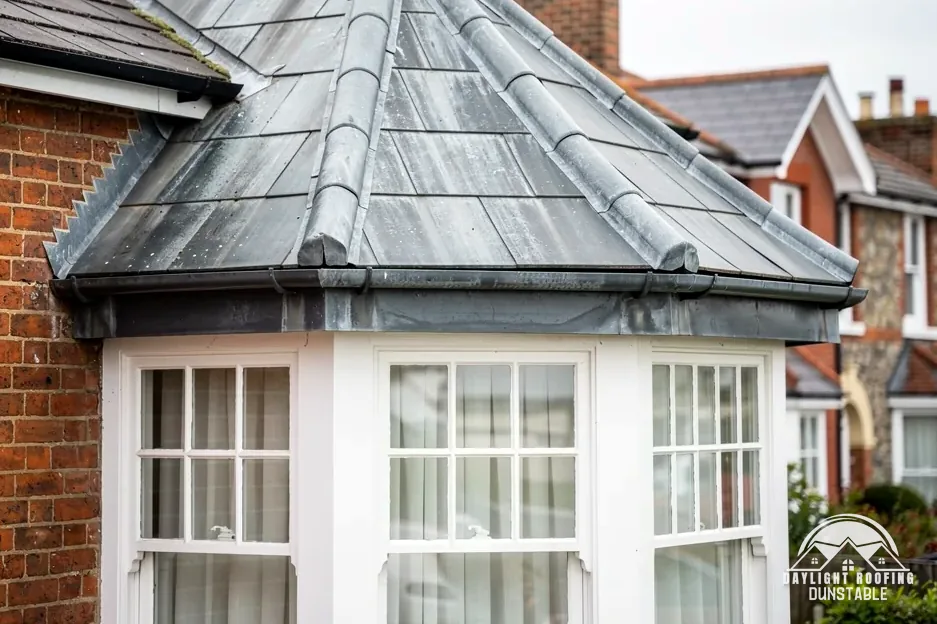
Where leadwork sits and how to look at it safely
Lead appears wherever a roof has to be sealed against something that is not roof. That covers the strips at the foot and sides of a chimney stack, the step of metal that runs up a wall where a lean-to meets the house, the lining of a valley between two slopes, the cheeks and top of a dormer, and the covering on a small flat section over a porch or a bay. Each of these is a junction, and the signs differ a little at each.
Reading the signs starts from the ground. A pair of binoculars brings a chimney or a high wall close enough to see whether the grey metal sits flat or stands away from the brickwork. A phone camera zoomed in also works, and it leaves a dated picture. An upstairs window gives a view of a valley or an extension roof.
Keep off the roof itself. Lead is soft and slippery, and tiles, moss and old mortar make poor footing. People are injured in falls even from a low eaves, and a foot placed on a thin strip of lead can crease it and make a small fault into a larger one. Inside, the loft is the second place to look: torchlight along the rafters near a chimney or a wall can show daylight, damp or a stain that the outside does not.
At each junction the same three questions apply: what you can see, what it points to and how to respond. If a sign looks like a reason to compare repair and renewal, our guide on whether to repair or replace lead flashing describes how that choice gets made.
Splits and cracks in the metal
See: a dark line cutting across a fold, along a seam or through the middle of a run of lead. Sometimes it is a hairline, sometimes a gap wide enough to show the tile or the felt underneath. On a chimney the splits can sit where the lead is bent around a corner.
Mean: lead expands and contracts with every change of temperature, and a sheet that cannot slide freely can crack along the line where the strain gathers. A split is an open path for rain, even on a dry day when nothing shows inside.
Do: note the position, photograph it from the ground, and check the ceiling or the loft below after the next rain. A single short split in an otherwise sound sheet is a fault that a repair can answer. Several splits along one run are a sign that the strip is worn, which is a different conversation.
| Note this | Why it helps |
|---|---|
| How many splits | One points to a local fault, several to a worn run |
| Where they sit | Folds, steps and corners show where the metal moves |
| How wide | A gap lets in far more water than a hairline |
| Date of the photo | A second photo later shows whether it has grown |
A shop-bought tube of sealant or roll of tape can mask a split for a time and hide how far it runs. It is not a repair, and it can make the next inspection harder.
Edges that lift, curl or hang away
See: a strip of lead standing proud of the wall, a corner that curls up like a page, or a length that sags and leaves a dark slot between metal and brick. After a windy night a loose piece can be found flapping, or a piece of lead can be lying in the garden.
Mean: the top edge of a flashing is held into a groove in the wall by small lead wedges and then pointed over with mortar. If the wedges slip or the mortar breaks up, the grip goes and the edge can lift. Wind can then get under the lead and work it further loose, and rain can be driven into the slot behind it.
Do: photograph the edge from several angles, and do not press it back by hand from a ladder. A lifted edge can be dressed back and re-fixed with new wedges and pointing, provided the lead has not hardened and cracked where it was bent. Where one edge has lifted and others are close to following, a wider look is needed.
A loose piece that is lying on the ground is worth keeping. It shows the thickness of the sheet and the state of its back, and it can be photographed beside a coin or a tape measure for scale.
Staining on the wall face and the roof below
See: dark streaks running down the brickwork beneath a flashing, a patch of wall that stays damp-looking long after the rest has dried, green algae along one line, or white salts on the face of the brick. On the roof, a patch of tiles below a chimney that is permanently darker than its neighbours can point the same way.
Mean: water that should have been shed onto the tiles is running down the wall instead, or soaking into it. The lead may have lifted, the pointing above it may have opened, or a split may be feeding water behind the metal. A wall that stays wet can in turn carry damp into the room behind.
- A single dark streak starting at the edge of the lead can point to one lifted section.
- A damp band along the whole top edge can point to failed pointing in the groove.
- A damp patch below a corner can point to a split or a gap at the fold.
- A wet chimney breast inside, with a dry exterior, can point to the flashing or the stack itself.
Do: photograph the staining in dry weather and again after rain, because a stain that darkens soon after rain starts shows where the water is arriving. Mark the spot on the picture. Staining that is only on the wall, with a sound-looking flashing, may be a masonry problem rather than a lead one, and the survey can sort the two apart.
Damp and stains inside the house
Leadwork failures show indoors in places that match the junction outside. A stain or flaking paint on a ceiling near a chimney breast, a damp mark on a chimney breast itself, a patch beside a party wall, or a dark ring on a bedroom ceiling under a valley are all candidates.
| Inside | Outside, check |
|---|---|
| Ceiling stain by a chimney breast | Chimney flashings and the pointing above them |
| Damp on the breast itself | Stack flashings, the stack, the cap |
| Stain along an upper wall | Step flashing where a roof meets that wall |
| Ring under a valley | Lead lining of the valley |
| Drips in a bay or porch | Lead on the bay or porch roof |
A stain can travel. Water entering at a flashing can follow a rafter or the felt a long way before it drops, so the mark inside is not always directly under the fault. That is one reason the survey looks along the whole junction rather than only at the spot that leaks.
Do: put a bucket under any drip, move furniture, and photograph the stain with a date. A damp patch that dries out in summer has not gone away, because the same water will arrive with the next wet spell. If the loft is safely reachable, check whether timbers near the chimney or the wall look dark or damp.
Gaps, missing pieces and signs after bad weather
Some signs are about what has gone rather than what has changed. Lead can be lifted or torn by a strong wind, and a missing strip leaves a clear opening. Look for bare brickwork where a grey strip used to be, a dark gap between a chimney stack and the tiles, or a flashing that now ends short of the corner it used to turn.
Insurance uses its own idea of a storm. The Financial Ombudsman Service gives its definition: a storm usually involves violent winds, usually with rain, hail or snow. Rain, hail or snowfall by itself can constitute a storm. If wind has damaged your leadwork, photograph the damage where it lies and report it to your insurer. Our guide to lead theft and insurance covers lead that has been taken as well as lead that has been blown off.
A missing piece of leadwork means a temporary cover may be needed while the proper work is planned. Throwing a tarpaulin over a roof from a ladder is a risk to the person doing it. A photograph or a call tells us what has happened to the junction, and the call is the quickest way to get an opinion on what to do while the roof is open.
Signs of theft are similar to storm damage, with one difference: neat cut edges, or lead missing from several places at once, point to a theft rather than the weather. That is worth telling the police as well as the insurer.
What to do next and what the survey looks at
Gather four things before you call: dated photographs shot from the ground, a record of the room and wall where damp appears, a note of when it appeared, and the weather beforehand. They make a first conversation more useful, and photographs sent to 07880 284133 on WhatsApp can be looked at before any survey.
A survey of leadwork looks at the whole junction, which means the metal, the wedges, the pointing, the brickwork around the groove and the covering the lead sits on. It also looks at the junctions beside the one that is leaking, since the same age and the same weather act on all of them. Afterwards we say plainly what the junction showed, and anything else noticed up there.
Age is a clue rather than a verdict. MyJobQuote says correctly installed lead flashing can last for over 80 years. For lead on flat roofs, HomeBuilding gives 60-100 years and Less gives 50 to 100 years. The figures are ranges from published guides, and no one of them measures your roof. A good strip of leadwork should not be renewed only because it is old, and a failed one should not be kept only because it is young.
One total, in writing, follows the survey. Where you are choosing between a patch and renewal, the guide to lead roofing costs sets out what drives the price of leadwork. Telephone 01582 935272 if the roof is leaking now.