
Choosing a material for a flashing or valley
A flashing or a valley is a junction where two parts of a roof, or a roof and a wall, meet. The material laid in that junction has to shed water, stay in place and move a little with the building, and several materials do that job in different ways. Lead is the familiar choice, yet it has company, and a roof can carry two or three materials in different places.
The choice is never made in the abstract. It depends on the junction in question, on what is already on the roof and on what the specification for the work calls for. A flashing against a brick chimney is a different detail from a valley between two slopes, and a flat roof upstand at a wall is different again.
Each material differs in what it is and how it is laid, and the lifespans that publishers give are attributed to their sources one by one. It makes no comparison of weight or cost between materials, since nothing cited here supports one, and no material is named as the winner. The lead roofing and leadwork page covers the lead jobs themselves.
Lead, zinc, GRP, EPDM, mortar and sealants all turn up at these junctions, valleys carry choices of their own, and a survey settles the question for a given roof.
Lead: what it is and what is published
Lead for roofing is rolled sheet, made to BS EN 12588 in codes 3 to 8. The code stands for thickness, and code 4, for example, is 1.80 mm. A roofer cuts the sheet, folds it to the shape of the junction and fixes its upper edge, leaving the lower edge free to move. Flashings, soakers, aprons and valley linings can all be made from it.
MyJobQuote says correctly installed lead flashing "can last for over 80 years", and adds that higher codes can run over 100 years. For lead flat roofs, HomeBuilding gives 60 to 100 years and Less gives 50 to 100 years. Those figures are published as ranges and as qualified statements, and they do not amount to a promise for one roof.
Lead's character is that it is soft and workable, so it can be dressed into awkward corners, and that it expands and contracts with temperature, so the detail has to allow for movement. Its weakness is that it can be stolen, which is covered in the guide on stolen or damaged roof lead and insurance.
A roof with lead in good order does not need changing for the sake of it. Where lead has failed, or where an owner wants a different material for a particular reason, the alternatives below are the options a survey will weigh.
Zinc sheet
Zinc is a sheet metal, supplied in rolls and coils, and it is formed and joined on site. It is used as a roof covering and for flashings, gutters and cladding. A zinc flashing is cut and folded to the junction, as lead is, though the sheet is stiffer in the hand, and it is joined with folded seams and soldered or welted joints and not by dressing.
VMZinc makes zinc roofing, and its published line is: "When correctly designed and installed a zinc roof can last in excess of 100 years." A manufacturer is speaking there about a zinc roof as a whole, and the wording carries its own conditions: the roof has to be designed and installed correctly. The figure stands as printed.
Zinc and lead are different metals with different habits. Zinc is formed to a pattern and fixed with clips that let it move, and its details are designed in a different way from lead's. A flashing in zinc cannot simply be made by copying a lead pattern, and a roofer who works with zinc follows the maker's guidance for the detail.
Where an existing roof is lead, a change to zinc at one junction means two metals meeting. How they are separated and joined is a detail for the specification, and it is one of the points a survey raises before any material is chosen.
GRP and EPDM at upstands and bays
GRP and EPDM are flat roof coverings, and both can form the upturn at a wall, which is where a flashing would otherwise sit. GRP is glass-reinforced plastic, laid wet and cured into one surface. EPDM is a rubber sheet, bonded to the deck and folded up at the edges. EPDM belongs to the single-ply group, and GRP does not.
That makes them alternatives for the covering of a small flat roof, such as a bay or a porch, and for its upstands. They do not replace a flashing on a pitched roof at a chimney, where the junction runs up a slope and across brickwork. A lead flat roof is a lead covering, and changing it to GRP or EPDM means changing the whole roof surface, not a single junction.
| Material | Source | As published |
|---|---|---|
| Lead flashing | MyJobQuote | Can last for over 80 years |
| Zinc roof | VMZinc | Can last in excess of 100 years |
| EPDM | HomeBuilding, Less | 25-30; 30 to 50 years |
| GRP | HomeBuilding, Less | 25-30; 25 to 40 years |
Each source describes its own material, so the rows are not a league table. For EPDM and for GRP two publishers give different ranges, and both are printed as published. BS 6229:2025, the flat roof standard, covers membranes of this kind, which is a point of difference from lead: the standard's scope does not include lead sheet.
Mortar fillets and sealants
Some junctions are finished without any sheet metal. A mortar fillet is a sloping band of mortar laid along the line where a roof covering meets a wall. A sealant, sometimes called mastic, is a flexible compound squeezed into a gap. A flashing tape is a self-adhesive strip that is pressed over a junction. All three are used to make a joint, and none is the same as a flashing.
A mortar fillet is rigid. A junction between a roof and a wall moves a little with temperature and with settlement, and a rigid band can crack where the two parts move apart. Once a crack opens, water gets behind the fillet. A sealant is flexible, but it is exposed to the weather on its surface, and a sealant joint can open where its edges lift or where it splits.
These materials have a place as repairs and as a stopgap on a roof, and a surveyor will say whether a given patch is holding. They differ in kind from lead: none is sheet metal lapped over the roof covering and tucked into the wall. The lifespan figures in this guide belong to lead, zinc, GRP and EPDM, and none of them describes a mortar or sealant joint.
Where a flashing has been replaced by a smear of sealant, the survey aims to see what lies beneath it. The sealant can hide a gap in the lead, or the absence of lead, and the repair is judged on what is underneath.
Valleys: lead, GRP and tiles
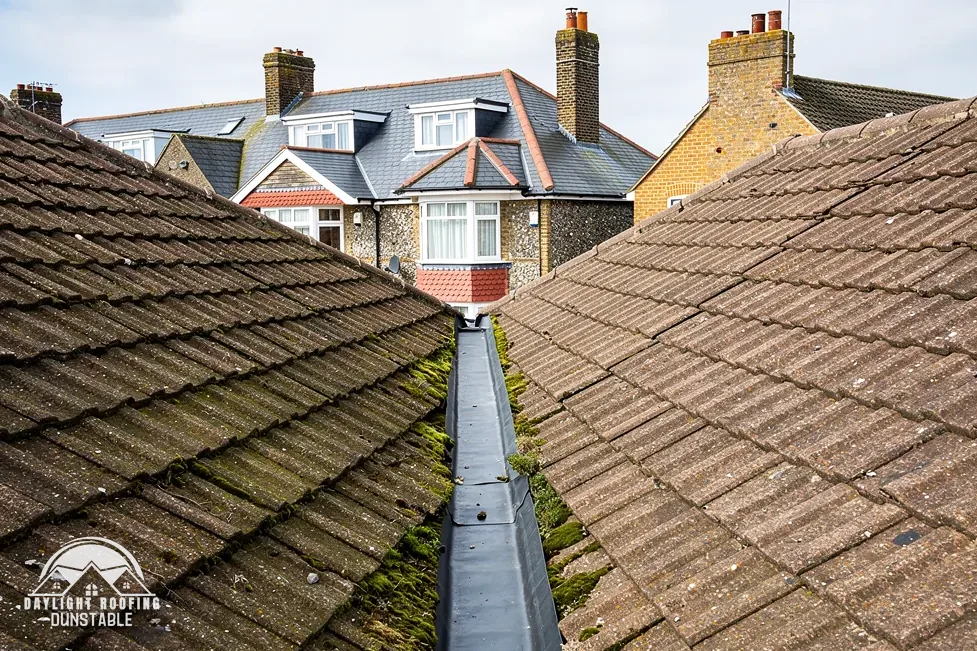
A valley is the angle formed where two slopes come together, and rainwater from both runs down it. Three constructions are recognised. A lead valley has a lining of lead sheet laid in the angle, with the tile or slate edges lapped over its sides. A GRP valley has a trough moulded in glass-reinforced plastic, fitted in the angle and lapped by the covering. A tiled valley is made of special valley tiles, shaped to turn the corner without a lining on top.
Each works differently. The lead lining is a sheet, laid in lengths and lapped, and its life depends on the fixings and laps. A GRP trough is a rigid moulded part that is fitted in place, and its joints depend on how it is bedded and lapped. A tiled valley relies on the shape of the tiles and the underlay below them to turn water, so it depends on the roof's pitch and the tiles used.
A survey cannot judge a valley from the ground, because the edges of the covering hide the lining. The roofer checks how the tile or slate edges lie, whether the laps are sound and what state the boards are in, and the choice of material then follows from what is found and from what the specification for the roof requires. A post on lead valleys on older roofs goes through the parts of a lead valley.
Where a lead valley fails, the repair is not always to replace lead with lead. A valley can be changed to another construction, but the covering on both sides has to be lifted for that, so the choice is made when the roof is open.
How the choice is made
A survey settles the choice for a particular roof, and the questions it asks are the same whatever the material. Five questions carry the decision.
- What is on the roof now, and what condition is it in?
- What does the junction need to do: seal a chimney, line a valley or turn up a flat roof at a wall?
- How much movement does the junction have to allow for?
- What does the specification for the roof call for?
- Is there any reason to match the materials already in place?
There is no ranking of materials on this site, and no claim that one is cheaper, lighter or longer-lived than another. What a source publishes is attributed to that source, and everything else is decided at the roof. The leadwork costs guide sets out what moves the price of lead work.
A quote that proposes a change of material should say why. The reason might be the junction, the condition of what is there or a request from the owner, and it should be stated in the quote along with the materials being fitted. Our own quote follows the survey and is one written total price.
A flashing or valley can be talked through by phone on 01582 935272, with photographs sent to WhatsApp on 07880 284133 and written questions to info@daylightroofingdunstable.co.uk.