
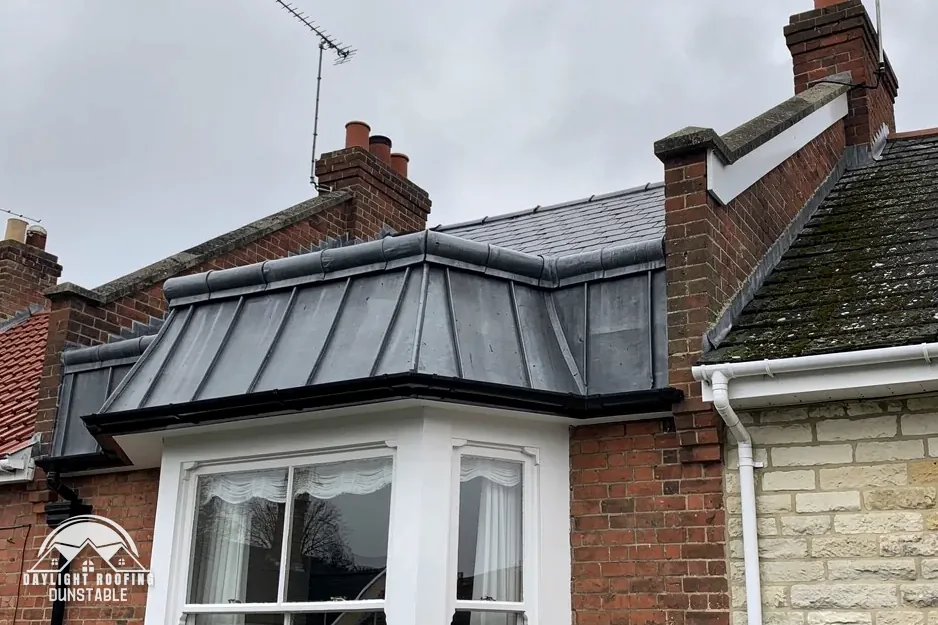
What a lead flashing does at the junction
Where a sloping roof finishes against a brick wall, a chimney stack or a dormer cheek, the tiles stop and a gap opens between roof and wall. A flashing is the strip of metal that bridges that gap. One edge is tucked into the wall, the other lies over the roof covering, and rain that runs down the wall is carried onto the tiles rather than into the building.
Lead is chosen because a fitter can bend and hammer it to follow awkward junctions, and it keeps its shape once dressed. Several parts make up one flashing, and a fault in any of them can send water inside. The names help when you read a quote or look at a photograph.
- The upstand, the part that turns up the face of the wall.
- The apron, the part that lies over the roof covering at the foot of a chimney.
- The step, a stepped run of lead that follows the courses of brickwork up a sloping wall.
- The raggle, a groove cut into a mortar joint to take the top edge of the lead.
- The wedges, small strips of lead pressed into the raggle to hold the top edge in place.
- The pointing, the mortar that fills the raggle over the wedges.
A flashing is a chain of parts, so the choice between repair and renewal starts with finding which link has failed. A lifted edge and a split across a flat run are different faults. Each fault has its own repair. If you want the fuller picture of how the failures look from the ground and from a window, our guide to the signs your leadwork needs attention covers it.
Splits and cracks across the lead
A split is a tear right through the sheet. It can run along a fold, across a step or in a line along the middle of a long run. Lead expands when it warms and contracts when it cools, and a sheet that is fixed hard at both ends has nowhere to move. Over many cycles of warming and cooling the metal can work-harden and crack along the line where the stress is concentrated.
A hairline crack in an otherwise flat, firm sheet is a different case from a sheet that is split in several places. One short split in lead that is otherwise sound can be dressed back or patched with a new piece of lead let in over it, because the rest of the strip is still doing its job. Splits in several places along one run point to a strip that has had its movement and is worn.
| Appearance | Possible cause | Route |
|---|---|---|
| One short crack | Local stress at a fold | A lead patch can hold |
| Cracks at each step | A run that cannot move | Renewal needs weighing |
| A long split along a run | Fatigue along the strip | Renewal of that run |
| Thin, rippled lead | The sheet is worn | Renewal of the strip |
Sealant or a self-adhesive tape pressed over a split from a shop is a stopgap. It sticks to a surface that is still moving, and the lead around the split can be as worn as the lead at it. Keep off the roof to check a split. Binoculars from the garden or a bedroom window will show where it sits.
Lifted laps, loose edges and slipped wedges
Lead flashings are made in lengths, and where two lengths meet they overlap. That overlap is a lap. A lap that has lifted shows as an edge standing proud of the sheet beneath it. Wind can get under a lifted edge and work it further, and rain can be driven in beneath it.
The top edge is held in the raggle by the wedges. If a wedge works loose or drops out, the top of the lead is no longer gripped, and the sheet can sag away from the wall and hang open. A flashing that has sagged leaves a slot between wall and lead for water to run into. Looking up from the ground, a loose flashing can show a dark line at the top edge where the mortar has opened or fallen away.
A lifted lap or a loose wedge is the kind of fault a repair can answer. The lead is re-dressed into place, fresh wedges are set and the joint is re-pointed. That is a repair of the fixings rather than the sheet, and it works while the lead itself is sound. If the lead has thinned or hardened where it has been bent back and forth, a repair is only a short answer, because a re-dressed edge can crack along the bend.
Ask for the cause as well as the cure. A lap that has lifted once, and been pressed back, can lift again if nothing about the way it is held has changed. Lead that has been bent back on itself several times should be looked at as a whole strip rather than as a lap.
Failed pointing along the raggle
The pointing is the mortar that fills the raggle after the lead and wedges are in place. It closes the slot at the top of the flashing so that water running down the wall cannot get behind the lead. Mortar can crack, shrink or crumble away, and a gap in it lets rain run in behind the upstand.
Failed pointing is a separate fault from a failed flashing, and the two are easy to confuse from the ground. The lead can be sound while the mortar above it has gone. In that case the work is to rake out the loose mortar and point the raggle again, with the wedges checked as the mortar comes out. Nothing about the lead needs renewing if it is firm, flat and free of splits.
- Pointing that has cracked along its length, with a thin dark line.
- Pointing with gaps showing the edge of the lead.
- Mortar crumbs lying on the roof covering below the flashing.
- Damp or staining on the wall face directly above the lead.
Re-pointing is worth doing while a flashing is otherwise sound, because a lead strip with a sound sheet and open pointing can be put right without renewing it. Where the wall around the raggle is itself crumbling, the brickwork may need repair before any pointing will hold, and the job then involves a bricklayer as well as a roofer.
When a patch is enough and when to renew the strip
Two sets of questions decide between repair and replacement: how much of the flashing has failed, and how sound the lead that remains is. A repair works on a local fault in sound metal. Renewal makes sense when the fault is spread along the run, because patches then cover only the places you can see.
Cost points the same way, though it should not decide the matter alone. MyJobQuote's chimney leadwork page, last updated 22/09/26, puts a patch repair to a chimney lead flashing at around £200 and a full replacement at around £570 on average. They relate to chimney flashings alone and are third-party averages, not a price for your roof. A chimney stack differs from a long wall abutment or a valley, so none of them carries over to other leadwork.
| Condition | A repair can suit | Renewal points |
|---|---|---|
| Lead sheet | Flat and firm | Thin, rippled or hard |
| Splits | One, short | Several along a run |
| Laps and wedges | A loose edge | Edges failing repeatedly |
| Pointing | Open but sound wall | Wall crumbling too |
The survey looks at all four conditions together before a repair is chosen. A flashing that looks poor from the ground can turn out to be sound with open pointing, and one that looks fine can have hairline cracks on its back where they cannot be seen from below. A single written total follows the survey, so a repair and a renewal can be priced side by side.
Time is part of the choice too. A patch buys a stretch of weather-tightness, and renewal is a fresh start for that junction. A strip patched twice already suggests that a third patch is not the answer.
Lead codes and what the specification sets
Rolled lead sheet is made to BS EN 12588 in codes 3 to 8. The code is a number for thickness, and a higher code is a thicker, heavier sheet. Code 4 measures 1.80 mm. Which code goes on a flashing is decided by the detail being fitted, so a renewal is specified junction by junction rather than with one code across the whole roof.
Weights differ by maker, which is why the table names Calder and Ecobat, two sheet makers whose weight charts were read for this guide. Codes 3 and 6 show a small difference between the two. Thickness is the same whichever maker supplies the sheet.
| Code | Millimetres thick | Calder kilograms per square metre | Ecobat kilograms per square metre |
|---|---|---|---|
| 3 | 1.32 | 14.97 | 15.0 |
| 4 | 1.80 | 20.41 | 20.41 |
| 5 | 2.24 | 25.40 | 25.40 |
| 6 | 2.65 | 30.05 | 30.10 |
| 7 | 3.15 | 35.72 | 35.72 |
| 8 | 3.55 | 40.26 | 40.26 |
When you compare a repair with renewal, ask what code a replacement would be and why that code suits the junction. A repair patch is cut from sheet of a stated thickness too, so the same question applies to it. Both answers belong in the written quote, and if either is missing it is fair to ask for it. Our page on lead sheet codes explained goes further into the codes.
How long lead lasts and what that means for the decision
MyJobQuote says correctly installed lead flashing can last for over 80 years. The statement concerns lead properly fitted and then left alone, and it carries no assurance for your own roof. It also says nothing about how a particular flashing has aged, because wind, movement and the condition of the wall behind it all act on the lead.
An age alone does not settle repair or replacement. A flashing that has been in place for a long time and is still flat, firm and free of splits can need only its pointing renewed. A much newer one can have failed early if it was fixed so that it could not move, or if the wedges were set badly. Look at condition before age.
A written quote should name the flashings it covers, the code of lead and what is being done to each: renewed, repaired or re-pointed. Where a quote says only 'lead repairs', ask which flashings are meant. A quote from another firm can be compared with ours on the same points: which junctions, which code and which method.
If the roof is not leaking now, there is no need to rush a decision made from the ground. Take photographs, note the date, and compare them after the next spell of wet weather. Our guide to lead roofing costs explains what moves the price of leadwork.