
When lead is stolen or damaged
Roof lead can be lost in two broad ways. It can be taken, with flashings, valley linings or sheets cut away and removed from the roof. Or it can be damaged in place, by wind that lifts a flashing, by a falling branch that tears a sheet, or by a ladder or a foot. Both leave an opening where the roof used to be sealed, and a roof with an opening lets water into the structure below.
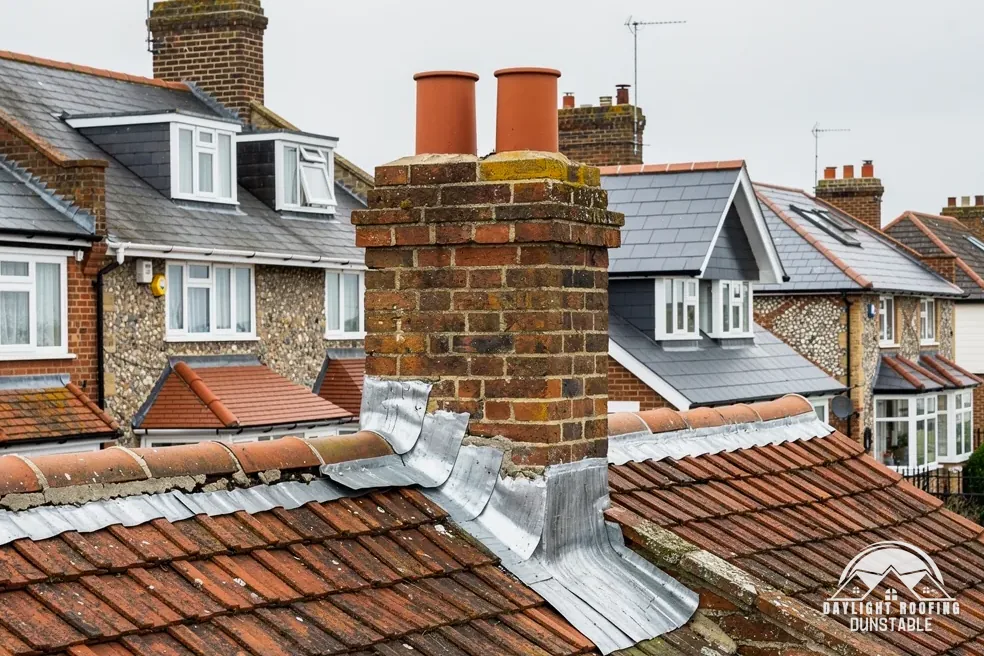
The signs differ. Missing lead can show as a bare line of mortar or timber where a flashing used to run, a gap beside a chimney stack, or an abutment with nothing covering the wall joint. Damaged lead shows as a flashing that is lifted, torn, bent back or hanging loose. Inside the house the effect is the same in both cases: a damp patch, a stain or a drip once rain has got in.
It carries no crime figures and no promise about what a policy will pay. What a claim receives depends on the policy, the cause of the loss and the insurer concerned.
The lead roofing and leadwork page covers the jobs that follow, from replacing a flashing to relaying a valley or a bay.
First steps once you find it
Safety comes first. Nobody should climb on a roof or lean from a ladder to inspect a gap, and a damaged edge can be unstable. Look from the ground, from a window, or from the loft, and keep people away from any area below loose lead.
The steps below are in a sensible order, and each is advice to the owner of the building.
- Take dated photographs of the damage, from the ground and from inside, before any of it is touched.
- Report a theft to the police and keep the reference you are given.
- Tell your insurer and ask what it needs from you.
- Limit the water indoors: clear belongings out of the way and catch any drip in a bucket.
- Ask a roofer to look at the roof and say what it needs.
A roofer can make an opening watertight for the time being, with a temporary covering, while the claim and the permanent repair are sorted out. That is a holding measure, and it is a separate job from relaying the lead. The lead itself, once a claim is settled, is replaced to a specification. It is worth telling the insurer what has been done and keeping any receipt, since a policy can ask for reasonable steps to limit further damage.
Photographs matter early, because the roof will change once repairs begin. The Financial Ombudsman Service says it will usually look at expert reports and photos, so photograph the damage before anything is moved.
What your policy decides
Whether a lead loss is covered, and for how much, is set by the policy and not by this guide. Policies differ on theft, on storm damage, on accidental damage and on wear, and each has its own wording, excess and conditions. The first job is to read what yours says about the cause of this loss.
| Question | Why it matters |
|---|---|
| What caused the loss? | Theft, storm and accident are treated separately |
| Is there an excess? | It reduces what is paid |
| Are there conditions? | Some require reports or notice |
| What counts as wear? | Gradual decline may be excluded |
Excluding gradual wear is a general pattern in policies, not a statement about any single one, and your own document is the only authority on what is excluded. If the wording is unclear, ask the insurer to explain in writing how it applies to the loss.
Building owners, tenants and landlords are in different positions, and who holds the insurance depends on the lease or tenure. Leaseholders in flats and shared buildings may find that the freeholder or a managing agent holds the policy for the roof. In that case the report goes to them first, and the questions in the table go to whoever manages the insurance.
How the ombudsman treats storm damage
Lead lifted by wind is a storm question, and the Financial Ombudsman Service has published how it looks at those. Its definition reads: "a storm usually involves violent winds, usually with rain, hail or snow". The same page adds: "Rain, hail or snowfall by itself can constitute a storm". Those are the service's own words, and they frame the question when an insurer and a customer disagree about whether a storm took place.
The page also covers evidence. The Financial Ombudsman Service says it will usually look at expert reports and photos, while the same page notes that an insurer will normally ask a surveyor for a written report. On exclusions, the page leaves the proof with the insurer: "The insurer has to prove that the exclusion applies", with an inspection report given as an example. A customer's photographs, taken before anything was disturbed, add to what the service can look at.
These points apply to complaints about storm cover. They do not describe how a theft claim is handled, and none of them speaks for any single insurer. A reader whose loss was a theft should rely on the policy and on what the police and the insurer ask for.
The ombudsman's role starts after a complaint, which is covered below. Up to that point the claim is between the policyholder and the insurer, and the evidence gathered in the first days is what both sides will refer back to.
Evidence to gather for a claim
A claim for lead is easier to follow when it is documented. An insurer, or the ombudsman later, may want to see dated photographs, a police reference, the date of discovery, a repair quote and the letters already exchanged. None of it needs special skill, and most of it can be gathered by the owner with a phone.
- Dated photographs of the damage, from several distances, taken before anything is moved.
- Photographs of the roof from before the loss, if any exist, showing the lead in place.
- The police reference, for a theft.
- The date and time the loss was found, and the weather in the days before.
- A roofer's quote for the repair, and any receipt for temporary cover.
- The insurer's own correspondence, kept in one place.
An insurer may appoint its own surveyor, and a roofer's quote can be compared with the surveyor's findings. Where they differ, the written details matter: which parts of the roof are affected, how much lead is involved and what code the original was. An insurer's loss adjuster is the person who assesses the claim, and the roofer's role is to say what the roof needs.
Keep the damaged lead if any is left. A piece that was torn or lifted shows how it failed, and it can be looked at by the insurer's surveyor. Do not throw it away before the insurer has said whether it wants to see it.
If the claim is refused or disputed
A refusal, or an offer the owner thinks is too low, starts with a complaint to the insurer. The insurer then has time to respond. The Financial Ombudsman Service tells consumers: "For most complaints, a business has up to 8 weeks to consider a complaint". If no response arrives within that time, the complaint can then be referred to the ombudsman.
A separate limit applies once the insurer has replied. On time limits the service says: "You have 6 months from the date on the final response". Together they make two separate limits, and they are not added up: the 8 weeks is the business's time to respond, and the 6 months runs from the date on its final response.
The Financial Ombudsman Service can be reached on 0800 023 4567. It is a free route, and it looks at the insurer's decision against the policy and the evidence. Photographs, reports and the police reference are the kinds of document that make a complaint easier to follow.
Nothing here predicts how a claim will turn out. What a roofer can do is describe the roof's condition and the work it needs, in a written quote that the owner can pass to the insurer along with the photographs.
Repairing lead after a loss
Once the claim is under way, the permanent repair can be planned. A roofer surveys the roof, looks at what was lost or damaged and writes one total price for the job. The quote should name the parts being renewed, the code of lead for each and what is being done about the boards, pointing and fixings beneath.
Lead sheet is made in codes 3 to 8 to BS EN 12588, and code 4, for example, is 1.80 mm thick. Which code goes into which detail is written in the specification. The lead sheet codes guide gives every thickness, and the leadwork costs guide explains what drives the price of lead work and why a survey comes first.
After a theft, another material may be worth weighing, and the guide to lead and its alternatives sets out what each material is. Whether an insurer will agree to a change of material is a matter for the policy, so ask the insurer before the work is booked.
For a roof damaged by theft or weather, the phone number is 01582 935272, WhatsApp takes photographs on 07880 284133 and the email address is info@daylightroofingdunstable.co.uk. A photo of the damage together with the ceiling below it gives a first view, and a survey follows.