
Lead lifespans as publishers give them
Three sources give lifespans for lead, and each speaks about a slightly different thing. MyJobQuote writes about lead flashing: when it is correctly installed it "can last for over 80 years", and MyJobQuote adds that higher codes can run past 100 years with minimal maintenance. HomeBuilding gives a range of 60 to 100 years for a lead flat roof. Less says lead is the longest-lasting option for flat roofs, at 50 to 100 years.
| Source | Applies to | As published |
|---|---|---|
| MyJobQuote | Lead flashing, correctly installed | Can last for over 80 years |
| MyJobQuote | Higher codes | Over 100 years |
| HomeBuilding | Lead flat roof | 60 to 100 years |
| Less | Lead flat roof | 50 to 100 years |
The first row carries its own qualifier: the words are "can last", and they describe a flashing that was installed correctly. They promise nothing about a particular roof, and they are not a floor that a flashing is certain to reach. HomeBuilding and Less give different ranges for a lead flat roof, and each range is shown as its publisher printed it.
Those figures say how long the metal can last. A flashing is the metal plus the way it was cut, folded and fixed, so the realistic question for a given roof is how the flashing was installed and the history it has had since. Both start with knowing which pieces the word flashing covers on that roof.
What counts as a flashing
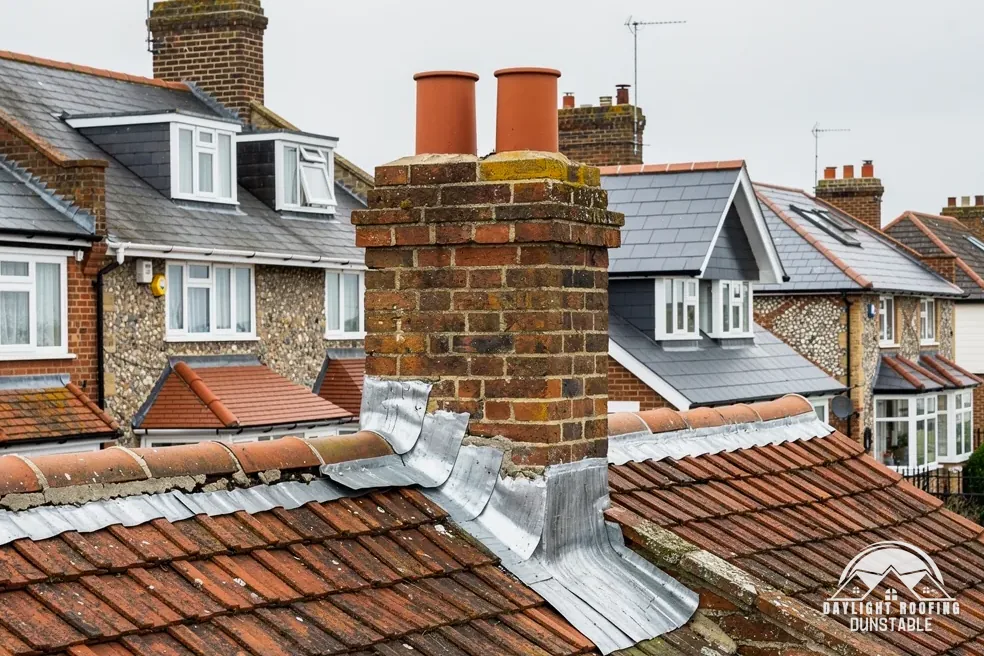
A flashing is a strip of waterproof metal that seals the line where a roof meets something else. The something else can be a chimney stack, a party wall, the wall of an extension, a dormer cheek or the edge of a roof window. Lead is cut and dressed to follow that line, and it overlaps the roof covering on one side and the masonry or frame on the other, so water running down the slope passes over the joint instead of into it.
Several pieces make up the flashing round one chimney. A back gutter sits behind the stack on the uphill side. Stepped flashings follow the slope up each side, and an apron covers the downhill face. Soakers are small sheets laid with the tiles or slates, and the flashing is turned over their upstands. Each piece is a separate length of lead, and each has its own fixings, so a roof can have one piece in good order and its neighbour worn out.
That matters when a source says a flashing can last for over 80 years. The statement is about lead flashing as a type of component. It does not say that the apron, the steps and the back gutter on one chimney will all reach the same age together, or that a roof which has been repaired in sections has a single date for its leadwork.
The page on lead roofing and leadwork lists the places lead is used on a roof, from flashings and valleys to bays, porches and flat roofs. The rest of this guide stays with flashings.
Why correct installation carries the figure
Lead is a soft sheet that expands and contracts as the temperature changes, and a flashing has to be made so that it can do that without tearing. A long, rigid length fixed hard at both ends can split where it cannot move. For that reason, stepped flashings are cut in lengths, joints are lapped, and the lead is held at its upper edge by a fixing while its lower edge is left free to shift a little.
The upper edge goes into a mortar joint cut into the brickwork, which is then wedged and re-pointed. Where a flashing is set into a joint with weak mortar, or where the pointing has been left to crumble, the lead can drop out of the wall. Clips along the lower edge hold the lead down against the wind, and they are spaced so that gusts cannot lift the sheet.
A second point is the thickness of the sheet. MyJobQuote's longer figure, over 100 years, is given for higher codes, and lead is sold in codes 3 to 8 under BS EN 12588. A thicker sheet is not simply better, and a thin one is not simply a fault, because the specification names the code that suits each part of the roof. The lead sheet codes guide gives the thicknesses.
Taken together, the "correctly installed" in the lifespan sentence means a sheet of a suitable code, cut in sensible lengths, lapped, clipped and tucked into sound masonry. Work that skips any of those steps has no claim on the published figure.
What can shorten a flashing's life
Because lead lasts so long, the faults found on an old roof can lie in the metal's surroundings rather than in the metal wearing thin. From the fixing to the weather, they are these, in the order a survey would look at them.
- Fixings that have loosened, so the lower edge of a flashing lifts in the wind.
- Mortar at the upper edge that has crumbled, so the lead pulls out of the joint.
- Cracks at folds and corners where the sheet was bent too tightly or left no room to move.
- Lengths cut too long, so thermal movement has split them.
- Damage from a ladder, a foot or a falling branch.
- A neighbouring fault, such as a slipped tile, that sends water over the flashing's edge.
Several of these are movement or workmanship problems, not a sign that the metal itself has given out. A split in a long flashing can sometimes be treated by a repair to that section, while a flashing whose upper edge has lost its fixing needs the joint re-cut and the lead refixed. The repair or replace guide goes through how that choice is made.
Repairs made with a sealant smeared over a gap are a separate point. A sealant is not lead, and it does not carry the lead lifespan: the figure belongs to the metal, correctly installed, and not to a sticky patch laid across it. Where a sealant covers a defect, the survey looks under it, because the lead beneath is what decides the roof's condition.
What lead wears like over time
A new sheet of lead is bright and silvery. Within weeks it dulls, and it settles into a matt grey as a protective layer forms on the surface. That change is normal, and it is not a sign of decay. A grey flashing that is smooth, flat and tight to the roof is in a better state than a bright patch of newer lead sitting next to a crumbling mortar joint.
The signs of age to look for are physical. Sheet can ripple where it has expanded and not returned, and the ripple becomes a crack at a fold if it moves back and forth for long enough. Edges lift and curl. Holes appear where a nail or a stone has punctured the lead, and a dent can hold a pool of water. White streaks or powder on the surface are a surface effect and not a leak in themselves, but they show where water has sat.
Staining below a flashing is a more direct signal. A brown mark on a bedroom ceiling next to the chimney breast, or damp patches on the chimney wall, means water is getting past something. The lead may be the cause or the cover for it, and only a look at the flashing, its lapping and the brickwork round it can say which.
None of these signs fixes a date for the end of a flashing's life. A flashing in the roof of a house built in one decade can fail early because it was fixed poorly, while another of the same age stays sound because it was fixed well. Age is information, and condition is the verdict.
How to check a flashing from the ground
A roof should be left to a roofer, and nobody should climb on a roof for this. A flashing can still be read from outside and from the loft, and what a reader sees helps with a call or a photograph sent on WhatsApp. Pick a dry day, stand back and use a pair of binoculars, or a phone's zoom lens.
- Run your eye along each flashing's lower edge for a gap, a lift or a clip that has come away.
- Look at the joint where the top edge goes into the brickwork, for crumbled or missing pointing.
- Look for ripples, splits, holes and places where the lead has curled.
- Look for sealant, tape or cement that has been smeared over lead.
- Look in the loft after rain for dark marks, drips or damp timber beside the chimney or a wall.
- Look for stains on ceilings and chimney breasts below.
A photograph taken before anything is moved is useful on its own account, and it carries weight if the damage ever becomes the subject of an insurance claim. Take a wide view and a close one, from the same spot, and note the date. Do not pull at loose lead: a flashing that is pulled can tear, and the repair then costs more than it needed to.
If a flashing looks tired, the next step is a survey. The survey comes before any quote. A photo sent on WhatsApp to 07880 284133 lets us look at what you have seen first, before anything is arranged.
Planning replacement before it is urgent
Lead flashing that has worn out does not pick a convenient day to fail. A flashing that has been watched, photographed and surveyed can be replaced on the roof's own timetable, when the work can be done in one visit and the weather suits it. A flashing that fails in a storm has to be made safe first and replaced later.
Replacing flashings while other roof work is under way can also be efficient, because the access is already in place. A re-roof or a chimney repair exposes the flashings anyway, and the old lead can be inspected at that point. The leadwork costs guide sets out what drives the price and what a written quote after a survey contains.
A last point concerns money, and no general figure can settle it for one roof. A lifespan of 50 to 100 years or over 80 years is attractive, but an owner sees the roof as it is today, and what it needs today depends on the details of that roof. For that reason a survey of the flashing itself settles it, not a number from a table.
To have a flashing looked at, call 01582 935272, send a photograph on WhatsApp or write to info@daylightroofingdunstable.co.uk. The quote band below this guide has the form.