
Why lead jobs are priced after a survey
Two flashings that look alike from the ground can be very different jobs. One may need a short length of lead refixed, while the other needs its mortar joint cut out, the timber behind it repaired and every piece of lead round the chimney renewed. A price given without a look at the roof is a guess about which of those is on the table, and a wrong guess ends in a revised figure or a repair that does not hold.
For that reason the price of leadwork here comes after a survey, and it arrives as one written total price for the whole job. It is never a rate per metre, because a figure borrowed from another trade or another roof would be misleading, and a lead job has too many variables for one rate to cover.
Published figures, what moves a price and how to read a quote from any firm all apply across three jobs: flashings, which seal the roof to a wall or stack; valleys, which carry water between two slopes; and lead on bays and porches, where the shape of the roof decides the work.
The lead roofing and leadwork page explains the jobs and the terms. A reader who wants a first opinion on a flashing before a survey can send a photograph to the WhatsApp number at the foot of the page, and the survey follows from there.
The published figures are for chimneys
MyJobQuote publishes prices for leadwork on a chimney, and its page was last updated on 22 September 2026. On that page, a patch repair of a chimney lead flashing is put at typically around £200, and a full replacement averages around £570. The same page gives a range for a full chimney leadwork replacement, between £350 and £920, depending largely on whether scaffolding is required.
| Job | Figure |
|---|---|
| Patch repair | Typically around £200 (chimney) |
| Full replacement | Averages around £570 |
| Full chimney leadwork replacement | £350 to £920 |
Those figures belong to chimney leadwork and nothing else. They are not prices for a lead flat roof, a valley, a bay window roof or leadwork in general, and they should not be stretched to cover any of those. The two full-replacement numbers come from the same page and describe the same chimney job, and the second is a range around the first, so a reader can place a stack somewhere between a small patch and a full renewal.
MyJobQuote's wording on scaffolding is useful as a pointer, since access is the one driver its range is said to depend on. Our own jobs are priced differently: a job that needs scaffold has it built into the one written total, and we arrange the licence with our scaffolder.
What sets the price of a lead job
The surest guide to the price of lead work is the list of things that change it. These apply to flashings, valleys and bays alike, and a survey checks each of them before a figure is written.
- How much lead is involved: the length of flashing, the number of pieces and the area of any sheet.
- The code of the lead, since a thicker sheet uses more metal.
- Access: a single-storey bay is reached differently from a chimney on a ridge, and a stack at the far side of a roof is harder to reach.
- The condition of what lies under the lead, such as boards, battens and the mortar joints that hold the top edge.
- The number of details that need work, where one flashing may need a patch and the next may need renewing.
- Whether other work is going on at the same time, which can share access.
A list of this kind helps in a conversation, because it explains why two quotes for apparently similar jobs differ. A firm that quotes a lead flashing without looking at the pointing has not priced the same job as one that has. The pointing is part of the work, since the lead's top edge is held in it.
Lead sheet is made in codes 3 to 8, and code 4, for example, is 1.80 mm thick. The code on a quote tells you which sheet is going on the roof, and a quote that leaves it out leaves out one of the main things that sets the price.
Pricing flashings
A flashing job begins with the old lead. Loose or failed lead is taken off, the joint in the brickwork is cut out and the surface behind is checked for damage. New lead is cut to length, lapped, clipped along its lower edge and tucked into the joint, which is then wedged and re-pointed.
A patch repair deals with one failed piece, and it makes sense where the rest of the flashing is sound. A full replacement renews all of it, which is why the chimney figures from MyJobQuote sit well apart for the two jobs. Between those limits lie jobs that replace one side of a stack, or the back gutter, and a survey can say where on that scale a roof lies.
Replacing a flashing at the same time as other roof work is a different job again. A re-roof strips the covering along the flashing line, so the lead is exposed, and the roofer can renew it with the access already in place. The repair or replace guide sets out how the choice between patching and renewing is made.
Lifespan is part of the cost picture, because a flashing that can last for over 80 years, according to MyJobQuote, is judged over a long period. The guide on how long lead flashing lasts covers what the published figures mean and what shortens them.
Pricing valleys
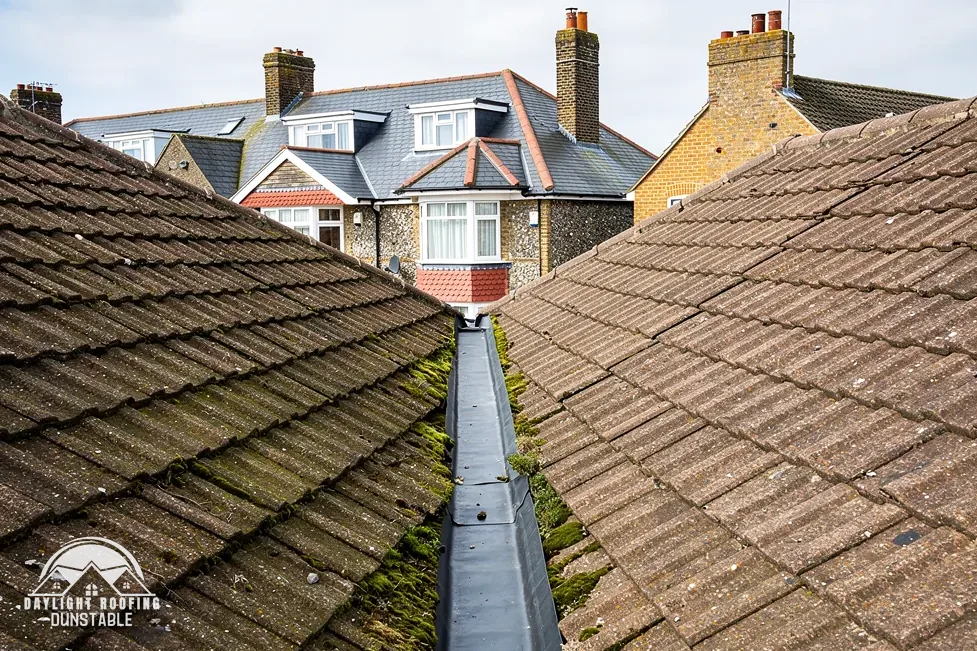
A lead valley is a long, narrow lining laid in the angle between two roof slopes. The tiles or slates on either side overlap its edges, so reaching the lead means lifting the covering along both sides. That work is what separates a valley from a flashing: a flashing can sit on the outside of a roof, while a valley is laid in the roof itself.
A short split can sometimes be dealt with by treating a section, but a valley is made of laps, boards and tile edges that work together, and a repair has to match the lap direction of what is already there. Where the lining has worn through along its length, or the boards below have rotted, the work becomes a renewal.
For that reason the extent of a valley job cannot be read from the ground. The survey looks at the tile edges, the laps and the boards, and it records whether the failure is a point or a length. A valley quote that does not say how much of the run is being renewed is missing the main fact.
Chimney leadwork prices should never be borrowed for a valley, and the job is priced on its own length and condition. What can be said is how the job is built, and what the survey checks before a figure is written.
Pricing bays and porches
A lead bay roof is small, but it is a roof with many details: an abutment flashing at the wall, a main sheet, rolls and drips, side cheeks and a front edge. Each can be sound or failed, so the price follows the count of details that need work and the state of the deck beneath them.
Access has a large say. A first-floor bay is reached differently from a porch over a front door, and the work may need scaffold or a tower, depending on the height and the house. If a bay needs scaffold for safe access, that forms part of the written total, and we arrange the licence with our scaffolder where the highway authority requires one.
The deck can alter a job. If a board has rotted under the lead, it is replaced before the new sheet goes down, and the extent of that rot cannot be known until the old lead is lifted. A survey estimates it, and the written quote states what is covered. The guide to lead on bays and porches goes through each detail.
Flat roofs covered in lead belong here as well. HomeBuilding and Less publish lifespans for them, but their pages carry no prices for lead, so a lead flat roof gets the same treatment, with a price set once it has been seen. Its size, its fall, its outlets and the state of the deck all change the work, and each is weighed before any figure is set. A flat roof in lead is a larger job than a bay, with long joints and a need for good drainage, and the quote reflects that.
How to read a quote for leadwork
A quote from any firm, ours included, should say what the work covers. For leadwork, the useful questions are short: which parts are renewed, what code of lead, what happens to the pointing, what is under the lead and how access is made.
| Question | What the answer shows |
|---|---|
| Which parts are renewed? | Patch or full job |
| What code of lead? | Thickness being fitted |
| What about the pointing? | Whether the top edge is secured |
| What is under the lead? | Deck repairs, if any |
| How is access made? | Scaffold or other access |
When you set quotes from other firms side by side, check what each one covers before looking at the figures at the bottom. A short quote that says "renew lead" and nothing more leaves too much open: it does not say which flashing, which code or what happens to the pointing and the boards. A low figure that covers a patch is a different offer from a higher figure that renews the flashing. Our own quote comes as a single written total for the job, given after the survey, so the comparison is easy to make.
Valleys and bays follow the same logic as flashings. A quote for a valley should say how much of the run is renewed and whether the boards beneath are included, and a quote for a bay should name its details. If a quote is vague on any of these, the gap is worth closing before work starts, since the cost of an unplanned extra falls on the roof's owner. To have a leadwork job looked at, call 01582 935272, send photographs on WhatsApp to 07880 284133 or write to info@daylightroofingdunstable.co.uk.