
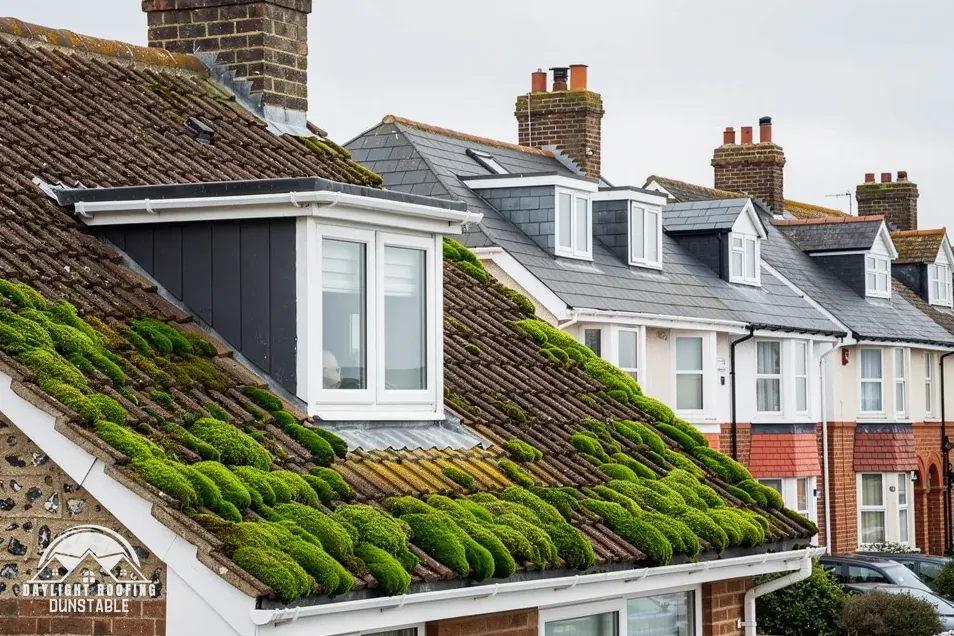
What the moss is doing
Moss on a tile roof is a mat of small plants rooted in the surface of the tile and in the grit that settles in the gaps between tiles. A mat like that is soft and spongy, and it takes up water and holds it against the tile it grows on. A tile that is meant to shed water quickly is instead kept damp, and a damp surface is where more moss takes hold.
Moss does not stay put on the roof. Clumps loosen, dry out and drop, and the rain washes loose material down the slope into the gutter. A gutter that gathers moss, grit and leaves at its outlet can block, and a blocked outlet sends the water over the lip. That is the link between a green roof and a damp wall below it, and it is the reason a moss problem is worth a look even where the roof is not leaking.
The same principles apply in Dunstable and in the Chilterns villages close by, Kensworth and Studham among them. The kind of tile may differ from house to house, but the way moss sits on a tile and drops into a gutter does not. The things that do differ are the access to the roof and what the tiles can stand, and the next sections deal with both.
What Marley says about jet wash damage
Marley, a roof tile maker, states its position in one sentence: "The use of high powered jet washes is not recommended as it can damage the surface of the slate or tile, thus reducing its expected life considerably". The sentence names the tool, says it is not recommended and gives the reason: harm to the surface, and a shorter life for the covering.
A tile's life is the thing being protected. Marley says roof tiles are "typically" expected to last for around 60 years, and adds that this "is not a guarantee or warranty of its longevity". The BRE determined a minimum life expectancy of 60 years for clay tiles. Those are the figures that a harsh wash eats into: a tile with a roughened or flaked surface sheds water less well, holds more moss and wears faster.
In a Chilterns village such as Kensworth or Studham, the Chilterns Conservation Board's roofing note calls plain clay tiles "universally predominant" on the area's traditional buildings. A clay roof of that kind is worth keeping in good order, because replacing a covering is far larger work than cleaning one gently.
The point is the method, not the moss: how the tiles are cleaned decides what is left of them. The page on how long roof tiles last sets out the published lifespans.
You might hear
A jet wash does tiles no harm and clears moss fast.
Plain as day
Marley says a high powered wash is not recommended, since the tile surface can suffer.
Cleaning by hand
Moss can come off without water at pressure. A brush or a scraper lifts the mat from the tile surface, and the loosened material is gathered as it comes away. Working from the ridge downwards keeps the debris moving down the slope and away from tiles that are already clean. Soft brushing on the face of a tile is gentler than a nozzle held close to it.
Hand cleaning is slower than a jet wash, which has the drawback of damage to the tile face, and the work is done in short sections along each slope, from a roof ladder or a scaffold platform. That slower pace is also what lets the person doing it see the tiles as they go. A tile that rocks under the brush, a hairline crack or a tile sitting out of line shows up at once, where a nozzle would have driven water into the same gap.
Cleaning is a different job from re-roofing. It leaves the covering where it is and removes what has grown on it, which is why it sits among the maintenance jobs and not among the building control ones. A roof that has been brushed down still has the same tiles, the same battens and the same underlay beneath, and the same questions about their age.
Whether moss returns is a separate matter, and how quickly it does depends on the roof and its surroundings. What a cleaned roof gives is a clear view of the tiles, and that view is the real gain.
Gutters after the moss
Moss that has been lifted from a slope has to go somewhere, and the downhill route leads to the gutter. Debris that is not gathered as it comes away drops into the run below, where it can settle at the outlet. Clearing the gutters after the roof is cleaned makes sure that a job done to prevent damp does not leave a blockage behind it.
Which? Trusted Traders gave £75 to £350 for clearing out every gutter at the front and back of a house, in a survey of 11 of its traders gathered in November 2025. The prices cover labour and materials and leave out VAT. That range covers a clear-out by itself, so it is not to be added onto any figure for cleaning the roof.
A gutter that has overflowed before the roof is cleaned may have a dip or a loose bracket as well as a blockage, and the survey looks at the fall along each run and at the brackets while the roof is accessed. The page on pitched roof problems lists the faults a pitched roof can show, with moss and its effects among them.
Where moss has been growing at a valley or around a chimney stack, the lead and flashings there are worth a look as the moss comes off, because moss can hide a lifted edge.
What a cleaning rate means
Checkatrade's guide, last updated in April 2026, gives roof cleaning in the UK as something that "typically costs between £8.50 and £14 per m²". The unit is the square metre of roof surface, and the guide states no VAT basis, so none should be assumed.
| Source | Rate | Guide date |
|---|---|---|
| Checkatrade | Typically £8.50 to £14 per m² | April 2026 |
A rate is not a total. What cleaning a given roof comes to turns on its area, its pitch, how the slopes are reached, and how bad the moss and the tiles are, and a rate cannot know any of those. It also says nothing about the tiles beneath: a rate for cleaning does not include repair of a cracked or slipped tile found once the moss is off.
The sensible use of a guide rate is as a check on the size of a number, not as a sum to multiply. It tells a householder if a quote sits in the right region, and the quote itself tells them what is included. Quotes for one roof can be compared once each has said what it covers. Our quote is written after a survey of your roof, and it covers whatever the survey shows is needed.
Cold-weather cleaning
Winter does not stop moss from being a problem, and it changes how a roof is worked on, because the conditions at the eaves and on the slope change with it. Wet tiles are slippery, and a frost leaves a film on them that cannot be seen from below. A ladder foot on frozen or soft ground can move. For anyone working on a slope, a dry, still day matters, and a day that does not offer those conditions is one on which the job waits.
That waiting is a safety question, not a delay for its own sake, and nobody on the ground should press a roofer to climb in poor conditions. Work at height is the main risk on any roof, and cold and wet conditions add to it. A householder who wants the moss off should leave the climbing to people with roof ladders, a tower or a scaffold, and who can judge the conditions on the day.
A scaffold set up over a Dunstable footway or carriageway is licensed by Central Bedfordshire Council, the highway authority for those streets. We arrange the licence with our scaffolder. Moss clearance on its own may not call for scaffold at all: a tower or roof ladder can be enough on a simple slope, depending on the eaves height and the steepness of the pitch.
Short days also change when a roof can be inspected with care. A survey done in poor light misses a hairline crack that shows clearly in clear daylight, which is another reason to choose the hour of a visit with care.
What the survey sees once it is clean
A clean roof shows its tiles, and that is the purpose of cleaning it before any decision is made. Under the moss, the survey can see cracked and slipped tiles, worn edges, ridge tiles that have shifted and the state of the bedding along the ridge. At valleys and around chimney stacks it can see the lead and mortar that the moss was covering. Some of those finds are small, and some are not, and the roof's own condition decides which.
If something other than moss turns up, a loose ridge tile say, you hear about it in straightforward terms, and the quote takes it in alongside the cleaning. A roof that needs a few tiles replacing is a repair. A roof whose covering is worn right through is a different conversation, one about replacement, and the page on when to re-tile a pitched roof covers it.
For the plain facts on pitched roofs, including what the covering is and how it is fixed, the hub page pitched roofing is the place to start. A photograph of the mossy slope, sent to WhatsApp on 07880 284133, is looked at. Phone 01582 935272 to talk about the roof, and say what the moss looks like and how long it has been there, since both help in judging what the survey will need to look at.