
What a new pitched roof costs in the UK
Three published sources put numbers on a new pitched roof, and they measure different things. Each figure below is the source's own, with its date and stated basis: the house, the covering and the VAT treatment it describes.
| Source | What it covers | Figure |
|---|---|---|
| Which? Trusted Traders, Nov 2025 | Entire roof, average three-bedroom house | £7,000 to £21,000 |
| HomeBuilding, 30 Sep 2025 | Three-bedroom semi, 65m² roof, plain concrete tiles | may cost £10,000 to £15,000 |
| MyJobQuote, 03/11/26 | New roof in the UK | average of around £5,250 |
The Which? figure comes from a survey of 11 Which? Trusted Traders, and it excludes VAT, which the table does not show. HomeBuilding words its figure as what a three-bedroom semi "may cost", and MyJobQuote gives an average without saying which house it describes or whether VAT is in it. The three describe different jobs, so each stands alone.
Published sums run from the low thousands into the low twenty thousands, and where a given roof sits in that spread depends on its own particulars. Dates matter as well: these figures were published in 2025 and 2026, and a range read years later is a weaker guide. Size, covering, access, the timber underneath and the details at the edges are the particulars to check against your own house.
Why one roof's price is not another's
A roof is priced from its own particulars. Two houses of the same size can carry very different quotes if one has a plain, simple slope and the other has hips, valleys, dormers and a chimney, or if one can be reached easily and the other cannot. A published average smooths all of that away, which is why it can mislead when read as a price.
Scope moves the price a great deal. A full strip and re-cover of every slope, a re-cover of one slope, and repairs to some tiles are all pitched roof work, and they differ in cost by an order of magnitude. When you set a figure from an article against a quote, check first that both describe the same scope.
- How much of the roof is being covered, and with what.
- The shape of the roof: hips, valleys, dormers, chimneys, rooflights.
- The pitch and height, which affect access.
- What the survey finds under the old covering.
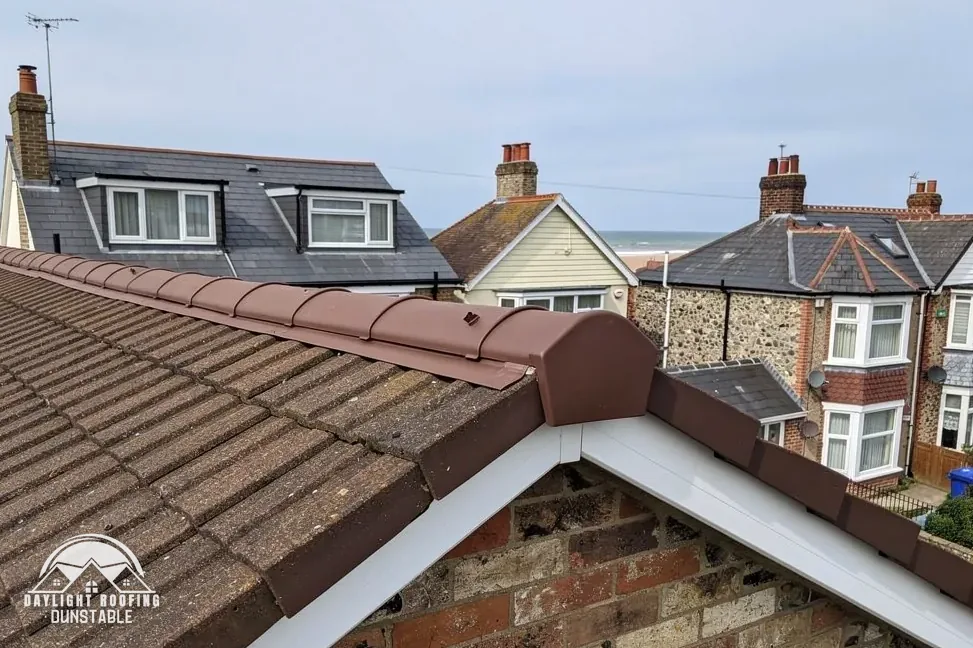
- The details at the ridge, verges and eaves.
- Any extra work the regulations call for.
None of these can be settled from a photograph alone, though a photograph helps, and a photograph sent on WhatsApp to 07880 284133 gives us a first look. The survey is where they are checked. After it, the quote is one written total price.
Size, shape and pitch
The area of the roof sets how much covering, batten and underlay are needed, so a larger roof costs more. The area is of the slopes themselves and not of the floor plan, since a roof has a bigger area than the plan of the house under it. A steeper pitch adds to the slope area for the same footprint.
Shape counts alongside size. Every hip, valley and dormer adds cutting, extra flashings and more joins to make watertight. A simple gable-ended roof with two plain slopes is quicker to cover than one with several hips and a valley, even where the total area is the same. The survey counts these features, because each one is somewhere a leak can start.
Pitch also decides what can be laid. Each tile product has a minimum pitch, and Marley, for instance, gives 35° for its Plain concrete tile and 15° for its Mendip. The product on the quote has to suit the angle of the roof. The page on the choice between clay and concrete tiles sets the minimum pitches side by side.
Height and access follow from the shape. A tall house, a roof reached only over another roof, or a plot with no room for materials adds time and handling. Those costs are real, and they show up in a written quote that reflects your own roof, which is a surer guide than any published average.
The covering you choose
The covering is a major line in any pitched roof price. HomeBuilding's own example is a roof with plain concrete tiles, and it says a Welsh slate roof on the same house might reach £18,000. MyJobQuote's slate page, last updated 06/10/26, says: "The average cost of fitting a slate roof is around £7,800."
Those figures describe different houses and measure different things, so they cannot be set side by side as a ranking of coverings. What they do show is that natural slate is priced in the same bands as, and above, tile in the published guides, and that the figure for any covering rests on the roof it goes on.
A covering is chosen on more than price. Its minimum pitch, its fixing rules and its published lifespan all belong in the comparison, and each is covered in its own page: how long roof tiles last sets out the published lifespans with each source's wording, and the clay and concrete page sets out pitch and fixing.
Ask any quote to name the product. A line that says only 'new tiles' leaves the product, the pitch rating and the fixing method unstated, and the written total should rest on a named product that has been checked against the roof.
Access, scaffold and what lies under the tiles
Reaching a pitched roof safely calls for scaffold. Scaffolding that takes up a footway or carriageway needs a scaffold licence from the highway authority; we arrange the licence with our scaffolder. Scaffold is part of the written quote, so what you see is one total.
What lies under the covering is the largest unknown at the survey stage. Battens can be sound or tired, an underlay can be intact or torn, and timbers can be dry or damp. A visible tile can say little about them. The survey assesses what it can see on the roof, and the quote is written on that basis.
The rules can add work as well. The Planning Portal says that re-roofing does not normally need a building regulations application where the work affects "Less than 25 per cent of the total 'building envelope'" and "Less than 50 per cent of the roof is affected". Replacing the whole covering passes the 50 per cent limit on the roof, and on its main page the Portal says: "In most situations, this work will need Building Regulations approval."
Insulation can come into the same job. AD L expects a roof renovated over more than 50% of its surface to be brought up to the improved standard where feasible, tested against a "simple payback of 15 years or less". Where it applies, it changes what goes under the tiles, and so the price. Our page on when to re-tile a pitched roof explains when a re-cover is due.
Smaller jobs: tiles, ridge and verge
Not every pitched roof job is a new roof. Published ranges exist for the smaller ones, and they are useful for scale. Each is a third-party figure with its own source and date, none is a price for your roof, and none is multiplied up into a larger total.
| Job | Source | Figure |
|---|---|---|
| One to six tiles replaced | Which?, excl. VAT | £75 to £400 |
| A new ridge tile | Which?, excl. VAT | £80 to £300 |
| Replacing roof tiles | MyJobQuote, 06/10/26 | average around £215 |
| Roof repair | MyJobQuote, 06/10/26 | average around £650 |
| Ridge tile replacement | MyJobQuote, 01/10/26 | £225 to £550 |
MyJobQuote also says a dry verge system "usually falls between £500 and £2,000", on a page dated 08/10/26. Hips are priced after a survey, and a ridge-tile figure cannot be borrowed for them. Neither the Which? range nor the MyJobQuote averages should be read as covering a hip, a valley or a chimney detail.
A repair figure and a roof figure answer different questions, and mixing them up gives a misleading picture. If your roof has some slipped tiles and a failing ridge, the repair ranges are the nearer guide, and the survey tells you plainly whether a repair will do. If the covering is failing across the roof, the whole-roof ranges are nearer.
Comparing quotes fairly
When two quotes arrive at different totals, start by checking whether they describe the same work. A lower quote can be doing less, and a higher one can include things the other omits. A bare total says nothing about either.
- Which slopes and how much of each are being covered.
- The named tile or slate product, and its minimum pitch against the roof.
- The battens and underlay: renewed, or kept where sound.
- The ridge, hip and verge fixings.
- Scaffold, and who arranges the licence.
- Whether the regulations call for insulation work.
Ask each firm for these points in writing. A quote that cannot say what product is going on, or which slopes it covers, is hard to compare with one that can. Our price arrives as one written total once the survey is done.
If you would like to see how the published ranges fit your own roof, call 01582 935272, or send photographs on WhatsApp and book a survey. The price comes after the survey, because that is when the shape, the pitch, the access and what lies under the tiles are known. A written quote also lets you compare firms on the same footing: same slopes, same product, same fixings, and a total that says what it covers. Keep every quote you receive and note the date on it, since prices move over time and an old quote is a weaker basis for a decision than a recent one.