
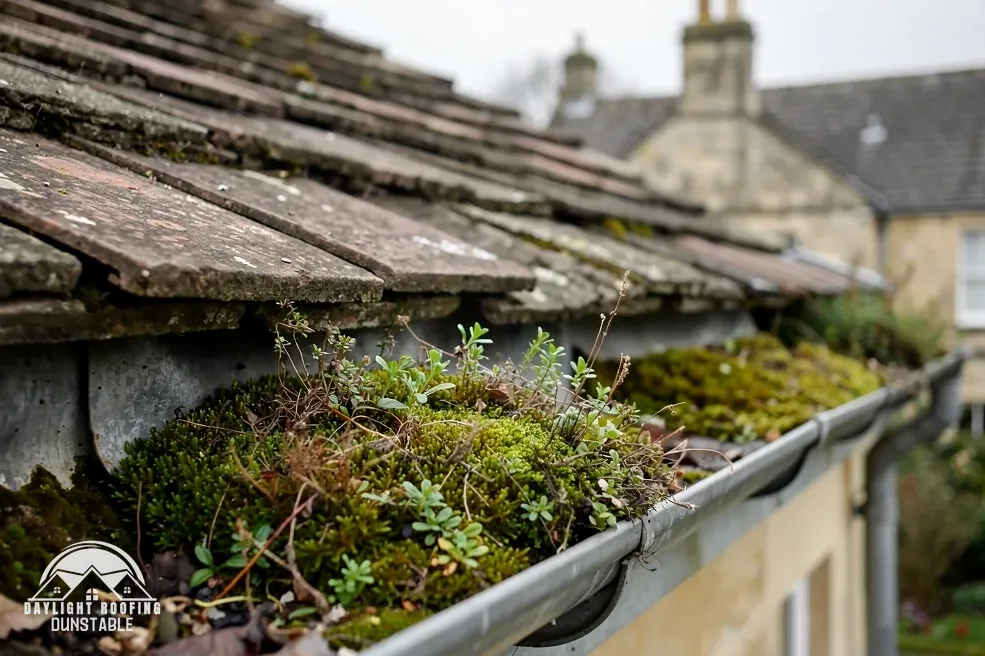
What a lifespan figure measures
A lifespan figure is an estimate about a material, written by a manufacturer, a researcher or a magazine. It is not a measurement of any one roof. A tile that is quoted at 60 years describes the covering when it has been made well, fixed to the right rules, laid on a sound structure and left in reasonable condition. Change one of those and the figure no longer applies in the same way.
A roof is also more than its tiles. Under the covering sit battens, an underlay and the fixings that hold each course. Around it are flashings, valleys, ridge and verge details, and the gutters that carry the water away. Each of these has its own age, so a roof can be covered in sound tiles and still need work on what holds them or seals their edges.
Read each figure with its source's own qualifiers beside it, since a published lifespan describes a covering in general and is never a promise for one roof, whatever its age.
If you only need the short route to a decision, the page on when to re-tile a pitched roof sets out the signs that a re-cover is due. The rest of this guide explains the numbers behind it.
The published figures
Marley, a tile maker, says: "Typically, roof tiles are expected to last for around 60 years". It adds: "This is not a guarantee or warranty of its longevity." For clay roof tiles alone, Marley reports that the BRE determined a minimum life expectancy of 60 years. That BRE figure belongs to clay and is not a figure for any other covering.
HomeBuilding's cost guide, dated 30 September 2025, lists approximate lifespans by covering. Its list is the broadest of the published sets and it is shown below in its own wording.
| Covering | Approximate lifespan |
|---|---|
| Welsh slate | 100+ years |
| Spanish natural slate | 75-100 years |
| Reclaimed Welsh slate | 50-80 years |
| Clay tiles | 60-80 years |
| Plain concrete tiles | 40-50 years |
Marley's "around 60 years" for roof tiles and HomeBuilding's 40-50 years for plain concrete do not match. The spread shows that tile coverings are measured in decades, and that a single precise figure quoted for one roof goes beyond what the published sources say. Welsh and Spanish natural slate, in HomeBuilding's list, run longer than either tile, and the structure under any covering still has its own say in how long a roof performs. Anyone comparing a quote with these lists should check that the covering named is the one the figure belongs to.
Parts of a tile roof age separately
The tiles are the part you can see, and can be the part that outlasts the rest. Under them, the timber battens carry each course and the underlay catches what water gets past the tiles. These are hidden, so their condition is judged when the covering is lifted or from the loft side, not from the ground.
Fixing has its own history. Marley notes that installing to BS 5534 isn't required by law. It also says that, following the 2015 amendments, mortar "could no longer be relied upon as the only means of securing the roof covering". An older roof may have been fixed in a way that today's guidance treats as insufficient on its own. That gives a reason to examine the fixings of an older roof, and it says nothing about whether its tiles are sound.
Lead flashings, at the junction of roof and wall or chimney, can last a long time as well. MyJobQuote says correctly installed lead flashing can last for over 80 years. That is a different material with a different figure, and it is sound reasoning to judge it on its own, so a good covering with a worn flashing can leak while the tiles look fine.
Ridge tiles are bedded or fixed separately from the main slopes, and their condition is read separately. BS 8612:2018 is the current standard where a dry-fixed system is used. Gutters and fascias belong to the wider roof edge and are worth a glance too, since water that cannot leave a gutter can reach places it should not.
What can shorten a tile roof's life
A tile that is well made can still fail early if something works against it. The causes below are general to pitched roofs, and none is tied to a particular street or town. Each is something that can be checked.
- Jet washing, which Marley says "is not recommended as it can damage the surface of the slate or tile, thus reducing its expected life considerably".
- Walking on the roof. Tiles can crack under a foot, and a cracked tile can let in water without showing from below.
- Slipped or missing tiles left for a long time, which expose the underlay and the batten beneath.
- Blocked gutters, which can send water back under the lowest course.
- Poor ventilation in the roof space, which can leave moisture in the timbers.
- Fixings that were never calculated for the site's exposure.
Ventilation shows how the details work. Marley's BS 5250 figures cover a cold roof built with high-resistance underlay: a 25 mm eaves gap for pitches up to 15° and a 10 mm gap above that. A roof space that cannot breathe can hold damp air, and damp can affect timber without any tile being at fault.
Seen together, these show that the longest published figures belong to roofs that have been laid properly and then left unharmed. A lifespan figure describes the material in good conditions, and what a roof actually gets depends on how it was built and what has happened to it since.
Reading your own roof from the ground
A lot can be seen from the garden. Binoculars or a phone with a zoom show the slopes in more detail, and a dated photograph lets you compare the roof after the next storm or the next winter. Keep off the roof itself, because a fall from even a modest height can be serious.
| You see | It can point to |
|---|---|
| A tile that has dropped below its neighbours | A slipped tile or a failed fixing |
| Flaking or crumbling tile faces | A surface that is wearing |
| A dip or wave along a slope | A batten or timber problem below |
| Gaps along the ridge line | Ridge bedding or fixings failing |
| Daylight in the loft | A gap in the covering or a slipped tile |
| Brown stains on a ceiling | Water getting in somewhere above |
A single slipped tile is different from a pattern across a slope. One tile can be refitted. Tiles failing across the slope suggest the batten, the fixing or the covering as a whole, and that is a question for a survey.
Inside, a torch in the loft on a dry day shows the underside of the covering. Dark timber, a stain around a chimney or a batten that looks damp are all worth a photograph. Our guide to pitched roof problems goes through each fault in turn and what it means.
Repair, part re-cover or full re-roof
Age on its own does not decide between repair and renewal. A roof at 50 years with sound tiles and a few slipped ones can be repaired, and a roof at 25 years with failed fixings can need a wider job. The deciding factors are the state of the tiles, the battens and the fixings together, and the survey looks at all three.
The size of the job affects the rules. Under the Planning Portal's re-roofing guide, a building regulations application is not normally needed where the work affects "Less than 25 per cent of the total 'building envelope'" and "Less than 50 per cent of the roof is affected". A repair of some tiles sits inside those limits. A full re-roof does not, and the Portal says: "In most situations, this work will need Building Regulations approval."
Price differs by scope as well. Which? Trusted Traders, in a survey of 11 traders gathered in November 2025, put one to six replaced standard roof tiles at £75 to £400 and a new ridge tile at £80 to £300, with VAT excluded from both. MyJobQuote's page, last updated 06/10/26, says: "The average cost of replacing roof tiles is around £215". These sources measure different jobs, so their figures are not joined into one range.
After a survey we give one written total for the job, whichever route is chosen. If you are looking at the cost of a whole roof, the page on pitched roof costs sets out the published ranges and what moves the price.
Questions to ask before deciding
A lifespan figure is most useful when it is turned into questions about the roof in front of you. Five questions can be put to anyone who surveys or quotes for it.
- Is the problem confined to a few tiles, or does it run across a slope?
- What is the condition of the battens and underlay where the tiles are lifted?
- How were the tiles fixed, and does that match the current code?
- What state are the flashings and the ridge in?
- Is the roof space ventilated?
If those answers point to a sound roof with a local fault, a repair is a reasonable answer. If they point to a covering that is wearing across its whole area, re-covering is the sounder route, and it is fair to ask any firm which tile product and fixing method its price assumes.
Send photographs on WhatsApp to 07880 284133 if you would like a first look before a survey is arranged. Include a wide shot of the elevation, close shots of anything that looks wrong and a note of where any damp shows indoors. The price that follows the survey is one written total, so the decision rests on the roof rather than on a guess.