
Repair or re-tile: what the decision rests on
A tile roof is a stack of parts. The tiles shed the water, the battens hold them in line, the underlay catches whatever gets past, and nails, clips or mortar keep it all in place against the wind. A fault in one layer can be mended on its own. A fault that runs through every layer is the case for stripping the roof and starting again.
That makes the question one about the whole roof and not just the slipped tile that brought you to it. A single cracked tile with sound battens and a sound underlay behind it is a repair. A roof whose underlay has torn, whose battens have softened and whose tiles are failing at the same time is not, because each repair buys little while the layers beneath keep deteriorating.
- the age and kind of the covering
- the surface and edges of the tiles themselves
- the battens and the underlay behind them
- the nails, clips or mortar that fix the tiles
- how much of the roof would be covered by the work
Those five points are the order a survey follows. The wider pitched roofing hub explains the covering types, and published figures exist for some of the five points, each tied to its source.
How long the tiles themselves last
HomeBuilding, in a guide last updated on 30 September 2025, gives approximate lifespans by covering: Welsh slate 100+ years, Spanish natural slate 75 to 100, reclaimed Welsh slate 50 to 80, clay tiles 60 to 80 and plain concrete tiles 40 to 50.
| Covering | Approximate lifespan |
|---|---|
| Welsh slate | 100+ years |
| Spanish natural slate | 75 to 100 years |
| Reclaimed Welsh slate | 50 to 80 years |
| Clay tiles | 60 to 80 years |
| Plain concrete tiles | 40 to 50 years |
Marley gives a figure for roof tiles in general: "Typically, roof tiles are expected to last for around 60 years", with the note that "This is not a guarantee or warranty of its longevity." For clay tiles in particular, Marley reports that the BRE determined a minimum life expectancy of 60 years.
These figures are the range for the covering as a material, not a countdown for your roof. A roof younger than the figure can need re-tiling if its underlay, battens or fixings fail while the tiles are still sound, and an older one can stay sound if they have not failed. The lifespan is where the conversation starts, and the roof's own condition settles it. Sources differ on the same covering, as the figures for clay and concrete show, and the table gives each as published.
Battens and underlay behind the tiles
Tiles hang from timber battens, and the battens are nailed over a layer of underlay laid across the rafters. Neither can be seen from the pavement. The loft shows the underside of the underlay and the back of the battens as well, so a torch and ten minutes from the hatch give a better view than a long look from the garden.
Underlay that has torn, gone brittle or sagged leaves the covering as the only protection, and any tile that cracks or slips then lets water straight onto the timber. Battens that have gone soft with damp hold nails badly, so refixing a few tiles on rotten battens does not last. Where both are in that state, repair has nothing sound to work on.
When a roof is re-tiled, the old covering and the old underlay come off, the battens are looked at, any that fail are replaced, and the new underlay and battens go on before the new tiles. The underlay guide explains how the sheet types differ, and ventilation at the eaves is set at the same time.
Daylight is the clearest sign of a gap between the covering and the roof beneath it, and a damp, dark patch on the ceiling below is the clearest sign that water has already got through. Neither is proof of where the fault is, since water can run along a rafter before it drips.
In the loft, look for
- daylight where no vent should be
- torn, brittle or sagging underlay
- dark, soft or powdery battens
- drip marks under one slope
Nails and fixings that have let go
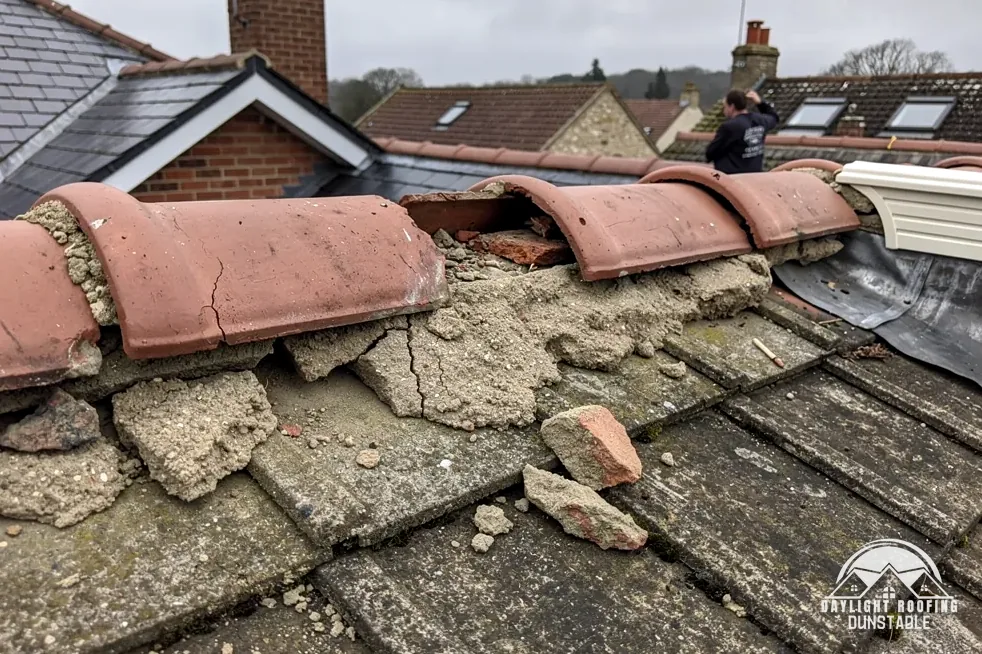
Tiles are held by nails, clips or, on older roofs, by mortar at the edges and ridge. Metal that has corroded or worked loose stops holding, and a tile held by little more than its own weight slips when the wind pulls at it. One slipped tile is a repair. A line of tiles slipping on one slope points to a fixing problem across that slope, and the roof is judged on the cause and not on the single tile that happens to show it.
The standard for fixing has also moved. BS 5534 is a code of practice, not law, but since its 2015 amendments mortar alone is no longer relied on to secure the roof covering, according to Marley. A roof that depends on old mortar and little else for its fixing is therefore behind current practice, even if nothing has yet come loose.
A re-tile sets the fixing afresh, to a specification worked out for the site's exposure under BS 5534, with the ridge and hip tiles fixed by mechanical means. The detail is in re-tiling and Building Regulations.
- a run of tiles out of line along one course
- tiles that rock or lift when pressed from underneath
- cracked mortar at the ridge or the verge
- fragments of mortar in the gutter below
The published prices for patching, repairing or re-covering
Third-party guides give ranges, each one published for a stated job, and the price for your roof is set after a survey. Which? Trusted Traders, surveying 11 of its traders in November 2025, lists a small tile repair, one to six tiles, at £75 to £400 excluding VAT. MyJobQuote's figure for the average roof repair is around £650 in 2026, and for tile replacement it quotes an average of around £215.
At the other end, the same Which? survey lists "Replacing entire roof on an average three-bedroom house" at £7,000 to £21,000 excluding VAT. HomeBuilding (30 September 2025) says a plain concrete tile roof of 65m² on a three-bedroom semi "may cost between £10,000 and £15,000".
| Question | Repair | Re-tile |
|---|---|---|
| Layers touched | Tiles at the fault | Tiles, battens, underlay |
| Scaffold | Sometimes | Part of the job |
| Fixings | Tiles at the fault | Set afresh |
| Regulations | Small jobs sit inside the limits | Past the roof limit |
The gap between the two ends is wide, and no formula turns one into the other. One written total price follows the survey. When comparing a repair price against a re-tile price from another firm, check that each quote says what it covers: the tiles, the battens, the underlay sheet and any scaffold. The pitched roof costs guide explains what moves the figure.
The 50 per cent line and Part L
Under the Planning Portal's guide, re-roofing does not normally need a building regulations application if it affects less than 25 per cent of the building envelope and less than 50 per cent of the roof. A few replaced tiles sit far inside that test. A whole new covering does not, because it affects more than 50 per cent of the roof, and then Building Regulations approval applies.
That line is a practical reason to decide between repair and re-tile in the right order. A string of small repairs that together cover more and more of the roof is worth adding up before the next one is ordered. If a roof is heading towards the 50 per cent line, a planned re-tile makes the application route clear from the start, and the council's building control team can say where a particular job stands.
Insulation joins the picture when the work is big enough. Table 4.3 of Approved Document L holds two roof figures: 0.35 W/m²K, the threshold, and 0.16 W/m²K once improved. Paragraph 11.3 brings the whole roof up to the improved value where feasible once more than half the surface is renovated. Building control gives the answer for a given house.
Before you agree to a re-tile
A re-tile is a large job, so ask for the reasons in plain words. The answer should name the layer that has failed (the tiles, the battens, the underlay or the fixings), say where on the roof it is and say why a repair would not hold. A reason that cannot be pointed to in the loft or from the garden deserves a second look.
Photographs help from your side. Take pictures of ceiling stains with the date, of the loft under the worst of the stains and of the tiles from the garden, and keep them. Send photos to our WhatsApp line and we look at them ahead of a survey, though the survey is what settles whether the roof needs a repair or a new covering.
Moss and growth are a separate question. On cleaning, Marley's advice is "The use of high powered jet washes is not recommended as it can damage the surface of the slate or tile, thus reducing its expected life considerably". Checkatrade says roof cleaning typically costs £8.50 to £14 per square metre (April 2026), which is a different job from either a repair or a re-tile.
If the cause is a storm and not age, photograph the damage before anything is moved. The Financial Ombudsman Service says it will "usually look at expert reports and photos" in a dispute over a claim, and roof damage and home insurance sets out the steps.