
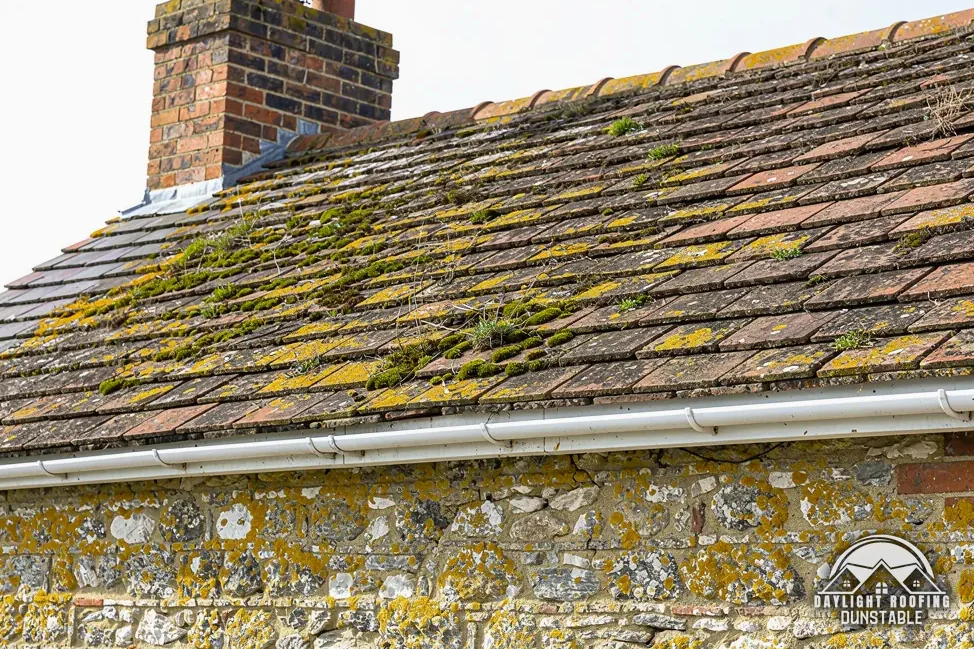
Learning the parts of a pitched roof
The roof over a pitched house is built from several parts working together, and a fault in one can appear some distance from where it begins. The tiles or slates are the visible covering. Beneath them lie the battens that carry them and an underlay that catches what water gets past. The ridge runs along the top, hips run down the outside corners, and a verge finishes the edge at a gable end.
Where two slopes meet in an inside corner, a valley carries water down to the gutter. Where roof and wall or chimney join, a flashing seals the junction. At the lower edge, the eaves hold the gutter, and the gutter carries the water away. Knowing these names makes it easier to describe a fault on the phone or to read a quote.
Look from the ground. Binoculars or a phone camera zoomed in bring a slope close, and a dated photograph can be compared with one taken after the next storm. Keep off the roof itself. Tiles crack under a foot, and a slip off the edge, even a low one, can cause serious injury.
Every section below follows one pattern: see, mean, do. The words 'can' and 'may' are deliberate. A sign is a prompt to look closer, and the cause is confirmed at a survey, not from a photograph.
Slipped, cracked and missing tiles
See: a tile hanging lower than the others in its course, a tile with a diagonal crack, a gap where a tile has gone, or fragments of tile lying in the gutter or the garden.
Mean: a slipped tile can mean its fixing has failed or the batten beneath it has loosened. A cracked tile can have been struck, stepped on or split with age. A missing tile leaves the underlay exposed, and underlay is not made to face the weather for long.
Do: photograph the gap and its surroundings, and note whether the tiles around it look sound. One slipped tile in a sound roof is a repair job. Several across one slope can mean the fixings or battens are failing over that area, and that is a different job.
| Fault | What it can mean | What to ask |
|---|---|---|
| One slipped tile | A failed fixing | Are the neighbours fixed? |
| Several slipped | Fixings or battens failing | How far does it run? |
| Cracked tile | Impact or age | Is the batten below sound? |
| Missing tile | Underlay exposed | Is there damp in the loft? |
A tile that has fallen is a small item, but a gap left open lets water in directly and exposes the underlay to light and wind.
Sagging, dips and waves in the slope
See: a slope that dips between two points, a ridge that bows, or a wave running through the tiles when you look along the roof from a low angle.
Mean: tiles follow what is under them. A dip can show that a rafter, a purlin or a batten has moved, or that timber has weakened, perhaps after long exposure to damp. A bow in the ridge can show that the structure beneath is shifting. A roof that was built with a slight irregularity looks different from one that has moved, which is why a dated photograph is useful.
Do: take a photograph from the same spot each time, with a straight edge such as a fence in the frame, so that a change can be seen. A new dip, or a dip that has grown, is worth a survey. Do not climb up to look.
Inside the loft, a dip can have a counterpart that shows: a timber that bows, a join that has opened, or a damp stain on the wood. A structural fault is a different matter from a surface one, and it can only be judged by someone who has seen the timbers. If the dip is new, say so when you call, and say whether any ceiling below has cracked.
Ridge and verge faults
See: ridge tiles that look loose or out of line, gaps along the ridge, pale mortar crumbs on the tiles or in the gutter below, or a verge where the tiles seem to be lifting at the gable edge.
Mean: ridge and verge tiles sit at the edges of the roof where the wind has most effect. Marley's guidance reads: "In all cases, ridge or hip tiles should be mechanically fixed to resist the calculated wind uplift force." A ridge held by mortar alone can loosen as the mortar breaks down. BS 8612:2018 is the current standard for the dry-fixed systems that hold ridge, hip and verge parts without a mortar bed.
Do: look at the ridge from the ground, and photograph any gap or tilted tile. Check the gutter for mortar crumbs. A loose ridge tile can come down in wind, so nobody should stand or park below it in the meantime.
- Ridge tiles out of line along the top of the roof.
- Dark gaps between ridge tiles where bedding has gone.
- Mortar crumbs in the gutter or on a flat roof below.
- A verge edge where tiles lift or show a gap.
Costs for ridge work vary. On its page dated 01/10/26 MyJobQuote says the average ridge tile replacement costs between £225 and £550. A Which? Trusted Traders figure for a new ridge tile is £80 to £300, excluding VAT. These are different jobs described by different sources, so read them as scale, not as a price for yours.
Valleys, flashings and junctions
See: a stain on a ceiling beside a chimney or an upper wall, a valley where moss or debris has built up, a gap between a flashing and its wall, or a flashing that is lifting.
Mean: a junction is where the covering ends and something else begins, so it depends on the flashing or the valley lining to keep water out. Lead is widely used for these parts, and MyJobQuote says correctly installed lead flashing can last for over 80 years. A flashing can fail even when the tiles around it are sound, because a lifted edge, a split or open pointing lets water behind it.
A valley collects the water from two slopes at once. If its lining is damaged or its channel is blocked, water can back up under the tiles beside it. A fault in the valley can appear as a stain on the ceiling below a corner of the house.
Do: look at each junction from the ground, note where any stain sits indoors, and compare the two. The damp mark need not sit directly under the fault, since water can travel along timber before it drops. Clear loose debris from a gutter you can reach from the ground, but leave valleys alone. A survey follows the water back to its entry point.
Underlay, ventilation and condensation
See: water droplets under the covering in the loft, dark patches on rafters, a musty smell, or damp insulation.
Mean: not every wet loft is a leak. Moisture-laden air from the house can rise into the roof space and condense on cold surfaces. That is condensation, and it can happen with a sound covering. A leak, by contrast, leaves a stain that spreads after rain and dries when the rain stops.
Ventilation is how a cold roof deals with moisture. For a roof built with a high-resistance underlay, Marley, working from BS 5250, calls for an eaves opening of 25 mm for pitches of 15° or less and 10 mm for steeper pitches. Vapour does not pass through a high-resistance underlay, so its detailing matters. Roofs differ, so the ventilation of yours is judged at the survey.
Do: note the time of day and the weather when you see moisture, and whether it follows rain or follows cold nights. Do not block eaves vents with loft insulation or storage. Our guide to pitched roof ventilation covers how air moves through a roof space. Underlay itself ages and can tear, especially where it was exposed by a missing tile. A torn underlay may not show from outside, but daylight in the loft can point to it. Report both daylight and damp when you call.
The disadvantages of a pitched roof, and what to do next
The disadvantages of a pitched roof deserve a plain statement. It is built from more separate parts than a flat roof: covering, battens, underlay, ridge, hips, verges, valleys, flashings and gutters. Each part can fail, and each is checked on its own. The work is done at height, which can mean scaffold and its cost; on a pavement or road a licence is needed as well, and we arrange the licence with our scaffolder.
It also needs its roof space ventilated, and it can be affected by wind at the ridge and verges, which is why fixings are calculated for the site's exposure. These are costs of the form, not a case against it. Our page on the disadvantages of a pitched roof takes them one at a time.
What to do next is simple. Photograph what you see from the ground, with a date. Note where any damp shows indoors, and whether it appeared after rain or after a cold night. Telephone 01582 935272, or WhatsApp the photographs to 07880 284133, for a first look ahead of any survey.
The survey's results come to you in plain words, and what else was noticed up there. A written price, as one total, comes after it, so you can weigh a repair against a larger job knowing what each involves.