
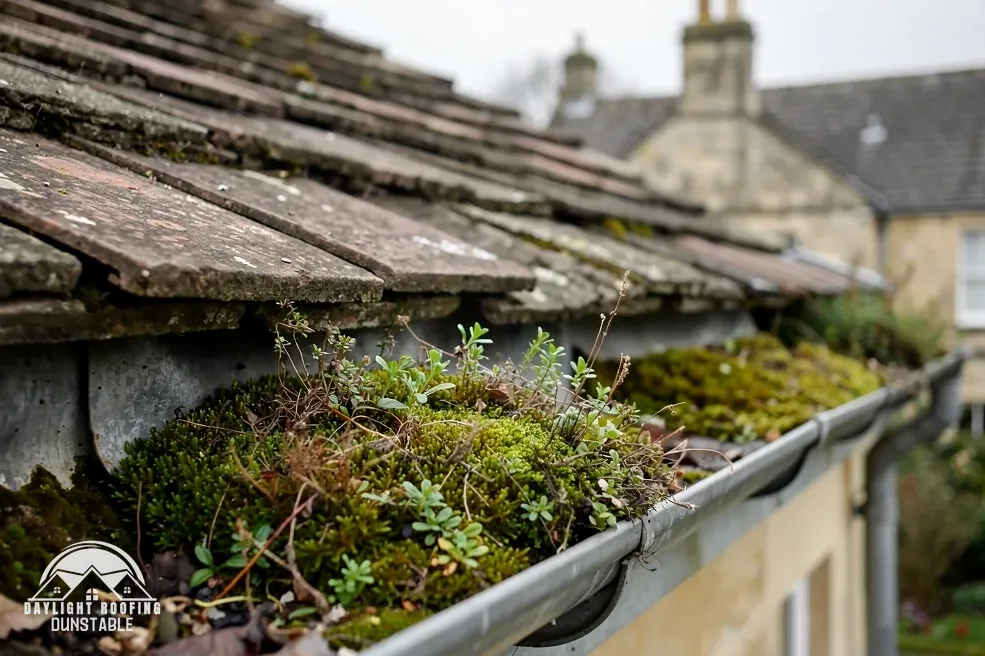
Where the water leaves the gutter
An overflowing gutter is a symptom, so the first job is to see where the water actually leaves. It can spill over the front lip, drip from a joint, run out at a corner or pour past the outlet. Each of those points to a different cause. Watching the gutter in a downpour, from a dry spot on the ground, tells you more than a guess made later on a ladder. A short film of the spill, sent to WhatsApp, lets a roofer see the same thing you saw.
A gutter collects the water that runs off the roof edge and carries it sideways to an outlet, where it drops into the downpipe and on to a drain or soakaway. Three things have to hold for that to work. The run must fall towards the outlet, so the water travels instead of standing. The outlet and downpipe must be open. And the gutter must be held at the right height and angle by a fascia board sound enough to take the brackets.
The checks are the same for a gutter in Dunstable, in Houghton Regis or on any other house we work on. Each gets its own section here: the fall, the outlet and downpipe, then the fascia, before looking at access, cost and what the survey covers.
What to watch in heavy rain
- Spill along the front lip
- Drip at a joint
- Overflow at a corner
- Flow past the outlet
- Water down the wall
The fall towards the outlet
Brett Martin, a guttering manufacturer, sets the fall at 1 mm for every 600 mm of gutter, sloping towards the outlet. The slope is very gentle, too small to judge by eye from the ground, which is why a gutter can look straight and still hold a pool. A bracket works loose, a fascia board moves, one length drops below the next, and a shallow dip forms where water stands after a shower.
The sum is short. Divide the length of the run by 600 mm and the answer is how many millimetres the gutter should drop along it. The table works that sum for three run lengths.
| Length of run | Drop towards the outlet |
|---|---|
| 3 m | 5 mm |
| 6 m | 10 mm |
| 9 m | 15 mm |
A roofer checks a run with a level held in the gutter itself. If the bubble leans the wrong way, that length slopes away from the outlet and will keep water. Standing water adds weight to the brackets, and a dip is also where grit and seeds collect. The page on the correct fall for guttering goes through the figure in more detail, and a gutter laid dead level can hold a little water even when nothing is blocked.
Outlets and downpipes
The outlet is the opening where the gutter empties into the downpipe, and it is the narrowest point in the whole system. Leaves, moss, grit washed off the roof surface and the odd ball can settle there and stop the flow. Once the outlet is part blocked, water backs up along the gutter and spills over the lip even though the fall is correct. A gutter that overflowed in one storm and not in the next may simply have had its blockage shift.
Below the outlet the downpipe can block at a bend or at its shoe, the angled piece at the bottom that turns the flow towards the drain. A downpipe with a blocked bend or a broken joint sends water down the wall face instead of into the drain, and a damp, green or stained patch on the wall under a gutter points that way. Where the downpipe empties into a gully, a gully full of silt sends the water back up the pipe.
Two plain observations help. Watch whether water leaves the foot of the downpipe during rain, and look at the wall behind it. A cracked or missing outlet cannot be cleared; the part is replaced, and a downpipe split open at a joint is refitted or renewed.
You might hear
An overflowing gutter means the whole gutter has failed.
Plain as day
A blocked outlet or a dipped run can each cause it; the survey tells them apart.
Fascia boards carry the gutter
The fascia is the board running along the eaves, and the gutter brackets fix into it. While the board is sound, the brackets hold the gutter at the set height and fall. When the timber behind them goes soft, the screws loosen, one end of the gutter drops and the fall changes. A gutter that sags between brackets, or leans away from the wall, is worth a look at the board it hangs from. The page on what a fascia board is sets out the parts.
One uPVC roofline retailer states that its fascia boards "can typically maintain reliable performance for between 20 and 40 years" when installed correctly. That is a retailer's statement about a product. How long a board lasts on one house depends on what is behind it, so its condition is judged on the board in front of you, looked at close up from the ladder or scaffold.
Where a timber fascia is sound but tired, capping covers it with a uPVC board. On a page last updated on 17 September 2026, MyJobQuote puts capping of fascias and soffits at around £800 on average. A published average helps a householder judge if a quote falls within a sensible range. It does not replace the written quote, which arrives as a single sum once your own roofline has been surveyed, and it carries no information about the length of your eaves, the number of corners or the condition of the timber.
Clearing, repairing and replacing
Clearing a gutter, repairing a joint and replacing a run are three different jobs with three different price levels. Clearing deals with the blockage and does nothing for a dipped run. Repair resets brackets or reseals a joint. Replacement is for a run that has cracked, split at its joints or lost its fall for good. The page on repairing or replacing guttering helps with the choice.
Two published sources give a sense of scale. Neither is our price. Which? Trusted Traders gave its figures from a survey of 11 traders in November 2025, in prices covering labour and materials, with VAT left out. MyJobQuote gives no VAT basis for its figure, so nobody should read one into it.
| Job | Figure | Source |
|---|---|---|
| Clear out all gutters, front and back | £75 to £350 | Which? Trusted Traders, November 2025 |
| Gutter replacement | Around £1,000 to £1,600 | MyJobQuote, page dated 20 October 2026 |
On a given house, the run's length, the number of corners and downpipes, the material and how the eaves are reached all move the price. A house with a long side run and a single downpipe is priced differently from a short run with several, so the guide figures are a starting point for a conversation. The figure that applies to your house is the single written sum that comes after the survey.
Reaching the roof edge
Gutters sit at the lowest edge of the roof, but work there is still work at height, and a ladder alone does not always give a safe, steady position for pulling off a run of guttering or lifting a fascia board. A roofer may use a tower or a scaffold, depending on the house, and the choice follows from how much of the eaves has to come off.
Scaffolding over a pavement or a road needs a scaffold licence under the Highways Act 1980, and the highway authority is the body that grants it. For Dunstable and Houghton Regis that is Central Bedfordshire Council, which licenses scaffolding on its roads. We arrange the licence with our scaffolder, so you do not have to find the right department or fill in the form.
A homeowner can still help with access in a plain way. Say where the side gate and any narrow path are, and mention an overhanging branch or a conservatory roof near the eaves, as each changes how the work is reached. A car parked tight against a narrow frontage changes where a tower can stand. For your own safety, leave the climbing to people who have the equipment and the training for it.
What a survey looks at
A survey of an overflowing gutter looks at the whole path the water takes. The roof edge and the gutter's front lip come first, then the fall along each run, the joints, the brackets, the outlets, the downpipes and the board the gutter is fixed to. If we notice something else on the roof while we are up there, such as a slipped tile or a cracked ridge, you hear about it in plain words.
From that comes one written total price, covering the whole job in a single sum, whether the answer is a clear-out, a reset of the brackets or a new run. You can send a photograph of the overflow or the sagging run to WhatsApp on 07880 284133 and it will be looked at, or phone 01582 935272 and describe where the water leaves. Say whether the overflow is at the front lip, a joint or the outlet, and whether it happens in every downpour or only in the hardest rain, because those details tell a roofer what to look for first when arriving at the house.
The wider picture of a roofline, with its soffits, fascias and gutters and what each does, is under guttering, soffits and fascias.