
Why the check comes first
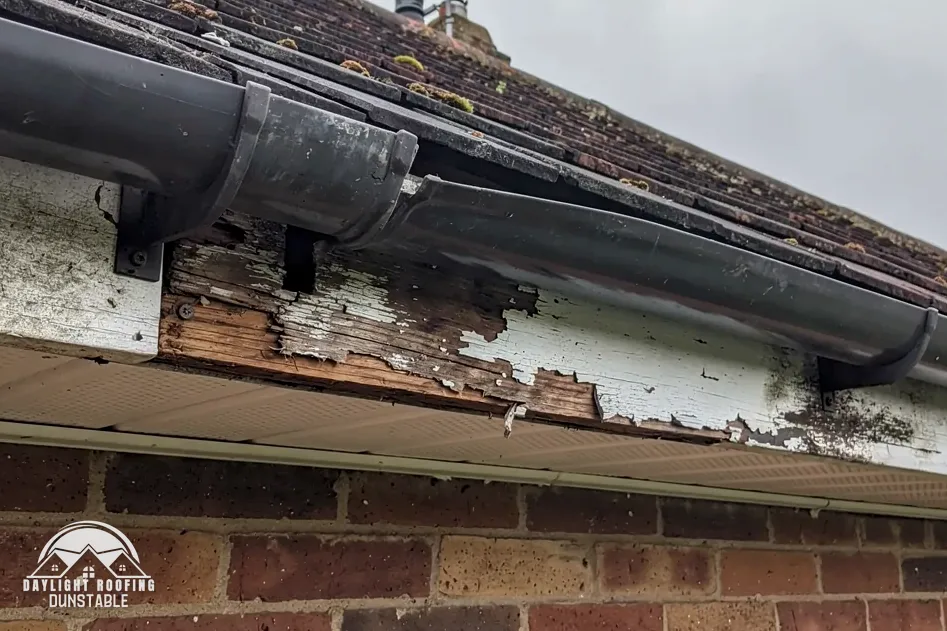
Replacing a fascia means working along the eaves, where the soffit board sits directly beneath it. The soffit is the lining beneath the roof edge, spanning from the wall out to the fascia, and taking a fascia off can mean unscrewing, levering or cutting the soffit as well. If that board contains asbestos, the way it is handled decides whether fibres are released. So the question has to be answered before tools touch it, not after the first panel has cracked, because a cracked panel cannot be put back together and the dust it shed cannot be recalled. Fascia work on a terrace or a semi can put several metres of soffit in play at once, so the question is not a small one.
HSE's rule is short: "If the building was built or refurbished before 2000, assume that there is asbestos in it." The word to notice is assume. The rule does not say every such building has asbestos in its soffits. It says the working assumption, until a test shows otherwise, is that asbestos is there.
The rule turns on the date a building was built or refurbished, not on the street or the estate. A house in Dunstable and a house in Stevenage are treated alike, and so is a house built in the 1960s and one refurbished in the 1990s. The page on asbestos soffits and what to know covers the same ground in a shorter form.
The materials HSE names
HSE names two families of material that matter at the eaves and the roof edge. The first is asbestos cement, which HSE describes among its examples as roof sheeting and rainwater goods. That puts old gutters and downpipes on the list, as well as sheet roofs on garages and outbuildings. On those roofs HSE's own guidance says "AC roofs are always fragile", a reason to keep off them altogether.
The second is asbestos insulating board, shortened to AIB. HSE's list of where asbestos is found includes "AIB white soffit panels to underside of roof eaves" and also "Damaged AIB soffit". A soffit board that looks like a flat, smooth, pale panel is exactly the sort of thing that list describes, though looking is not testing, and nobody can tell by eye which board is which.
Soffits made of timber or uPVC are a separate matter, and they are the boards a modern replacement uses. The asbestos question applies to the old board coming down, and a roofer needs to know what that board is before a replacement is priced. A new board going up raises no such question, since the one you are buying is made of known material. For the plain meaning of the part itself, see what a soffit is.
Named on HSE's lists
- Asbestos cement roof sheeting
- Asbestos cement rainwater goods
- AIB white soffit panels
- Damaged AIB soffit
Where the licence line falls
HSE splits asbestos work into three kinds, and the kind depends on the material and its state. The table sets out the lines HSE draws for the materials above.
| Material and state | HSE category |
|---|---|
| Asbestos cement, weathered but not otherwise substantially damaged, removed carefully without breaking up | Non-licensed work |
| Asbestos cement where the sheet has been substantially damaged or has been broken into pieces | Notifiable non-licensed work |
| AIB removal of short duration within a refurbishment project | Notifiable non-licensed work |
| AIB work that the risk assessment says will not be of short duration | Licensed work |
Two things follow. A soffit made of AIB sits in a category where the rules are tighter than for a sheet of asbestos cement, so the answer on what the board is decides who may take it down, and the difference in category can move a job from a roofer's own hands to a specialist's. Work that falls under a licence goes to a contractor who holds that licence, as HSE sets out. The soffit question therefore settles who does the work, and it does so before a roof quote can be written. Notifiable non-licensed work is different again: it needs no licence, but HSE requires the work to be notified.
Sampling by a qualified surveyor
The way to find out what a board is made of is a sample, taken by a qualified surveyor and sent for testing. A roofer cannot tell by looking, and a sample taken carelessly can itself break the board, which is why it is a surveyor's task and not a quick snip from a ladder.
MyJobQuote's page dated 9 September 2026 sets around £325 against an asbestos survey in 2026. That is the price of testing the material. The roof survey that leads to a written quote is another matter, and mixing the two up makes any comparison of figures meaningless.
Until the result is back, the sensible position is to leave the soffits alone. Do not drill into them to fix a light or a cable, do not scrub or scrape them, and do not send a pressure washer along the eaves. Any of those can break the surface of a board, and a damaged AIB soffit is one of the entries on HSE's list. If a board is already cracked or crumbling, tell the surveyor and the roofer before anyone goes near it.
A positive result changes the job without changing the facts about the roof. The fascia and gutters still need doing, but the soffit comes down by a different route, so the written total reflects that.
Waste and the skip
Asbestos that has been taken down has to go somewhere, and the rules on that are as specific as the rules on removal. HSE's guidance is blunt: "Use a lockable skip for asbestos". The same guidance says covering an ordinary skip with sheeting is not an acceptable substitute, because the load stays open to anyone who passes. A lockable skip keeps the boards out of reach until the carrier collects it. A standard skip, left on the drive with the boards in view, is the wrong container.
A household that clears a hazardous waste item from the home is spared a consignment note under a government exemption. The government's guidance carves one thing out of the exemption, written as "other than asbestos waste", so a householder is not covered for asbestos. The carrier moving asbestos waste is a registered waste carrier, and the register has an upper tier and a lower tier.
Council recycling centres each run their own rules on what they accept, and the rules are set council by council, so a neighbour's experience at one centre says nothing about another. Check with the council's waste service before anyone loads boards into a car. Never assume the answer is yes.
The same warnings cover other small asbestos jobs about a house, though the subject of this page is the soffit. Asbestos soffit panels go to a lockable skip, and the waste route is settled before the work begins, not decided on the day with boards lying on the drive.
You might hear
Old soffit boards can go in the ordinary skip.
Plain as day
HSE says to use a lockable skip, and rules out a sheet laid across an ordinary one.
What it does to the price
A new set of fascias and soffits is priced from the length of the eaves, the number of returns and corners, the height of the roof edge and the material chosen, and a long run with several returns costs more than a short plain one. MyJobQuote's page on capping fascias and soffits, last updated 17 September 2026, puts its average at around £800. That figure is for capping, which fits a new board over a timber fascia that is still sound, and it says nothing about soffits that need asbestos handling.
Where the old soffits are found to contain AIB, the job changes shape. Testing is one cost. Removal by a contractor who holds the licence, where the category calls for one, is another, and the waste route adds its own. A customer sees one written total after the survey, which already reflects the route the soffits will take. Guide prices elsewhere are no substitute for it, and they cannot know what your soffits are made of. If the first quote you are given for fascias is silent on the question of asbestos, ask what it assumes about the boards.
For the wider range of roofline costs and what sets them, the page on guttering and fascia costs goes through the published guides.
What a roof survey sees from the eaves
A roof survey before a fascia quote looks at the soffit boards from below and from the ladder: their colour and finish, whether any are cracked, stained or sagging, and whether the fascia timber behind the gutter has gone soft. Where the house was built or refurbished before 2000, HSE's wording tells owners to assume that asbestos is there, and the soffits are therefore handled on that basis until a sample says otherwise, and we tell you so plainly.
Your quote comes after the survey, written as one total. Anything else the roof shows us, a cracked ridge or a displaced tile for instance, goes into the same conversation, in plain words, next to the soffit question.
A photograph of the soffit and fascia, sent to WhatsApp on 07880 284133, is looked at. A clear shot taken from the ground, showing the board's finish and any cracks or stains, gives a roofer something solid to work from. The photo helps with the question of what the board looks like, though it cannot say what it is made of. Phone 01582 935272 to talk it through, and mention the age of the house, because the year it was built or last refurbished is the first thing the asbestos question turns on. The job begins under guttering, soffits and fascias, with the asbestos question answered first.