
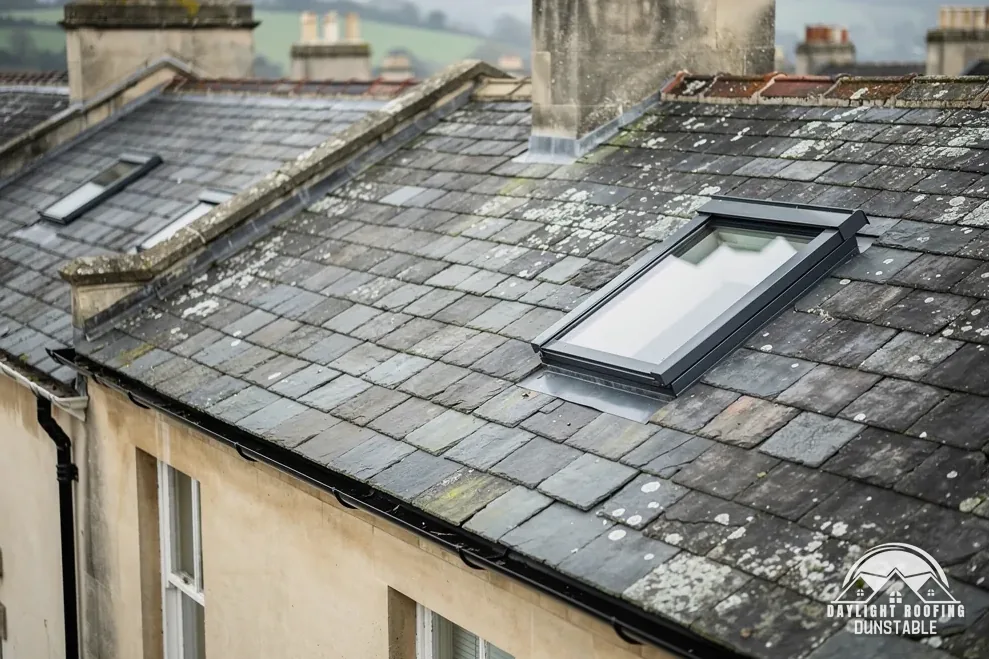
Two places, one council, and slate in the wording
Wolverton and Olney are both in the Milton Keynes City Council area, and the council says Milton Keynes has 27 conservation areas. Two of its Article 4 directions concern conservation-area housing, one for Wolverton and one for Olney. A direction takes away chosen permitted development rights inside a mapped area, so what each one names matters more than the fact that it exists.
What makes these two pages useful to a slate owner is a question the council puts on both of them. On both pages the council asks about "exterior brick, slate and stonework", and whether it is "maintained as existing and matched where replacement is required". The council is not setting a slate rule in that question. It is telling an owner what it looks at, and slate is one of three materials it names.
Their wording, set side by side in the council's own words, shows the two directions have little in common apart from that question. Nothing here applies to a house in another part of Milton Keynes, or to a house outside it, and the council confirms the position for a given address.
| Area | Where the council says it bites |
|---|---|
| Wolverton | Elevations fronting a road, including side elevations on corner properties and painting |
| Olney | Extensions, alterations, porches and painting of exterior walls |
Wolverton: the road-facing elevation
The council's text for Wolverton reads: "All dwellinghouses in this area are affected, but only in so far as extensions or alterations to elevations fronting a road (including side elevations on corner properties, and including painting), and the creation of hard surfaces, removal and replacement of walls, and installation of satellite dishes to the front." Every clause is about the part of the house that faces a road.
A slate roof slope facing the road is part of what a passer-by sees, which raises an obvious question: does a roof slope count as part of an elevation for this purpose? The council's wording does not answer it. That is a point for Milton Keynes City Council to settle in writing, with the address and the slope in question named, before a re-slate or a repair of any size is ordered.
Work to the rear slopes stands apart from the front slope, since the direction speaks of elevations fronting a road, and the plan of the house shows which is which. A corner property is specifically mentioned, which is a reminder that a house on a corner may have two road-facing sides. Draw the plan of the roof for the council, marking which slopes face which road, and the reply will be quicker and clearer.
Olney: alterations and porches
For Olney, the council's text says all dwellinghouses in the area are affected, but only in so far as "any extensions or alterations, erection of porches, and the painting of exterior walls". It is a shorter list than Wolverton's, and it is not tied to road-facing elevations, so it speaks of the house as a whole.
Roof work that replaces slates with slates of the same kind sits at the repair end of that range, while cutting a fresh opening in the slope, or switching to a different covering, sits at the alteration end. The council draws that line itself, in a note on both pages: the test is whether a repair would "materially affect the external appearance", and where it would not, the repair is not development. The note concerns repairs, so it does not stretch to changing the covering, and a repair that does alter the look of the roof falls outside it.
Olney is also a place where Class C of the General Permitted Development Order is in play. Class C covers "Any other alteration to the roof of a dwellinghouse", and a conservation area does not remove it, because article 2(3) land is excluded from Class B alone, the dormer class. A direction is what can take Class C away. If the owner of a house in Olney is unsure, Milton Keynes City Council's planning team is the body to ask.
What matching means on a slate roof
Matching is judged by eye and by specification, and both can be described to a planner. Slates differ in size, thickness, colour and finish, and the way they are laid, with a given overlap and a given pattern of courses, shapes the look of a roof as much as the slate does. A survey of the slope looks at all of these, and the council needs the same details to say whether a replacement matches.
Slate is sold new, from Wales, Spain and elsewhere, and reclaimed. HomeBuilding's new-roof guide lists approximate lifespans for natural slate: Welsh "100+ years", Spanish "75-100 years" and reclaimed Welsh "50-80 years". Which of those suits a Wolverton or Olney house is a question about the existing slates and what the council expects, not a claim that any one is right for these towns. A reclaimed slate can carry marks of age that a new one lacks, and the council may care about that difference.
For a repair, the council's note helps the owner, because it ties the question to whether the work would "materially affect the external appearance". Whether a particular job passes that test is a judgement about that roof, so a one-line email to the council settles it before the slates are ordered. Our guide to repairing or replacing a slate roof covers when a repair is enough.
You might hear
A like-for-like slate repair always needs an application.
Plain as day
A repair that leaves the outside look unchanged is not development, says the council. Confirm for your address.
Listed slate roofs and the character test
Listing is a layer above planning. Classes B and C still apply to a listed house, yet any work done "in any manner which would affect its character as a building of special architectural or historic interest" needs listed building consent. The question is whether the work affects character, and a slate roof can be part of that character in a way a modern covering is not.
Whether swapping slates one for one touches the character of a building is a judgement the council's conservation officer makes on the facts of the building, so the sensible route is to ask. A listed house that is also in a conservation area is covered by both regimes, and an Article 4 direction can sit on top of them. The three checks are separate, and each has its own answer.
A house on Milton Keynes' New Town Heritage Register is a further case. The council's own register note states that "Being on the NTHR leaves any existing permitted development rights intact and unchanged." That is the position for a house on the register and no more, and it says nothing about a conservation area or a direction. Ask the council which lists apply to the address before the survey is arranged.
Building control and the planning route for a re-slate
Whichever answer the planning team gives, building control is a separate matter. Milton Keynes City Council's building control team is on 01908 252721 in office hours. Building control is carried out by the council's team or by a registered building control approver, and either will want the slates, battens, underlay and fixings described before they sign anything off. The Planning Portal says re-roofing does not "normally" need an application if less than 25 per cent of the building envelope and less than 50 per cent of the roof is affected, and a full re-slate covers over half the roof, so it exceeds that limit.
On a full re-slate, the Portal's main re-roofing page therefore applies: "In most situations, this work will need Building Regulations approval." Where the new covering is 15 per cent or more heavier, approval applies as well, and the Portal tells the owner to have a structural engineer or surveyor look at it before the work begins. The guide to slate roofs and building regulations explains the tests, and these figures are national, not Milton Keynes ones.
The Portal's test is the national one, and Milton Keynes City Council's building control team answers questions about the route for one address. What is local is the conservation-area and Article 4 layer, and the council's own answer on matching. Get that answer in writing first, give building control the final specification once it is settled, and keep both replies with the house papers.
Scaffold, the survey and one written price
A slate roof needs scaffold, and scaffolding on the pavement or road needs a scaffold licence from the highway authority. Milton Keynes City Council lists a standard scaffolding licence of up to one month at £189 excluding VAT, with a separate, higher fee for complex scaffolding. We arrange the licence with our scaffolder, and the fee belongs to the council's own published list, not to ours.
Daylight Roofing surveys the roof before quoting. A plain report of the findings follows, including whatever else the survey turns up, together with one written total price. Because the council's questions are about materials, the survey looks at the slate itself and its condition, and the findings reach you in words you can pass on to the planning team. That matters in these two places, since the answer to the council's question depends on what is actually up there, and a survey is the way to find out.
A photo of the slope sent to WhatsApp, 07880 284133, is something we look at before a visit is arranged. The slate roofing hub covers slate work, small and large, and the questions in this post are the ones to settle before any of it starts.
One written total
What moves a slate roof figure
The slate chosen to match, the size and complexity of the slopes, how they are reached and what is found under the old slates all affect the number. One written total follows the survey.