
Two jobs that share a name
Repair and replacement are different amounts of work, and the line between them is a matter of how much of the roof is failing and why. A repair puts right a defined fault: a slipped slate, a cracked one, a failed lead apron or a patch of ridge. A replacement strips the covering from a slope or a whole roof and lays it again, with new slates or with sound ones that are reused.
A third option sits between them. Where the slates are good but the fixings are failing, the slates can be lifted, the battens renewed and the same slates fixed again. People call that re-slating, and it is priced like a replacement because the labour is the same, even though much of the material is kept.
| Route | What is done | What it suits |
|---|---|---|
| Repair | Slates or lead put right where they have failed | A defined fault in a sound roof |
| Re-slate | Covering lifted, timber renewed, sound slates refixed | Good slate on failing fixings |
| New covering | Old slates removed and new ones laid | Slate worn out across the roof |
The lightest route that works is the right one, and the survey exists to say which route that is. It examines the slates, the visible nails and battens, the lead and the ridge, and gives one view of the whole roof rather than a verdict on one slate.
Slipped and broken slates: when one fix is enough
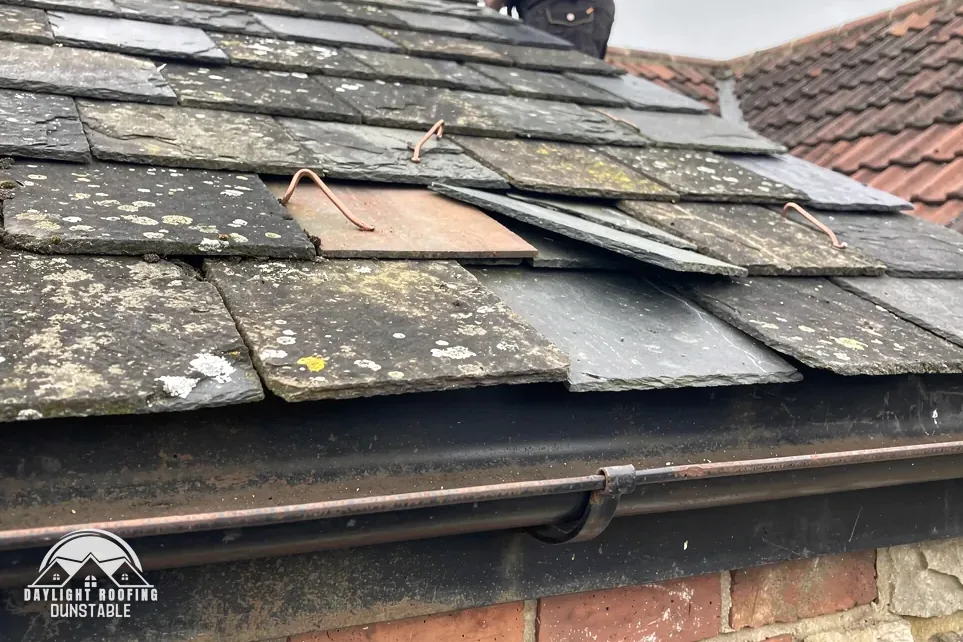
A slipped slate has lost its fixing and slid down, leaving a gap and a lower edge that does not line up. A cracked slate has split along a line of weakness or under a foot. Each leaves an opening above the batten, and rain can run through it onto the underlay and, when the underlay is old or torn, into the roof space.
Replacing a single slate does not need the whole roof taken apart. The slate above is lifted slightly, the damaged one is slid out, the nail or fixing is dealt with and a new slate is slipped in and held. A tingle, a small strip of lead or similar metal, can hold a slate where nailing is not possible. The result is a repair that shows only as a different shade of slate.
That approach suits a roof where the failures are scattered and the rest is sound. It stops suiting a roof where slates keep slipping in several places, since a repeat of the same fault in many positions points to the fixings and not to unlucky slates.
Count the problem slates from the ground, using binoculars, and note where they cluster. A cluster at one corner, one valley or one chimney points to a local fault. Slates dropping across a whole slope point to something wider, such as nails corroding along every course, which is for a survey to confirm.
Nail fatigue and the slope that keeps slipping
Nail fatigue is the wearing out of the fixings that hold slates to their battens. A slate hangs from its nail, and over many years the nail can corrode, loosen in the batten or cut through the slate around the hole. The slate then sits by friction and its neighbours until it slips. Where one slate has gone for this reason, others on the slope are likely to be next.
This cannot be mended slate by slate. Replacing a slipped slate in a slope with tired nails fixes one position and leaves dozens of similar ones. The repair that lasts is to lift the covering, check and renew the battens, renail the sound slates or fix them in a different way, and reuse what can be reused.
Our guide to slate roof problems covers how nail fatigue shows up from below. The signs to watch are slates dropping on several occasions, a roof that needs a repair after each strong blow of wind and slates found cracked along the line where the nail sits.
Nails and battens can fail before the slates do, so a decision to replace a roof should rest on the state of the fixings and the timber as well as on how the slates look. A slate roof can be sound on its face and tired beneath.
Tingles: a stopgap with limits
A tingle is a strip of metal, such as lead, that is nailed to the batten and turned up over the lower edge of a slate to hold it in place. It lets a roofer secure a slate without removing the slate above, and it is quick. A tingle is visible as a small bright tab at the tail of a slate, and a roof with several of them has had several slipped slates dealt with.
For one or two slates on an otherwise sound roof, a tingle can be a sensible repair. For a roof that is accumulating tingles, it is a sign that the underlying fixings are failing, and each new tingle only postpones a larger job. A strip of metal does nothing for a batten that has split or a nail line that has rusted through.
- one tingle on a sound roof is a minor repair
- a row of tingles on one slope suggests failing nails
- tingles in several places suggest the fixings across the roof have aged
- a tingle cannot cure a soft batten
Ask what a tingle repair assumes about the rest of the roof. A quote that offers tingles across a whole slope is describing a temporary measure, and you can ask what the plan is for the day the next slate goes. Set it against the price of lifting and refixing the slope.
Where the 50 per cent line falls
The Planning Portal's guide to re-roofing sets two limits. An application for Building Regulations is not normally needed where "Less than 25 per cent of the total 'building envelope'" is affected and "Less than 50 per cent of the roof is affected". The envelope is the walls, floor, roof, windows and door of the house, roof windows and roof-lights included.
A spot repair sits well inside both limits. Relaying a whole slope, or the whole roof, goes past the second one, and the Portal's main page says: "In most situations, this work will need Building Regulations approval." Building control is carried out by the council's building control team or by a registered building control approver.
Weight is a separate test. Separately, a new covering that adds "15 per cent or more" to the roof's weight brings in a structural engineer or a surveyor, on the Portal's advice. Weight is not compared between materials in this guide, and a structural check belongs on the actual roof, not on a table in a guide.
Our guide to slate roofs and Building Regulations goes further into the rules. For a listed house, the consent route is separate, and it turns on whether the work touches the building's character.
What the money looks like on each side
Published figures give a sense of scale and nothing more. MyJobQuote's average roof repair is around £650 in 2026 (6 October 2026). For slate it gives "The average cost of fitting a slate roof is around £7,800." The first figure covers roof repairs generally and not slate repairs, and the second covers a fitted slate roof, so the two are not subtracted.
HomeBuilding's example makes the gap bigger. A three-bedroom semi with a 65m² roof of plain concrete tiles "may cost between £10,000 and £15,000", and the same house in Welsh slate "might reach £18,000". These are prices for new coverings on one example roof, and they are not the cost of your own roof.
The difference between a repair and a re-slate lies in labour as much as materials, because a lifted roof is a full roof's worth of work even when most of the slate goes back. That is why re-slating costs much more than a patch yet much less than a new slate roof of fresh stock, since the slates are reused and need not be bought.
Every route is quoted as a single sum in writing. Where a repair would be cheap and short-lived beside a larger job that would last, the survey sets out both so the comparison is plain. Our slate roof costs guide gives the published figures in more detail.
Reusing sound slates and the decision in practice
Sound slates are worth keeping. A slate that is whole, flat, free of flaking and clear of cracks around its nail holes can go back on a new batten, and a roof relaid that way keeps the look and the weathering of the original. Slates that fail those checks are set aside and replaced with matches or with slates from stock.
Whether enough good slates survive is not known until the covering is lifted, so a quote for a re-slate states its assumption openly. Ask how many spare slates are being allowed and what happens if more are broken than expected. A roof that has been repaired many times may have too many broken or odd ones to reuse.
Weigh the options in this order: the state of the fixings and battens, the state of the slates, the lead and ridge work and the pitch and shape of the roof. Then ask the questions that depend on you: how long you will stay, whether the roof is a feature of the house and what the roof space is used for.
For a first view, send photographs on WhatsApp to 07880 284133 or ring 01582 935272. The survey then sets out each route, and what each leaves undone, on one sheet.