
Published figures for slate and its rivals
Asking how long a slate roof lasts gets an answer in ranges, never in one number. HomeBuilding's new-roof cost guide, last updated on 30 September 2025, prints an approximate lifespan beside each covering. Welsh slate is shown at 100+ years, Spanish natural slate at 75-100 years and reclaimed Welsh slate at 50-80 years. The word approximate is the publisher's own, and it travels with every figure in this guide.
The same table puts clay tiles at 60-80 years and plain concrete tiles at 40-50 years, so the three slates sit alongside the other coverings a house might carry. On those figures slate heads the list, though the table gives no reason. The ranges also overlap: 80 years falls inside both the Spanish and the reclaimed entries, which is a reminder that a range is a range.
| Covering | Approximate lifespan |
|---|---|
| Welsh slate | 100+ years |
| Spanish natural slate | 75-100 years |
| Reclaimed Welsh slate | 50-80 years |
| Clay tiles | 60-80 years |
| Plain concrete tiles | 40-50 years |
Read the table as one publisher's view of a roof built to the code and kept in repair. It says nothing about the roof over your own head until somebody has climbed up and looked at it, and that is what a survey is for. The real age of a slate roof is set by its parts: the slates, their fixings, the battens and the underlay.
Why a lifespan is a description, not a term
Nobody has agreed to a figure printed in a guide. Marley, a tile maker, shows the right attitude towards its own number: after giving a life expectancy for its roof tiles of around 60 years, it adds "This is not a guarantee or warranty of its longevity." Its figure covers tiles and says nothing about slate, but the caution carries across. A published range describes what a covering can do in good conditions.
Natural slate is split from quarried rock, and each slate has its own thickness and grain. Two roofs in the same stone can age at different speeds, because age also depends on the fixings, the timber beneath, the pitch and how much attention the roof has had. A range can therefore be right while one roof sits outside it.
Repairs blur the picture further. A roof can be a patchwork of ages: a slate laid in 1960 can sit beside a batten renewed in 1995 and a ridge rebuilt ten years ago. Asking how old the roof is gives a muddled answer, and asking how long each part has left gives a useful one.
That second question is the one a survey answers. It goes through the slopes, the junctions and the timber, and it ends in a written view of what can stay and what cannot.
Nails and battens keep their own clock
Each slate hangs from a fixing driven into a timber batten. Stone does not rot or rust, but a nail can corrode where it passes through the slate and a batten can soften with damp, so nails and battens can give out before the slates do. A roof of sound slate can still need refixing, so the state of the nails and battens is part of every survey.
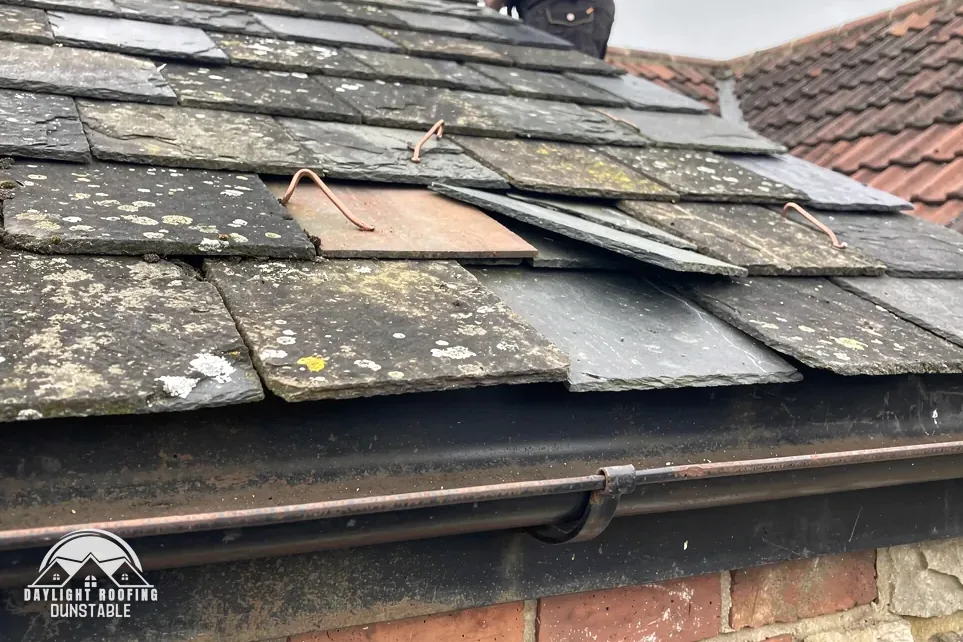
When a nail fails the slate above it loses its hold and slides down the slope until the course below catches it. From the ground the roof can look sound for a long time, then a slate drops into the garden. A batten that has split along a nail line can release several slates in a row, which is how one dropped slate becomes a patch.
- one slate hanging below the line of the rest
- a course that no longer lines up
- a gap with the batten showing
- slate fragments lying in the garden
Our guide to slate roof problems shows how nail fatigue and slipped slates look in practice. How slates are fixed is covered by BS 5534:2014+A2:2018, the current code. Cupa, a slate producer, says hook fixings are not used on any pitch below 25 degrees, which is one reason the pitch of a roof matters when slates are chosen. The fixing method is worked out for the individual building.
Lead, ridges and valleys age on a different schedule
Slate covers the slopes, and other materials seal the places where slopes meet each other or a wall. Lead lines valleys, forms the aprons around chimneys and tucks beneath slates at abutments. MyJobQuote says correctly installed lead flashing can last for over 80 years, so well-fitted lead can sit through a re-slate and go on working.
That statement has a condition in it. Correct installation is part of the claim, and it does not become a promise for the lead on your roof. An apron that has split, lifted or been smeared with mastic needs attention at any age, and a slate roof with failed lead can let water in while the slates beside it are sound.
Ridges and hips cap the roof along the top. Marley says that since the 2015 amendments to BS 5534, mortar "could no longer be relied upon as the only means of securing the roof covering". A separate standard, BS 8612:2018, covers dry-fixed ridge pieces, hips and verges. Older mortar bedding can crack and loosen, so a ridge may need work years before or after the slates beneath it.
From the garden, run binoculars along the ridge. A line that dips, a cracked joint or a ridge piece that has shifted deserves a photograph, and take it with your feet on the ground, never from a ladder against the slope.
How an ageing slate roof shows wear
A slate roof tells its age in small signs, and a long enough run of them adds up to a reason for a survey. Slates can crack across the middle, chip along the lower edge or break in a fresh line where a foot has been placed on them. They can also flake along their layers, so that thin sheets lift from the face and leave a rough, pale surface.
Moss and lichen settle on slate that stays damp, and they show where water lingers more than they show failure. On jet washes, Marley says: "The use of high powered jet washes is not recommended as it can damage the surface of the slate or tile, thus reducing its expected life considerably". Soft brushing and a patient hand do less harm than a lance.
| What you can see | What it can point to |
|---|---|
| A slate that has dropped | A fixing that has failed |
| Slate flaking in thin sheets | A slate near the end of its life |
| Broken slates in a line | Foot traffic on the roof |
| Staining below the eaves | A gutter or valley that has overflowed |
Keep your own feet off the slope. Slate is brittle, and a wet slate is slippery. When the signs start to add up, our guide to repairing or replacing a slate roof describes how the choice is made.
Reclaimed slate and the second life of a roof
HomeBuilding lists reclaimed Welsh slate at 50-80 years, the shortest of its three natural slate entries, and gives no reason for the order. A reclaimed slate has already served one roof, so what it has left comes down to its condition, and each one is judged by eye. Slates with cracks, soft edges or old nail holes in the wrong place are set aside before the roof is laid.
The same thinking applies within a single house. When a roof is stripped and relaid, sound slates can go back onto new battens, with broken ones swapped for matches. That route needs enough good slates to finish the roof, which is only known once the covering has been lifted and sorted.
A relaid roof does not restart the clock on the slates themselves. It does restart it for the timber, the underlay and the nails below, and those are the parts that decide how long a slate roof goes on working. Treat the roof as a set of parts with different lives, and the price of renewing the worn ones stays in proportion.
Where slates can be reused, the saving shows in the slates that never need buying, while the labour of stripping and relaying remains. Ask what share of the existing slates the survey expects to keep, and how many spares are needed for later repairs.
When to ask for a survey
Ask for a survey when more than a stray slate has moved, when a stain spreads on an upstairs ceiling after rain, or when the roof has had no attention for as long as anyone can remember. The survey looks at the slates, the fixings where they can be seen, the lead, the ridge, the valleys and the gutters, and it ends in one written price rather than a rough figure said aloud.
A full re-roof is a bigger step than a repair. The Planning Portal sets two limits. Below both, no application is normally needed: "Less than 25 per cent of the total 'building envelope'" is affected and "Less than 50 per cent of the roof is affected". Stripping a whole slope or more passes that second limit, so Building Regulations approval comes into the route.
Separately, a new covering "15 per cent or more" heavier needs approval, and the Portal advises asking an engineer or surveyor beforehand. Which way the weight moves depends on the roof being replaced, so this guide assumes nothing about any material.
For a first look, send photographs on WhatsApp to 07880 284133 or ring 01582 935272. The money side is covered in our slate roof costs guide.