
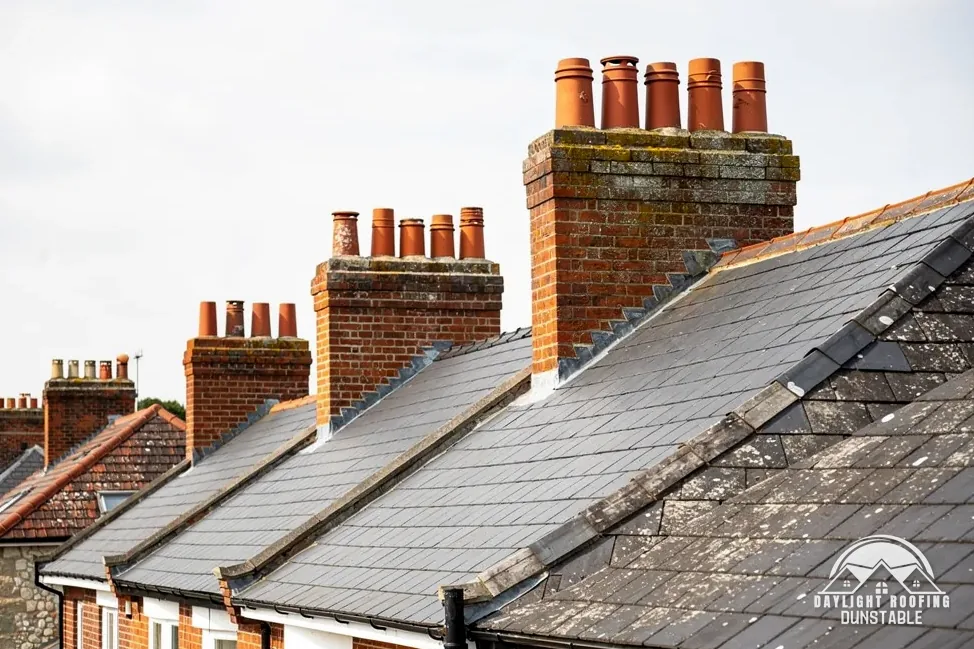
A slipped slate and the gap it leaves
Each slate is held at its head by nails driven into a timber batten, and the course above overlaps it. If the nail lets go, the slate slides down until something stops it, leaving a gap at the top and a tail that no longer lines up with its neighbours. From the garden it shows as a slate sagging below its course, or a dark gap where one ought to be.
The gap matters because slates are the outer of three layers that keep rain away from the house: the slate, the underlay and the roof space. A slipped slate lets rain onto the underlay, and an underlay that is old or torn may pass it on to the timbers and the ceiling. A slate that has dropped altogether can also land on a path or a person.
| See | It can mean | Do |
|---|---|---|
| One slate sits low in its course | A nail has let go | Photograph it and watch the neighbours |
| A dark gap in the slope | A slate has gone altogether | Check the ceiling below after rain |
| Slate pieces on the ground | A slate has broken and fallen | Keep people away from that edge |
A single slipped slate on a sound roof is a small job. Several in different places are another matter, which the section on nail fatigue below explains. Stay off the slope, and study it from the ground with binoculars.
Cracked, chipped and flaking slates
Slate can crack across its width, chip along its lower edge or split in a line from a nail hole. A foot on the slope is one cause, because slate is brittle and a step can break a slate that looks sound from above. A branch, a ladder or a tool dropped from a scaffold can do the same, and the damage may be invisible from the ground.
Slate can also flake along its natural layers. The surface lifts in thin sheets, which show as pale, rough patches or small flakes lying in the gutter. A slate in that state has lost thickness and strength, and it can break at the next knock. Flaking across many slates points to age, not to one accident.
A cracked slate lets water run through the crack onto the batten and underlay below. A small crack does not necessarily leak, since the course below can carry the water away, but cracks spread and should not be left to find out. Where a crack follows a nail hole, suspect the fixing as well as the slate.
Look along each slope in low sunlight, when a slate that is cracked or lifted throws a different shadow from its neighbours. Mark any you find on a photograph. Our guide to how long a slate roof lasts puts these signs in the wider picture of age.
Nail fatigue: the fault behind a run of slipped slates
Nail fatigue describes fixings that have worn out. A nail can rust along the stretch that sits in the timber, work loose in a softened batten or saw through the slate beside its hole. When one slate slips for that reason, its neighbours were fixed in the same manner, and they are candidates to follow.
The warning is a pattern. Slates that slip in several places, a slate that slips again after being replaced and slates found cracked at the nail hole all point to the fixings. Because the nails and the battens may wear out well before the slate does, the face of the roof can look sound while what holds it up has run its course.
- slipped slates in more than one place on a slope
- a replaced slate that slips again
- cracks starting at nail holes
- rust streaks below a slate's lower edge
A repair that suits nail fatigue is not slate-by-slate. The covering over the affected slope comes off, the battens are checked and renewed where they are soft, and the sound slates are fixed again, with matches for any that are lost. That is a bigger job than a patch, and our guide to repairing or replacing a slate roof explains how the decision between the two is made.
Tingles and the metal tabs on a slope
Look for a small bright tab under the lower edge of a slate. That is a tingle, a strip of lead or other metal nailed to the batten and bent up across the tail of the slate it holds. It secures one slate without taking the course above apart, and each tab on a roof marks a slate that has slipped before.
For one slate on a sound slope, a tingle is a sensible repair that is over in a short visit. It cannot cure what caused the slip. If the batten beneath is soft or the nail line has rusted, the tingle holds a slate to timber that is itself failing, and the next slate along goes the same way.
A roof that has gathered tingles tells its history in metal. Each is a small repair, and together they can mean fixings that have aged across the slope. Counting the tabs from the ground helps a survey see how many times the same fault has been patched.
Where tingles are scattered over a whole slope, put the question of what comes next. A quote that only adds more tingles addresses the symptom, so ask for a lift and refix to be priced alongside it, and set the two out together.
Ridges, hips and verges along the edges
The ridge caps the roof along its top, hips run down the sloping corners and verges finish the roof at a gable end. Each is built from pieces that meet and need sealing, and each sits where the roof meets the wind and the sky. A faulty one can leak even where every slate on the slope is sound.
Marley says that since the 2015 amendments to BS 5534, mortar "could no longer be relied upon as the only means of securing the roof covering". A separate standard, BS 8612:2018, deals with ridge, hip and verge pieces that are fixed dry. Older work bedded in mortar can crack, and ridge pieces can shift once the mortar behind them has crumbled.
| See | It can mean |
|---|---|
| A cracked line of mortar | Bedding that has aged |
| A dip along the ridge | A ridge piece or timber that has moved |
| Mortar crumbs in the gutter | Pointing breaking up |
| A gap at a gable edge | A verge that has loosened |
Look at ridges and hips from the garden and take a photograph of any piece that seems out of place. Do not climb to look closer. Ridge work can fall due at a different time from the slates below it, so a survey treats each part on its own merits.
Valleys, abutments and the lead that seals them
A valley is the inward angle where two slopes join, and it carries the rain from both. An abutment is where the slope stops against masonry or a dormer cheek. In these places slate alone cannot seal the joint, so lead is dressed into the gap and the slates are cut to fit alongside it.
MyJobQuote says correctly installed lead flashing can last for over 80 years, which is a long time. The claim depends on installation, and it is no promise about your roof. Lead split along a fold, lifted from the masonry or smeared with mastic is a fault whatever its age, and the water it lets in can show indoors some way from the point of entry.
Valleys also collect debris. Leaves and moss held in a valley can block the flow, and water then backs up beneath the edges of the slates. A stain on a ceiling near a chimney or along the line of a valley deserves following up promptly.
From the loft, a torch beam along the timber next to a valley or chimney during rain can reveal a wet patch. That points to the area, and the survey finds the cause. Note where the wet patch sits in relation to the chimney or valley, and keep the note for the survey. Do not lift insulation or push at the underlay, which can make a small leak larger.
The disadvantages of slate, stated plainly
Slate has more than one drawback, and a fair account names them. Cost is the first, as the published figures show: MyJobQuote's slate roof average is about £7,800, and HomeBuilding says Welsh slate on a 65m² semi might reach £18,000. Slate is a covering that has to be budgeted for.
Brittleness comes second. A slate can break underfoot, so a roof that is walked on soon shows broken slates in lines, and a sweep or an aerial fitter should use a roof ladder or crawl board. Pitch is the third: Cupa writes that "hook fixings should not be used on any pitch below 25º", and a low roof narrows the options.
Fixings are the fourth, since the stone can outlive what holds it to the roof. None of this makes slate a poor choice. It means the covering rewards attention, and a small fault caught early costs less than the same fault left to grow.
To have a roof looked at, send photographs to 07880 284133 on WhatsApp or ring 01582 935272. The survey covers the slates, the fixings, the lead and the ridge, and you receive one price in writing afterwards. Our slate roof costs guide sets out the published sums.