
The lifespan figures for each slate
HomeBuilding's new-roof guide, last updated on 30 September 2025, gives an approximate lifespan for each covering it lists. For natural slate it gives Welsh slate as "100+ years", Spanish natural slate as "75-100 years" and reclaimed Welsh slate as "50-80 years". For comparison, it gives clay tiles as 60-80 years and plain concrete tiles as 40-50 years. The guide labels the column as approximate, so the word "approximate" belongs with every one of these figures.
The table sets the figures out. Read the right-hand column as one publisher's approximations, not as a term anyone has promised, and not as a measure of how a particular roof will wear. Marley makes the point in a related setting: of its own tile figure it says "This is not a guarantee or warranty of its longevity." Lifespan figures describe a covering that has been correctly installed and kept in repair.
| Covering | Approximate lifespan |
|---|---|
| Welsh slate | 100+ years |
| Spanish natural slate | 75-100 years |
| Reclaimed Welsh slate | 50-80 years |
| Clay tiles | 60-80 years |
| Plain concrete tiles | 40-50 years |
Neither slate is a bad choice on these figures, and the guide does not say one is better. The two lists overlap between 75 and 100 years, which means a range alone does not separate them. The decision between them is made on price, appearance and what the roof needs, once the survey has said what that is.
Cost, with a size attached
HomeBuilding attaches a roof size to its slate price. The guide works through a standard semi with three bedrooms, whose 65m² roof carries plain concrete tiles; that roof "may cost between £10,000 and £15,000". It then adds that "The cost of a Welsh slate roof for the same property might reach £18,000". The words "may" and "might" are the guide's own, and they stay attached to the figures when anyone repeats them.
MyJobQuote offers a separate figure that carries no house size: "The average cost of fitting a slate roof is around £7,800." Its slate page was updated on 6 October 2026, and the figure is an average from a quoting platform, with no VAT basis given. HomeBuilding's example and the MyJobQuote average answer different questions, so a single sum cannot be built from the pair.
The HomeBuilding example prices Welsh slate. For Spanish slate or reclaimed Welsh slate on the same roof, the figure comes from the supplier's price and the survey, not from a table. The cost of any natural slate roof also depends on how the roof is reached, the shape of the slopes and what lies under the old covering, so the price we give is one total, put in writing after the survey, never a rate per square metre.
You might hear
A slate price in a guide is the price of your own roof.
Plain as day
A guide prices one example roof. Yours is priced from its own survey.
Reclaimed Welsh slate and what to ask
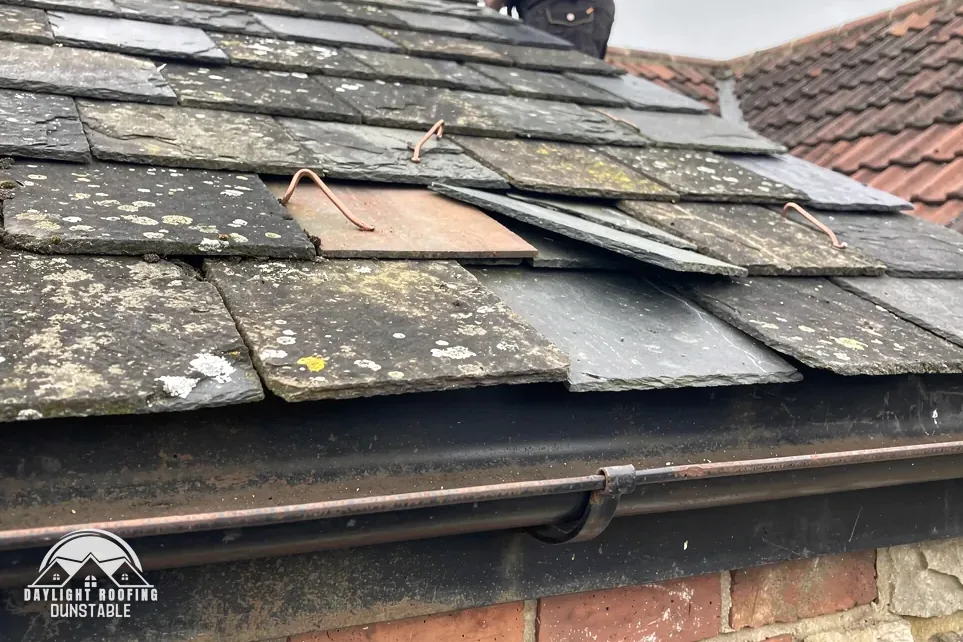
Reclaimed Welsh slate sits in HomeBuilding's list with an approximate lifespan of 50-80 years, which is the shortest of the three natural slate entries. That figure is for a slate that has already served on another roof, and the guide lists it below the figure for Welsh slate without giving a reason. Where the reclaimed option can appeal is in matching an existing roof, because the slates are already weathered and the council may care about that.
Ask the supplier how the slates are sorted, how many sizes are in the batch, and whether any are chipped or cracked. A roof needs a consistent supply, and a batch that runs short mid-job is a problem for a roof half laid. Ask also whether there is a spare quantity for later repairs, since slates from the same source are easier to match than slates bought a few years later, and settle who keeps the spare stock once the job is complete.
A reclaimed slate roof is laid to the same code as a new one, and the structure beneath is checked in the same way before any covering goes on. Our guide to natural against man-made slate sets out the wider choice of coverings for anyone still deciding between them.
Pitch and fixings: what a slate needs from the roof
A slate roof is only as sound as the fixing, and the standard for it is BS 5534:2014+A2:2018, which is current. Marley says installing to BS 5534 "isn't required by law", and that since the 2015 amendments mortar "could no longer be relied upon as the only means of securing the roof covering". Fixings follow a site-specific fixing specification that allows for how exposed the roof is.
Pitch is the part of the standard that shapes the choice of slate most. Cupa Pizarras, a slate producer, reports that BS 5534 "also indicates that the minimum roof pitch for natural slate is 20 degrees in the case of a project situated in an area with moderate exposure and with a slate 500mm long and a 115mm overlap". It adds that "hook fixings should not be used on any pitch below 25º".
These come from Cupa's reading of the standard. Slate length, overlap and exposure all move them, and a roof can only be tested against them once its real pitch has been measured. They are the same for Welsh and Spanish slate as far as these sources go. The guide to the minimum pitch for slate covers pitch in detail.
Conservation areas and matching across both counties
Re-roofing a house is normally permitted development under Class C, which covers "Any other alteration to the roof of a dwellinghouse", and a conservation area does not remove it. Three things can: an Article 4 direction, a listing, or a block of flats. Across Hertfordshire and Bedfordshire, each council holds its own list, and what each says differs.
North Herts Council describes the Hitchin and Stockens Green directions as covering "alterations to a roof of dwellinghouse", among other matters. For St Albans, the district council's page lists four main Article 4 areas and links to pages saying what each one removes. Central Bedfordshire Council's own list is more specific: Fairfield's direction takes in roof enlargements such as dormers, while the lists for Toddington and Husborne Crawley carry no roof item at all.
For slate, matching is something to raise with the council before the slates are ordered, in writing, with photographs of the existing roof attached. Describe the existing slate and the one proposed, and ask whether the council expects a particular type. A listed house needs listed building consent for works done "in any manner which would affect its character as a building of special architectural or historic interest". None of this says that any of these places has more slate than another.
Building control and who checks a slate re-roof
A complete re-roof touches over half of the roof area, which brings the Planning Portal's main page into play: "In most situations, this work will need Building Regulations approval." Its interactive guide gives the limits for work that "normally" needs no application as "Less than 25 per cent of the total 'building envelope'" and "Less than 50 per cent of the roof is affected". The Portal also brings in approval where a covering is 15 per cent or more heavier than the old one.
In Central Bedfordshire, which includes Dunstable, the council runs its own building control team on 0300 300 8635, a line for building control, not planning, enquiries. Hertfordshire Building Control Ltd is the provider for North Herts addresses, with North Herts Council among its owners. St Albans and Watford councils run a shared building control service. A registered building control approver is the other route anywhere.
Building control looks at the specification, so the slates, the battens, the underlay and the fixing method are all set out for it. The guide to slate roofs and building regulations explains the tests. The weight of one covering against another is not a point to settle by assumption, and any structural check the Portal mentions is made on the actual roof, with the actual covering named.
Scaffold, the survey and the written total
Central Bedfordshire Council licenses scaffolding on its roads; we arrange the licence with our scaffolder. Hertfordshire County Council charges £134 for a 14-day scaffold licence and £59 for each week beyond that. On timing, the council says: "It usually takes 3 weeks to process an application." The fee is the council's own published figure, and the sum is not a charge for hiring scaffold.
Whichever slate is chosen, the survey comes first, and the survey is also when a chosen slate meets the real roof. Before quoting, we survey. The report that follows is plain, covers anything else seen on the slopes, and comes with a single written total price. The survey is where the fit between a given slate and a given roof is judged, and where reclaimed stock, if chosen, is weighed against the roof's real needs. The survey is where the pitch, the structure and the condition of the battens are looked at, and where a choice between Welsh, Spanish and reclaimed slate becomes a priced option.
Photos of the slopes can be sent to WhatsApp on 07880 284133, and we look at them. The slate roofing hub takes in new slate roofs, repairs and the wider questions around them, and choosing between the slates in this post is one of the earliest.
One written total
What shapes a slate price
The slate chosen, how steep and large the slopes are, how scaffold gets to them, and the condition of the old battens and timbers under them all count. One written total follows the survey.