
The short answer
Yes, a chimney stack can be taken down above the roof line. The brickwork is dismantled, the flue opening is covered and the roof covering is made good around the gap. Planning, Building Regulations and a party wall notice may all come into it, so check each route before work starts.
What taking the stack down to roof level involves
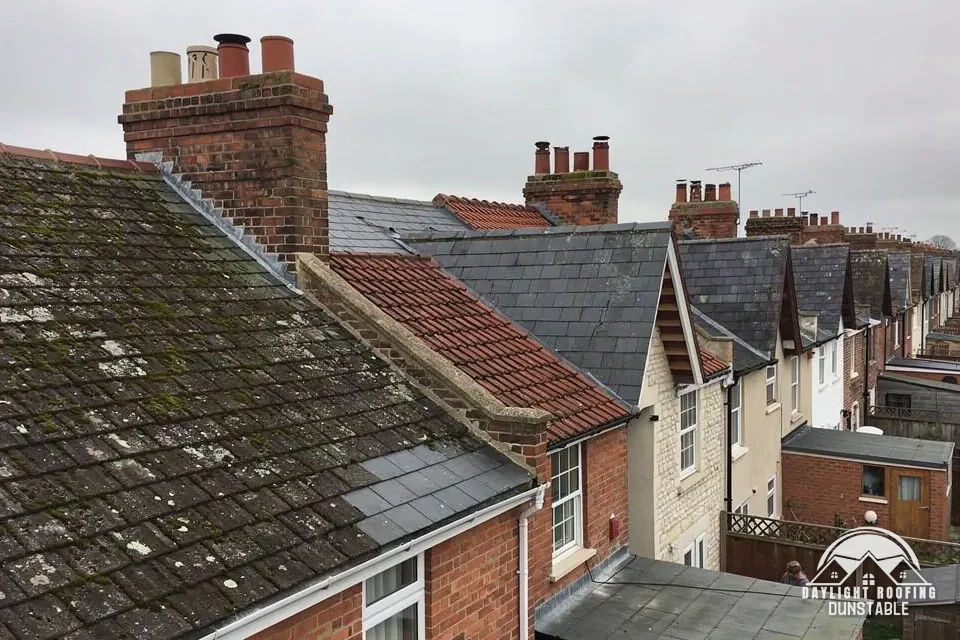
The stack is the brick column standing proud of the roof slope, topped with pots bedded in a mortar flaunching. Taking it away means dismantling the brickwork course by course from the top, lowering the material to the ground and stopping at or just below the roof line. Scaffold has to stand safely around the work, because bricks and mortar are heavy and a stack cannot be pushed over in one piece.
When the brickwork is down, the roof has to be closed up. The flue opening needs a covering so rain cannot reach the room below, and the tiles or slates around the gap are rebuilt and sealed, including any lead flashing that sat at the foot of the stack. If that step is rushed, the roof leaks in the spot where the chimney used to be.
Inside the house sits the breast, and it is a separate matter. The stack can come down with the breast left standing below, and the reverse is possible too. Taking out the breast is a bigger structural job with its own rules, which our guide to chimney breast removal regulations sets out. Decide at the survey which parts of the chimney you want to keep, so the quote and the building control question cover the right work.
Planning, building control and a shared wall
Three routes can apply to a stack removal. Each depends on the house and on what comes out: planning, Building Regulations and a party wall each have their own starting point and their own body to ask.
| Route | What to check |
|---|---|
| Planning | Class C excludes altering or replacing a chimney |
| Building Regulations | Building Regulations approval always applies to a breast |
| Party wall | Notice at least two months ahead for cutting away |
On planning, the permitted development right for re-roofing is Class C, and C.1(d) excludes the installation, alteration or replacement of a chimney, flue or soil and vent pipe. A call to the council is the safe step, and more so for a listed building, a conservation area or a street under an Article 4 direction. Our page on planning permission to remove a chimney goes through the questions.
Where the stack sits on a wall that is shared, the Party Wall etc. Act 1996 may apply, and the building owner serves the notice on the neighbour. Section 2 of the Act lists cutting away a projecting breast, jamb or flue from a party wall. Building control is a different body and does not advise on party walls: a party wall surveyor does.
Cost, scaffold and planning the job
MyJobQuote (page last updated 03/11/26) gives £2,500 or so as the average for a breast on its own, and around £3,000 to £3,500 for stack and breast together. Those figures describe a full removal, not the part above the roof alone, so they show the scale of the work rather than a price for any one house, and a survey is what fixes the number. Our chimney repair costs guide covers what moves a chimney price.
Scaffold belongs in the plan for any stack, as the work is done at height. Section 169 of the Highways Act 1980 requires a licence for scaffold that obstructs a highway; we arrange the licence with our scaffolder. Our quote for the removal arrives in writing after the survey, with the scaffold counted inside the one figure.
Our chimney repairs hub covers the other jobs on a stack, from pots and flaunching through to rebuilding, so you can see where a removal sits among them. If the stack is leaning or the brickwork is crumbling, a repair or a rebuild may be the better answer, and the survey is where that gets decided. To start, send a photo of the chimney to WhatsApp on 07880 284133, or ring 01582 935272 to arrange the survey.