
The short answer
A leaning chimney can sometimes be repaired, but a survey has to decide between repair and rebuild. A lean can come from failed mortar, a crumbling base or movement beneath the stack, and a stack that is moving may need to come down and be rebuilt. Keep people away from beneath it meanwhile.
Reading the signs from the ground
A chimney stack is meant to stand square to the roof. Stand well back in the garden or the street and look along each face of the stack, comparing its edges with the vertical lines of a window frame or a neighbour's wall. A lean is easier to see against a straight reference than against open sky, and a second photo from the same position a month on shows whether it is changing.
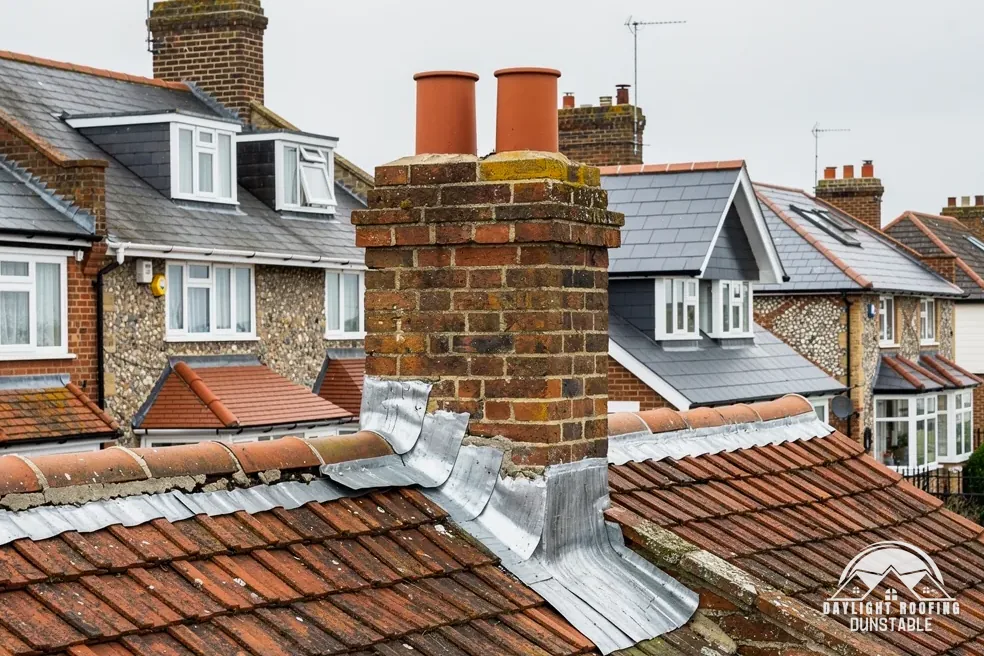
A lean can come with other faults. Look for open joints where mortar has washed out, bricks that bulge or sit proud of their neighbours, a pot at a crooked angle, and a flaunching with cracks running through it. Joints that have lost their mortar let a stack shift a little with each hard winter, and nobody indoors would notice. Inside the house, a damp patch or stain on the chimney breast, or plaster that has blown, can point to water entering higher up. Each of those can be a reason the stack has moved, or a result of the movement.
Open joints, bulging brickwork, cracks at the base and a stain on the breast each carry a range of meanings. None of them is a diagnosis, because several causes can produce the same picture, which is why the stack has to be looked at up close.
| Sign | What it can mean |
|---|---|
| Open or hollow joints | Mortar has weathered away |
| Bulging brickwork | The stack may be losing its bond |
| Cracks at the base | Movement where it meets the roof |
| Stain on the breast | Water getting in above |
Repair or rebuild, and who decides
Where the lean is slight and the brickwork is otherwise sound, repair may be possible: repointing the joints, renewing the flaunching and checking the flashing at the base. Where the stack has moved because the bricks have lost their bond, or because the base is crumbling, rebuilding from the roof line up is the likelier outcome, since new mortar cannot pull a leaning column back into line.
That choice is made on a survey, not from the ground. A roofer looks at the stack close up, from scaffold or a safe platform, taps the joints, checks how far the lean has gone and looks at what the stack sits on. If the movement might start in the wall or breast below the roof line, ask a structural engineer or building surveyor, because roofers repair roofs and stacks and do not report on how the house is built. Where the survey turns up a worry of that kind, you are told, and the next step is yours to take.
Our guide to repairing, rebuilding or removing a chimney compares the three routes, and the page on signs of chimney damage covers the faults that sit alongside a lean.
What to do while you wait
Treat a visible lean as a safety question. Keep children, pets and parked cars away from the foot of the wall below the stack, and do not use a fireplace that rises through a stack you think is moving. Bricks and a heavy pot can fall in strong wind, so a stack that has moved noticeably is worth getting looked at soon, not at the next convenient date.
Send a photo to WhatsApp on 07880 284133 or call 01582 935272, and say which side of the house the stack is on and whether the lean has changed. A photo taken from a distance, showing the whole stack against the roof, helps more than a close-up of one brick, and a second shot from the side shows the direction of the lean.
The written price follows the survey as one figure for the work, with scaffold inside it where the stack needs one. Should that scaffold stand over the pavement or the road, we arrange the licence with our scaffolder, and the whole job stays inside the one sum. The main chimney repairs page lists the other jobs that can be done on a stack.