
The short answer
It depends on how high the stack stands, how the roof can be reached and what the repair involves, so a survey settles it. A small job to a low stack may need less than a rebuild at height. Where scaffold obstructs a pavement or road, the highway authority has to license it.
What decides whether a scaffold goes up
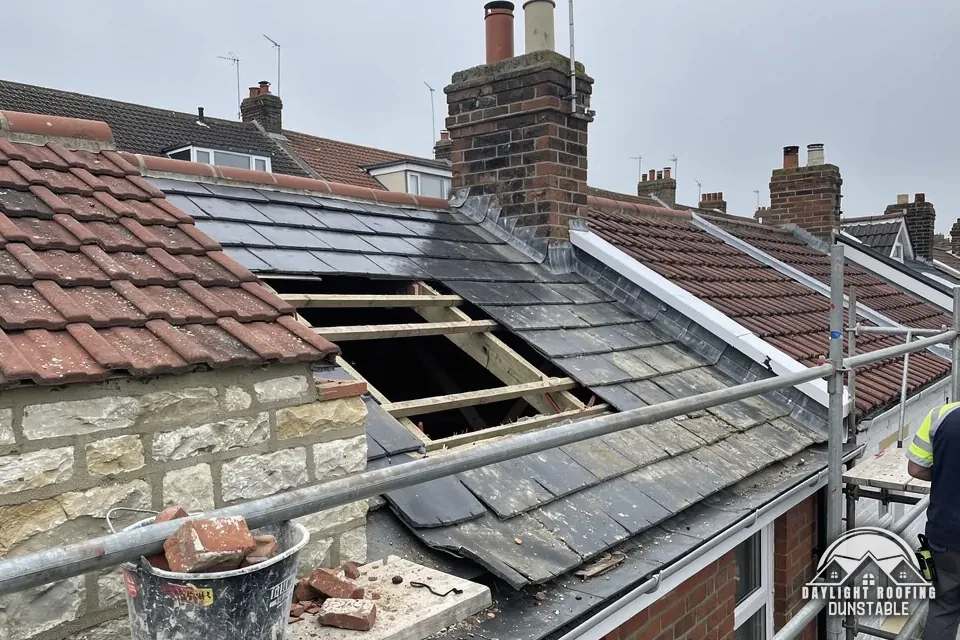
A stack can be the highest point of a roof, and the person working on it needs a safe, level place to stand, a way to reach the top and protection from a fall. Scaffold gives all three. Whether a particular job needs it comes down to a handful of things that a roofer weighs up at the survey, and a photograph alone cannot settle any of them with certainty. Each is set out below, so you know what the survey will be looking at.
The first is height. A stack that rises from the ridge of a tall house sits far above the ground, while one on a low extension is closer to the eaves. The second is access: a clear garden at the back is easier to work from than a tight alley or a front wall that rises straight from the pavement. The third is the job. Replacing a pot is a lighter task than rebuilding the brickwork from the roof upwards.
| Factor | Effect on the decision |
|---|---|
| Height of the stack | Higher stacks call for a safer platform |
| Access to the roof | Tight or sloping ground limits other options |
| Scale of the work | Rebuilds need more room than a new pot |
| Roof pitch and condition | A steep or fragile slope raises the stakes |
Scaffold on the pavement or road
When a scaffold stands where it blocks a footway or carriageway, section 169 of the Highways Act 1980 requires a licence. It is a scaffold licence under the Highways Act, and it sits apart from planning permission and Building Regulations. We arrange the licence with our scaffolder, and the work is not held up waiting for the homeowner.
Which body issues the licence depends on the address. Central Bedfordshire Council licenses scaffolding on its roads, which takes in Dunstable, and in Hertfordshire the county council holds that role, apart from Broxbourne. Hertfordshire County Council says: "It usually takes 3 weeks to process an application." A job on a pavement can therefore wait on a lead time that sits outside the roofer's own diary, which is worth knowing when a leak makes you want a quick start.
Trunk roads are a different case, and National Highways is the authority for them. A house on a trunk road, a motorway slip or a main road under that agency's control raises a separate question, which the survey will bring out. Scaffold that stands wholly on your own land, clear of the footway, needs no highway licence at all.
How scaffold sits in the price
Scaffold is part of the written quote where a job needs it, and a stack rebuild is the clearest example, and the quote is one total price after a survey. It is not something added or taken off afterwards. The reason to ask about scaffold at the start is that it can move the figure a good deal, and the survey fixes the number.
MyJobQuote gives a sense of how far. On chimney leadwork alone, it says a full leadwork replacement costs "between £350 and £920, depending largely on whether scaffolding is required" (page last updated 22/09/26). That range is for lead around a chimney and is not a price for a rebuild or any other job, but it shows scaffold can account for much of a small chimney bill.
Our guide to chimney repair costs covers what else moves a price, and the chimney repairs page lists the jobs. For lead specifically, see chimney flashing and leadwork. You can send a photo to WhatsApp on 07880 284133 before the survey, so the access can be seen early, including how close the stack is to the front of the house and whether side access exists.