
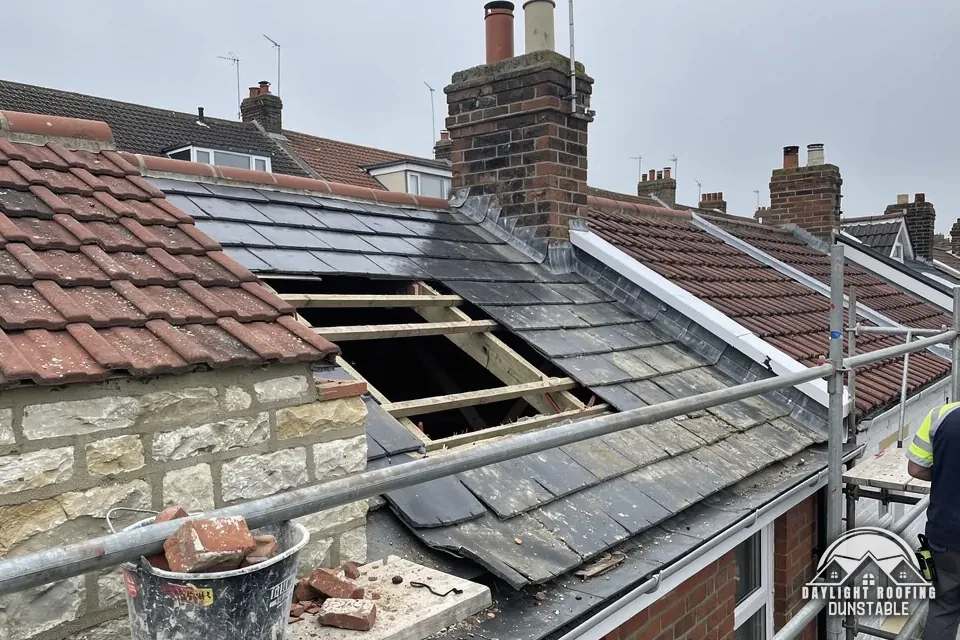
The short answer
Insurance for chimney damage turns on the terms of your own policy and the cause. A gale-hit stack may be a storm claim, though nobody can promise one will succeed, and the Financial Ombudsman Service says rain, hail or snowfall by itself can constitute a storm, so wet weather alone is not ruled out. Photograph first, move nothing, and report it to the insurer.
Why the policy wording decides it
A home policy is a contract, and what it pays for is written into it. Chimney damage can fall under different headings depending on the cause. A stack brought down in a gale may be a storm claim, brickwork that has weathered over decades may be treated as wear, and a leak that follows a loose flashing may turn on how the policy words sudden damage compared with gradual damage.
Two documents are worth reading: the schedule and the policy booklet. Check the list of insured events, the exclusions and any excess figure. Some policies set conditions about upkeep, and an insurer may ask whether the chimney was in sound order before the event. That is no reason to skip a claim; it is a reason to read before you ring.
No roofer can tell you in advance that a claim will succeed, and the decision is not ours. A roofer can make the damage safe and describe what has happened to the stack, in words you can pass on. Four questions to the insurer, on storm cover, exclusions, the excess and the evidence wanted, keep the call short and put the answers on paper.
| Ask | Why |
|---|---|
| Is storm damage an insured event? | Chimney damage may fall under it |
| What are the exclusions? | Wear and gradual damage may be listed |
| What is the excess? | It affects whether a claim is worth making |
| What evidence is wanted? | Photos and a report may be asked for |
What the ombudsman says about storms
The Financial Ombudsman Service settles complaints about insurers, and its page on storm damage is the clearest public statement of how it thinks. It says: "We say that a storm usually involves violent winds, usually with rain, hail or snow." It then adds: "Rain, hail or snowfall by itself can constitute a storm." The first line describes the familiar picture, and the second leaves room for weather that is wet or cold without being windy.
On evidence, the same page says its staff "usually look at expert reports and photos", and that the insurer "will normally ask a surveyor to write a report". It also says: "The insurer has to prove that the exclusion applies - for example, with an inspection report." The burden therefore sits with the insurer and not with you.
None of this settles a particular case. A complaint is judged on its own facts, and a chimney that fell on a calm day after long neglect sits differently from one that came down in a gale. Our page on chimney repairs and home insurance goes further into how a claim is put together.
Steps for now, and where to complain
Take photographs of the damage from the garden and, if there is a stain or fallen debris, from indoors too, before anything gets shifted. Make the area safe and stay clear of a stack that has moved. Ring the insurer soon, and jot down when you rang and who answered. Should a roofer make the stack safe, keep the invoice and any pictures, since an insurer may ask to see what was done and why it was needed.
If the claim is refused or the offer looks low, complain to the insurer in the first place. The ombudsman says: "For most complaints, a business has up to 8 weeks to consider a complaint." Once a final response has been sent, 6 months from the date on it is the window for taking the dispute to the Financial Ombudsman Service, on 0800 023 4567. The 8 weeks and the 6 months are separate, and the longer period is counted from the final response only.
Our signs of chimney damage page helps you put into words what you can see, and the chimney repairs hub lists the repairs themselves. To start, send photos to WhatsApp on 07880 284133 or call 01582 935272.