
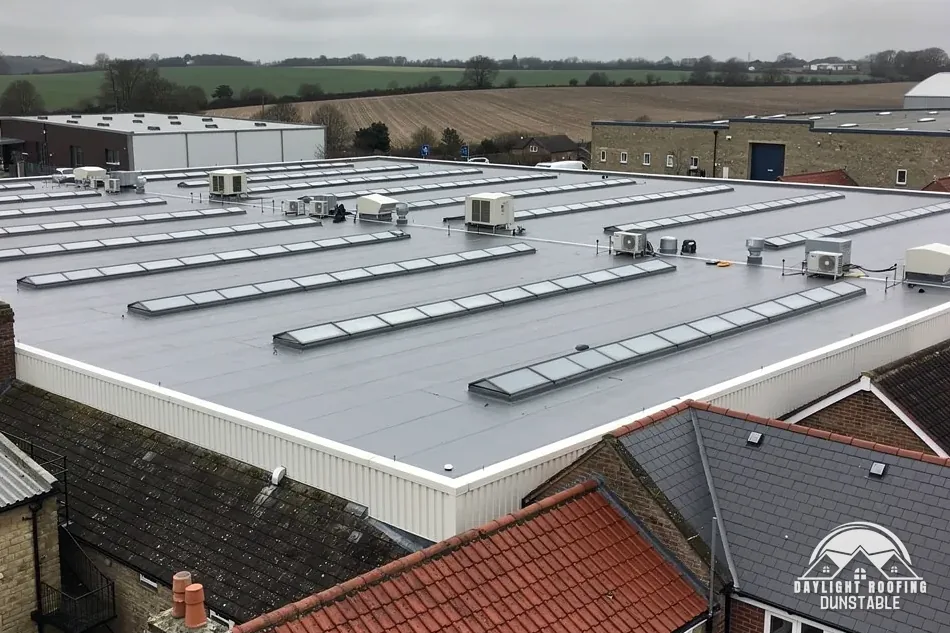
Why a commercial roof has no standard price
A house roof has a handful of familiar shapes. A commercial roof can be a steel-clad portal frame with a hundred metres of sheeting, a flat membrane over a parade of shops, a run of rooflights in a factory, or a mixture of all three added over several decades. Two buildings with the same floor area can need very different work, so a rate per square metre taken from a website says little about either of them. A food unit, a workshop and an office block under one owner can sit on three different structures, each with its own covering.
Cost guides for houses carry their own sources and dates elsewhere on this site, and a house figure cannot simply be carried across to a unit or an office block. A commercial job gets its price when the survey is complete, and the outcome is a single written total.
- How big the roof is, and how many separate areas it has
- How high it stands and how people and materials reach it
- What the covering is made of, and what lies beneath it
- Whether any of it is fragile or may contain asbestos
- Which rules apply to the project, and who carries the duties
Those five are what moves a commercial price. Each one changes what a roofer has to look at before a figure can be written, and a quote that ignores one of them is worth questioning.
Area, height and access
Size is the obvious driver, but the measurement that matters is the roof's true surface, with its upstands, parapets, valleys and any change of level, and not the footprint on a plan. Every junction between one area and the next has to be detailed by hand, so a roof cut into many small areas takes more labour than one plain slope of the same total size.
Height and reach decide how people and materials get onto the roof and how everyone is protected while they work. A low unit with a clear yard beside it is a different proposition from a shop on a high street with a pavement beneath. Where scaffolding stands on a pavement or road, a Highways Act 1980 scaffold licence from the highway authority is needed, and we arrange the licence with our scaffolder, with the scaffold forming part of the single price you are given.
Plant on the roof, such as extraction fans or air handling units, may need isolating or lifting aside, and that work belongs in the programme. Trading hours and neighbours count as well. A roof over an open shop, a classroom block or a store full of stock affects the order in which the job can be done and what has to be shielded, and the quote has to reflect that order. The survey is where those practical points are looked at, and they are the reason two firms can price one roof differently.
The covering: membrane, sheet or felt
The existing covering and the new one both move the price, and the choice between repair, overcladding and full replacement is made on what the survey shows. EPDM and TPO are the membranes that single-ply refers to, whereas GRP and built-up felt are laid and detailed differently from single-ply. The page on single-ply membranes describes the family.
Flat and low-pitched roofs also depend on how water leaves them. BS 6229:2025 is the current edition of the code for flat roofs covered with continuously supported flexible waterproofing, and NFRC reports that it sets "a minimum 1:80 finished fall for general roof areas and internal gutters". A roof that falls short may need tapered insulation or changes to the build-up, and a survey finds that where a photograph cannot.
| Covering | What the survey looks at |
|---|---|
| Profiled metal sheets | Fixings, laps, coating, cut edges |
| Single-ply membrane | Seams, upstands, drainage, deck |
| Built-up felt | Blisters, splits, wet insulation |
| Cement sheets | Material, breakage, fragility |
Insulation and rooflights bring further items of their own, and the survey checks where each of them sits on the roof. Overcladding means fitting a new weatherproof layer over the old one. A survey can raise it as an option, but only where the old covering and the structure beneath are sound enough to carry the new layer.
Fragile sheets and asbestos change the job
HSE's guidance says "AC roofs are always fragile", and it advises "If the building was built or refurbished before 2000, assume that there is asbestos in it." On an older unit, a cost question therefore begins with what the sheets are made from. Until that is known, the roof is treated as fragile and nobody walks on it.
HSE sorts asbestos work into groups, and the group sets the route and so the price: non-licensed work, notifiable non-licensed work, and licensed work. Whole cement sheets handled carefully fall in the first. Sheets broken by a storm or a fire move towards the second. Most work on insulating board is in the third. Each group carries its own requirements for notification, equipment and waste. A roof that has been patched, extended or fitted with plant can hold sheets of different ages, and those can fall into different groups, so each area is assessed and not the building as a whole.
Waste has its own rules, and one of them is HSE's "Use a lockable skip for asbestos". A price has to allow for these requirements, which is why no figure can be named before the material is identified. The page on fragile roofs and asbestos cement sheets takes the HSE groups one at a time, and the written price follows the assessment and the survey.
CDM duties and the plan for the project
A commercial roof job is construction work, so the Construction (Design and Management) Regulations 2015 apply. Every project has "a construction phase plan", and if several contractors share the project, one of them is appointed principal contractor. The plan covers the way on to the roof, the guarding of edges and openings, keeping the public and neighbours clear, and the route waste takes off the site. A plan written for this roof names its access, its edges and its hazards; a generic page of headings does not.
None of this is an optional extra that can be priced out. It is how the job is run, and it shapes the programme, the equipment and the number of people on the roof. A quote that says nothing about access, edge protection or the plan leaves questions open that the customer would do well to ask, and the customer is entitled to ask what the plan says about their own roof.
- How will people and materials reach the roof?
- What guards the edges, the rooflights and any fragile areas?
- Who is the principal contractor, if there is more than one contractor?
- What happens to waste, and where does it go?
The page on commercial roofing regulations explains where these duties come from and how they fall.
VAT, the reverse charge and the invoice
Between VAT-registered businesses, building work can come under the domestic reverse charge, which HMRC ties to services reported through the Construction Industry Scheme. Its technical guidance adds that the charge "does not apply for supplies to end users". In HMRC's terms an end user is a business registered for VAT and the Construction Industry Scheme that does not supply the work onwards, and the exclusion applies once it has told its supplier so in writing. Which side of the line a customer sits on changes how the invoice is made out, so it is worth settling before work starts, and the written quote is the place to confirm it.
A tenant paying for a roof repair, a landlord with a portfolio and a business that owns and occupies its premises can each stand in a different place. That is a matter for the customer's accountant or for HMRC, and this guide points to the question without answering it. The point to carry away is that the position should be known before the job starts and not discovered when the first invoice arrives.
Insulating a roof or loft in a home is zero-rated under HMRC's Notice 708/6 for installations "made between 1 May 2023 and 31 March 2027", with the reduced rate of 5% after that. The notice is written around homes and energy-saving materials, so ask the accountant how it applies to a commercial building before assuming that it reaches one.
Reading a quote: what to compare
Two quotes for the same roof can differ widely, and the figure at the bottom is the least informative part of either. The wording on covering, area, access, the fragile or asbestos position and the project's duties shows whether two firms priced the same job. Where one quote is silent on a point and another is specific, the gap deserves a question.
- Is the covering named, and is the area it applies to stated?
- Does it say how the roof will be reached and protected?
- Is the sheet material identified, and is asbestos addressed?
- Does it say what is repaired and what is replaced?
- Is the total one figure, in writing?
That last point is how we work. Before any figure, the roof is surveyed. You then hear plainly what was found, other faults on the roof included, and receive a single written total. We will look at any photo sent to WhatsApp (07880 284133), and that is where a conversation can begin. The age of the building, the covering if it is known and the presence of rooflights are useful details to send with it.
The commercial roofing hub sets out the work taken on, from repair to replacement. The cost follows the survey, and the survey follows that first conversation.