
Start inside the building, under the roof
The underside of a roof is the quickest place to read its condition, and it is safe to check without going near the edge. Walk the floor under the roof once in dry weather and once during rain, looking up. Water need not drop straight below the hole in the covering. It can run along a purlin, a liner or a steel rafter and falls where the run ends, so a drip can sit several metres from the point of entry.
Things to look for on the ceiling, liner or underside of the sheets are brown or rust-coloured stains, bubbling or flaking paint, damp insulation hanging from a liner, and pinpricks of daylight where two sheets meet or around a fixing. A roof that drips only in cold weather can have condensation, not a leak, and that points to a ventilation or insulation problem, which needs a different answer.
| You see | It can mean | Do this |
|---|---|---|
| Brown stain on liner | A slow leak at a lap or fixing | Note where, then look from outside |
| Daylight at a sheet join | An open lap | Photograph it and ask for a survey |
| Drips in cold weather only | Condensation | Check ventilation and insulation |
| Sagging liner | Trapped water above | Clear the area and report it quickly |
Keep a note of the date, the weather and the spot for each stain, with a photograph, and pass it on when you ask for help from a commercial roofing contractor. A pattern that follows the wind direction or the line of a purlin helps the surveyor trace the entry point.
Cut-edge corrosion along the sheet ends
Profiled steel roof sheets carry a protective coating on their faces. When a sheet is cut to length, to fit a rooflight or around a vent, the cut face has no coating, and the bare steel can start to rust. The rust spreads inwards from the edge and under the coating, which then lifts and flakes. This is cut-edge corrosion, and the page on what cut-edge corrosion is explains the mechanism in more detail.
What you can see: orange-brown streaks running up from the sheet ends at the eaves, around rooflight openings and along the lap lines; blistered or peeling coating along the edge; staining on the gutters below where the rust-laden water has run off. What it points to: the steel beneath the coating is losing thickness, and if it carries on the sheet can perforate. What to do: a surveyor can tell whether treatment of the edge will hold the sheet or whether the sheet has passed saving.
Corrosion at the edge does not always mean the whole sheet is gone. A line of rust confined to a few edges can sometimes be cleaned back and treated. Broad streaking across the face of several sheets, or holes you can see through, suggests the coating has failed across the roof, which can mean moving towards overcladding or replacement. The page on repair, overclad or replace sets that choice out.
Do not scrape or wire-brush an old roof from above. A corroded sheet can fail beneath a person, and sheets of any age are slippery when wet.
Fasteners that have loosened or rusted
Profiled sheets are held down by screws or bolts with sealing washers, and a roof can carry thousands of them. Each fixing is a hole in the sheet, sealed by its washer. As the washer ages it hardens, splits or loses its seal, and the shank beneath can begin to rust.
What you can see: screw heads standing proud of the sheet; red rust rings around fixings; washers that have cracked, rolled or gone missing; sheets that rattle or lift in wind. Inside the building, rows of small stains running in lines along a purlin can trace a line of failing fixings. What it points to: the sheet is no longer held firmly to the structure, and water can enter at every affected hole. What to do: have the roof surveyed; a fixing problem on a few sheets can be repaired, but fixings failing across the roof point to the covering ageing as a whole.
A loose sheet is also a safety matter. Wind can lift sheets that have lost fixings, and a sheet working against its neighbours cuts into the coating at the lap and begins the next corrosion site.
- screw heads raised from the sheet surface
- red rust rings at fixings
- cracked, rolled or missing sealing washers
- rattling or lifting sheets in wind
- lines of small stains along purlins inside
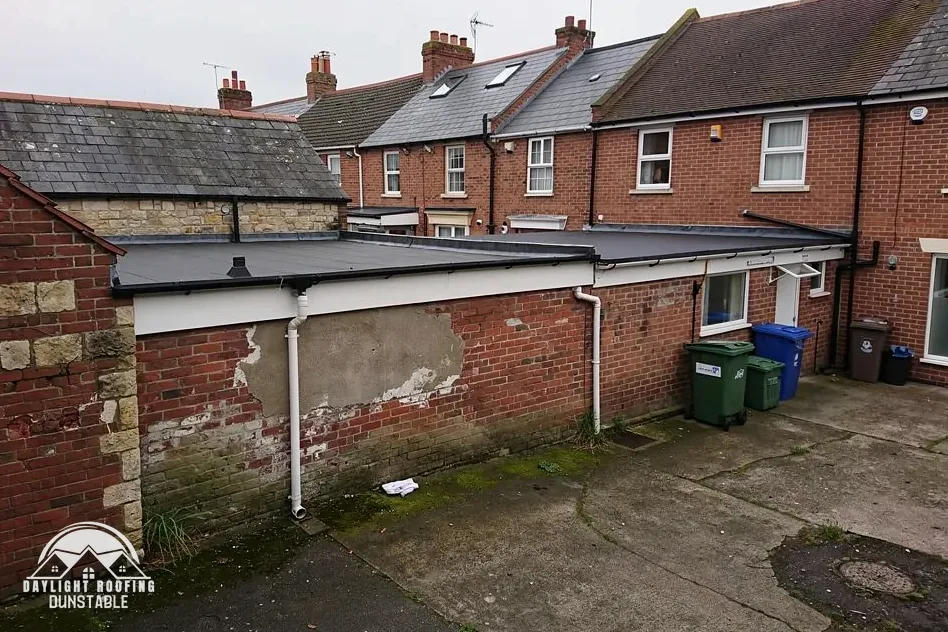
Ponding on flat and low-slope roofs
Ponding is water that stays on a roof after rain, instead of draining to the outlets. On a flat or low-slope roof it is a sign that part of the surface is lower than it should be, or that an outlet is blocked. A roof of this kind is meant to be built with a fall towards its outlets: NFRC's summary of BS 6229:2025 gives a minimum 1:80 finished fall for general roof areas and internal gutters, and, according to IKO, the code of practice wants a design fall of 1:40 so that 1:80 is reached once built.
What you can see: pools still standing well after the rain has stopped; a tide mark or a ring of dirt where a pool has dried; algae or moss growing in a patch; grit and silt gathering at a low point; outlets with debris over them. What it points to: a deck that has dipped, a settled support, insulation that has been crushed, or an outlet that cannot take the flow. A membrane that sits in water for long periods is under more strain at its seams and details. What to do: clear any blocked outlet if it can be reached safely from a stable position, and have the roof surveyed if the pool returns.
Ponding does not mean the roof is leaking, and a roof can pond for years without letting water in. It does mean the roof is working harder than designed, and a surveyor will check the membrane at the pool for splits, blistering and failed seams.
Measuring a fall is a job for a surveyor with the right level. Water lying in the same spot after a dry spell is a better prompt to call than a guess at the slope.
Split laps and open seams
Where two profiled sheets overlap, the lap is held shut by sealant tape and fixings. On a single-ply roof, the equivalent is the seam, where two sheets of membrane are welded or bonded together. These are the joints a roof depends on, and movement from heat, cold and wind works at them every day.
What you can see: daylight or a gap along a lap; sealant that has dried, cracked or pulled back; a membrane seam with a lifted edge or a visible fish-mouth; dirt trails running down from a joint. Inside the building, a line of staining under a lap points straight to it. What it points to: the joint has lost its seal and water is being driven through it, particularly in wind. What to do: photograph the joint and the staining inside, and have it looked at; a lap or seam repair is among the more modest jobs when the surrounding covering is sound.
A split seam on a membrane roof should not be pressed back down with tape bought from a shop. Membranes of different materials need different adhesives and welding methods, and a wrong product can hold for a few weeks and then peel, leaving a worse edge than before. A repair done properly welds or bonds the seam to the manufacturer's method for that membrane.
Open laps on a sheet roof sometimes appear after a roof has been walked on repeatedly by other trades, for instance during the installation of plant or solar panels. If that has happened, tell the surveyor, since the damage may be more widespread than the stain suggests.
Cracked rooflights and fragile roofs
Rooflights are weak points in an industrial roof, and they are places where people have fallen through. A rooflight panel can crack, craze or discolour as it ages, and its fixings and seals can fail just as sheet fixings do.
What you can see: hairline cracks or crazing on the panel surface; yellowed or clouded panels that let less light through; gaps where the panel meets the sheet beside it; staining on the lap lines running away from the rooflight; panels that sag or lift at the corners. What it points to: water is getting in at the panel or its seal, and a panel that has lost strength may not take a person's weight. What to do: keep everyone off the roof around it, and arrange a survey with fall protection set up first.
HSE states plainly that "AC roofs are always fragile." Where a roof is asbestos cement, every sheet and every rooflight in it is a fall risk, and the same care applies to old roofs of other types where the sheet condition is unknown. Treat any unfamiliar roof as fragile until a competent person has said otherwise, and make sure anyone sent up has the right training and works from crawling boards, a platform or edge protection.
If you suspect asbestos in the sheets, leave them alone. The page on fragile roofs and asbestos cement sheets explains what that means for access and for any work.
What to do next, and what to leave to a survey
Standing on the floor of the building or on the ground outside, a good deal can be recorded safely. Photograph stains with a date, note which areas drip in which weather, and keep a note of anything that changes. Check gutters and outlets that can be reached from a proper platform, since blocked drainage causes some of the symptoms above.
Leave the roof itself to people equipped for it. Do not ask an employee to climb a ladder and look, and do not allow anyone to walk on rooflights or on sheets whose condition is not known. A fall through a fragile sheet or rooflight is a fall to the floor below, and a roof survey from above needs planned access before anyone steps on it.
A survey lets a roofer see which of the signs above belong together. A leak with open laps, rusted fixings and edge corrosion across the roof tells a different story from a leak at one cracked rooflight. We survey before quoting, report plainly on what the roof showed and on any other findings, and give one written total after that.
To get a roof looked at, call 01582 935272 or send photographs to WhatsApp on 07880 284133. Photographs of the stains inside the building help as much as those of the roof, and we will look at whatever you send as a first step.