
Why one number cannot say how long a roof lasts
Ask how long a commercial roof lasts and the honest reply starts with a question: which roof? A single-ply membrane over an office, a steel sheet roof on a unit, a lead-lined gutter between two pitches and a felt roof on a flat-roofed extension are four different products with four different ways of ageing. A lifespan quoted without the covering, the way it was laid and the way it has been looked after is a guess.
The published figures come from consumer guides to roofing in homes and home extensions. They are useful as a sense of scale. They are not promises, and none of them describes a particular building, so each comes below with its source named, and the survey is what applies them to a roof.
- The covering: membrane, felt, lead, zinc or profiled metal
- How it was installed, and what lies beneath it
- How water leaves the roof, and whether it stands anywhere
- What has walked on it, been fixed to it or been cut through it
- How it has been looked after
Those five things explain why two roofs of the same age and the same covering can be in quite different states. It is also why one roof can be called old and sound at once: age is a date, and condition is a finding.
Flat membranes: EPDM, GRP and felt
For flat roofs, two sources each give a figure for the three coverings, and the two sets do not agree. HomeBuilding's guide to new roof costs, last updated 30 September 2025, gives approximate lifespans. Less's flat roof cost guide, now showing a last-updated date of 12 November 2026, gives its own. Both are written for homes, so for a commercial roof they are a starting point, not a verdict. A figure from either is an approximate range for a covering that has been installed and looked after properly.
| Covering | HomeBuilding | Less |
|---|---|---|
| EPDM | 25-30 years | 30 to 50 years |
| GRP | 25-30 years | 25 to 40 years |
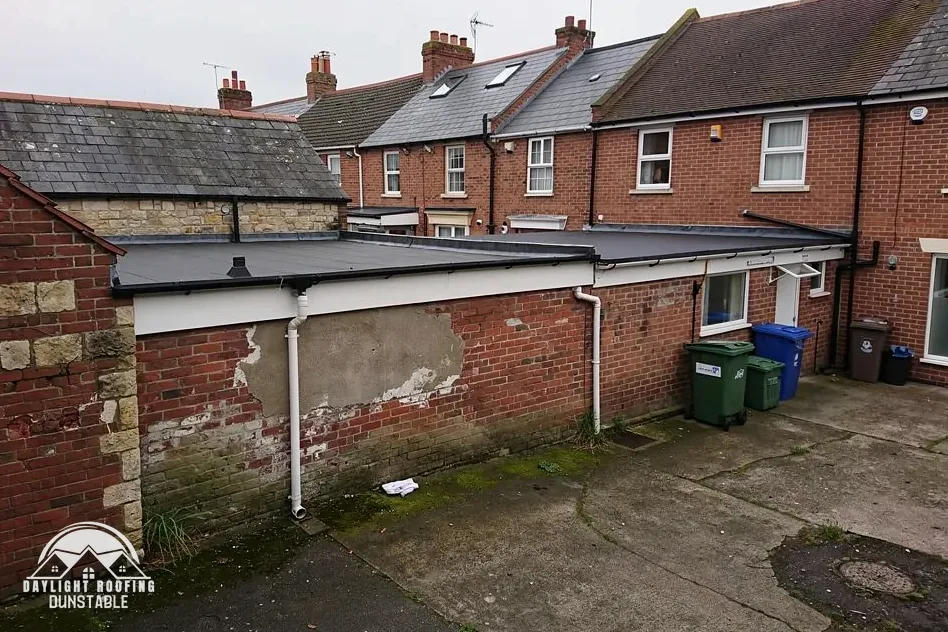
| Felt | 10-15 years | 10 to 20 years |
Less attaches conditions to its entries in its own words: EPDM rubber membrane "typically lasts 30 to 50 years", GRP fibreglass lasts "25 to 40 years with minimal maintenance", and torch-on felt lasts "10 to 20 years depending on quality and installation". The two sets are shown side by side as published. Felt is the shortest-lived of the three in both, and Less names quality and installation as the conditions that decide where a felt roof falls in its range.
The single-ply group is made up of membranes like EPDM and TPO, and it leaves out GRP and built-up felt. The page on signs of commercial roof failure lists what an ageing flat roof shows.
Lead and zinc on a commercial roof
Metals sit at the long end of the published figures. HomeBuilding's figure for lead on a flat roof is 60-100 years, while Less describes lead as "the longest-lasting option at 50 to 100 years". Those are two ranges for lead roofing as a whole, and they overlap without matching.
For lead flashing, which is the lead at junctions, parapets and abutments, MyJobQuote says correctly installed lead flashing can last for over 80 years. The phrase describes flashing that is correctly installed. It is not a promise for every roof, and it is not a minimum.
Zinc has a figure from its maker. VMZinc says: "When correctly designed and installed a zinc roof can last in excess of 100 years." A maker's figure comes with the same condition as the others, correct design and installation, and it describes the material and not the whole roof around it. Joints, penetrations and details are where a roof of long-lived metal is more likely to need attention before the sheets do.
The sheet itself is only part of the story for any metal. Sheet lead for flashings follows BS EN 12588 and comes in codes 3 to 8, with the specification deciding the code for each detail. Zinc and lead are both worked by hand to shape on site, so the detailing at each junction is checked as well as the sheet.
Profiled metal sheets and cut edges
Profiled steel or aluminium roof sheets have no age that can be read off a table. What can be said is what the sheet's life depends on: the coating on its faces, the condition of its cut ends, the fixings through it, the laps between sheets and the conditions around the building.
Cut ends are worth singling out. A sheet cut to length has an edge where the steel under the coating is exposed, and that edge is where corrosion can start and spread inwards. Cut ends occur along the eaves, up at the ridge and around rooflights, so those are places a survey looks. The page on cut-edge corrosion describes the mechanism.
- Rust at cut ends of sheets, or brown lines running from fixings
- Coating that is lifting, flaking or crazed
- Fixings that have backed out or are rusting
- Gaps or movement at the laps
- Sag or dents where sheets have been walked on
A sheet that appears sound from below may be failing at its fixings, and a stained sheet can be sound underneath. Where a roof has been overlaid before, the older layer and its fixings are checked too, because they sit out of sight beneath the newer one. That is why age on its own does not decide whether a metal roof is repaired or replaced.
What shortens or extends a roof's life
Maintenance matters as a general point. A roof whose gutters and outlets are kept clear, whose damage is repaired while it is small and whose foot traffic is limited to proper walkways is better placed than one that is left alone until it leaks. How much longer depends on the roof, and no extension is promised.
Drainage is the mechanical reason. NFRC reports that BS 6229:2025 sets "a minimum 1:80 finished fall for general roof areas and internal gutters", and a flat roof that holds water gives its covering a harder life than one that sheds it. A survey checks how water leaves the roof, whether any stands, and whether the outlets and gutters are clear.
Alterations count too. Plant that has been mounted on a roof, cables run across it and penetrations cut through it are all places where the original waterproofing has been interrupted. A roof that has been altered several times is a roof with several junctions to check, and each is checked in the survey.
Plant on the roof matters here as well. Extraction fans, aerials and solar equipment bring foot traffic, and proper walkways spread the load and mark a safe route across the covering. None of these produces a number. They explain why a survey's judgement of a particular roof is worth more than a table of published ranges.
Reading the signs of an ageing roof
Age shows itself in a few recognisable ways. Some are visible from the ground, some from inside the building, and some only from the roof. An owner or manager can check for the signs inside the building and from the ground without going near the roof.
- From inside: stains on ceilings or tiles, drips that repeat in the same place, daylight at laps, wet or sagging insulation
- From outside: ponding after rain, blisters or splits in membrane, rust at cut edges, debris in the gutters
- From the roof, at survey: lifting seams, cracked flashings, backed-out fixings, soft deck
Each of these justifies arranging a survey, and none justifies climbing up. Writing down when a stain first appeared, and whether it followed rain, helps the surveyor trace it. Where the sheets may be asbestos cement, nobody walks on the roof at all, because HSE says "AC roofs are always fragile". The page on fragile roofs and asbestos cement sheets explains why.
Photographs taken over time are useful, and keeping them in one folder with the date in each file name makes the sequence clear. A picture of a stain on one date and the same stain a few weeks later shows whether it is growing, and that tells a surveyor more than a description does.
Repair, overclad or replace
When a roof reaches the age at which the published figures start to apply, the choice is between repair, a new layer over the old covering, and replacement. The right one is chosen from the survey's findings and not from the date the roof was laid. A roof past the figure may need only localised work, and a roof well inside it may be failing because of one detail.
No price exists until the roof has been surveyed. Afterwards the findings come in plain language, other faults on the roof included, along with a single written total. Send a photo to WhatsApp (07880 284133) to begin, and it will be looked at. Overcladding, a new weatherproof layer over the existing covering, suits a roof whose structure and deck are sound, and the survey says whether yours is. Say how old the building is, what the covering is if you know, and what repairs the roof has had.
The commercial roofing hub describes what the firm takes on, from repair through to replacement. Scaffolding that stands on the highway takes a Highways Act 1980 licence from the highway authority. We arrange the licence with our scaffolder.
A roof's age is one input among several. The survey puts the others beside it: the covering, its condition, the drainage, the details at every junction and what has been done to the roof since it was laid.