
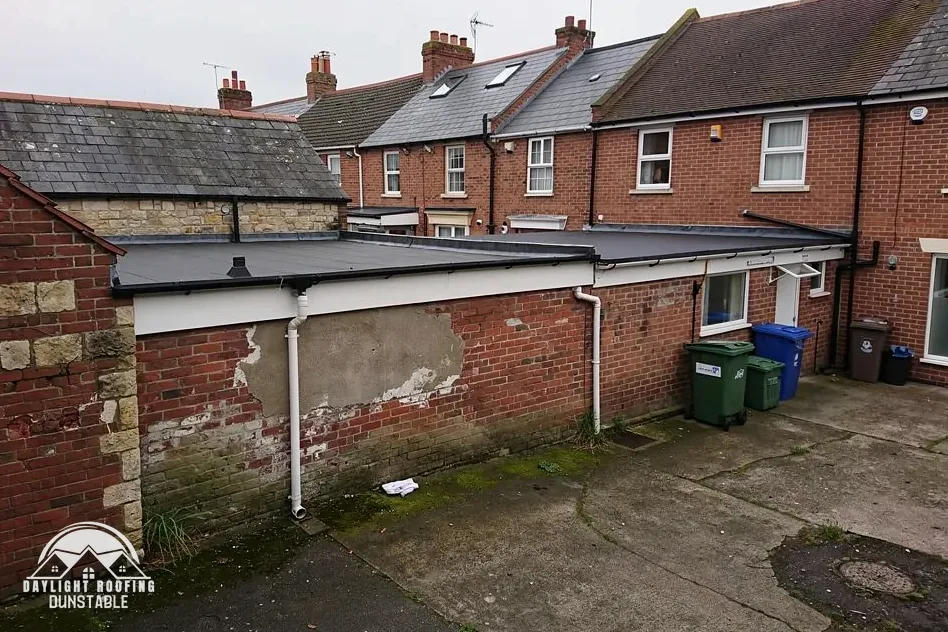
What single-ply means, and what it leaves out
A single-ply membrane is a thin, flexible waterproofing sheet made in a factory and supplied in rolls. On the roof the sheets are laid side by side and joined at the seams, so the weather barrier is formed by one layer of material instead of several layers built up on site. The membrane sits on top of the insulation and the deck, and the quality of those layers underneath has as much to do with how the roof performs as the membrane itself.
The term has a defined meaning. EPDM, TPO and PVC are single-ply materials. GRP, which is fibreglass laid wet, and built-up felt, which is laid in layers, are not single-ply, even though they also cover flat roofs. The flat roofing section compares those materials separately. This guide is limited to the three true single-ply materials as they are used on commercial buildings such as units, shops, schools and offices.
| Material | What it is | How seams are made |
|---|---|---|
| EPDM | Synthetic rubber sheet | Adhesive or tape |
| TPO | Thermoplastic sheet | Hot-air welding |
| PVC | Thermoplastic sheet | Hot-air welding |
The overview of commercial roofing shows where single-ply sits among the other coverings, and which kinds of building each covering suits. Shops, factories, schools and offices all carry flat or low-slope roofs, and the same three membranes serve each of them.
EPDM: a rubber sheet
EPDM is a synthetic rubber, supplied as large sheets that can cover a sizeable area with few seams. Because it is rubber it stays flexible and moves with the building, and its seams are made with adhesive or jointing tape, not with heat. The sheet is cut and folded to fit upstands, corners and penetrations, and the corners and outlets are finished with moulded pieces or additional strips.
Two lifespan figures are published for EPDM on flat roofs, and they disagree. HomeBuilding gives 25-30 years. Less says that an EPDM rubber membrane "typically lasts 30 to 50 years". Neither figure is a promise for any particular roof. How long a membrane lasts also depends on the detailing, the drainage and the care of the roof once it is finished.
Where an EPDM roof is repaired, the repair uses the same family of adhesives and patches. The surface must be clean and dry, and the repair is made to the manufacturer's method for that sheet. A patch stuck on with the wrong product can peel.
EPDM is also sold for domestic roofs, where it covers garages and extensions. On a commercial roof the same material is laid in larger sheets and over larger areas, which brings its own demands for access, drainage and wind resistance.
TPO: a welded plastic sheet
TPO stands for thermoplastic polyolefin. It is a plastic sheet that softens under heat, and that property is how its seams are made: the overlap between two sheets is warmed with a hot-air welder and pressed together, so the two sheets fuse into one. A properly made weld forms a joint that belongs to the membrane itself and not to a layer of adhesive between the sheets.
A welded seam can be checked. A probe is run along the edge of the weld to test for any place where the fusion has not taken, and a failed section can be re-welded. That ability to test the joint matters on a roof with a great many seams and details.
TPO sheets come in a range of widths and thicknesses and in light colours as well as grey. Details at upstands, rooflight kerbs and outlets are formed with welded accessories made from the same material, so the roof is waterproofed as a continuous skin.
Both EPDM and TPO are laid over insulation that must itself be sound, dry and fixed correctly. The membrane is only the surface. If the insulation board is crushed, wet or badly bedded, no membrane will hide it, so the survey reads the layers under the membrane as well as the membrane itself.
PVC: a flexible, welded sheet
PVC membranes are also thermoplastic, and they are joined by hot-air welding in the same way as TPO. The sheet is reinforced with a fabric or glass scrim, which adds strength and keeps it stable, and it is made flexible by additives that suit it to being rolled out and shaped around details.
Welding gives PVC the same testable seams as TPO. The membrane can be cut and welded around awkward shapes, such as plant bases, pipe collars and rooflight kerbs, with prefabricated corners and flashings. Repairs follow the same principle: a clean, dry surface and a weld or patch made to the manufacturer's method.
PVC differs from the other two materials in one practical way. A repair on an older PVC sheet is affected by the age and surface of the membrane, and the surveyor needs to know what the existing sheet is before anything is welded to it, because plastics of different kinds do not always weld together. A sample can be identified, and the repair product matched to it.
No one of EPDM, TPO and PVC is the right answer for every building. Each is a recognised way to waterproof a flat roof, and which one fits depends on the building, its roof layout, the access for the work, the details around the edges, the existing roof and the budget.
How the sheet is held down
A membrane has to resist being lifted by wind as well as keeping rain out. There are three broad ways to hold it. In a mechanically fastened system, fixings through the sheet or along its edges secure it to the deck. In an adhered system, the membrane is bonded to the insulation or deck with adhesive. In a ballasted system, the sheet lies loose under a layer of stone or paving that holds it down by weight.
- mechanically fastened: fixings secure the sheet to the deck
- adhered: adhesive bonds the sheet to the layer below
- ballasted: a loose-laid sheet held down by stone or slabs
The right method depends on the building. A ballasted roof needs a structure that can carry the extra load, and a fastened roof needs a deck that can hold the fixings. On commercial roofs the fixings follow a calculation that takes account of how exposed the site is, set out in a fixing specification written for that roof and its location.
The edges and corners of a roof take the greatest uplift from wind, so the fixing pattern is closer there. If a quote describes the method in one vague line, it is fair to ask which of the three is proposed and why it suits your roof.
Falls and details decide the result
Flat roofs are laid with a gentle slope, so that water drains to the outlets. NFRC says BS 6229:2025 sets "a minimum 1:80 finished fall for general roof areas and internal gutters". IKO writes: "To achieve a 1:80 fall, the code of practice says that the roof should be designed for a fall of 1:40". BS 6229:2025 covers flat roofs with continuously supported flexible waterproof coverings, which is the category single-ply membranes belong to.
Water that stays on the roof is a sign that something needs a look, since a membrane under standing water is working harder at every seam. A new membrane laid over a deck with poor falls will keep the poor falls, so the survey checks drainage as well as the covering. If a roof is being renewed, the opportunity to improve the falls with tapered insulation is worth discussing.
Details are the places where flat roofs leak. Upstands at walls, corners, pipe penetrations, rooflight kerbs, expansion joints and outlets all need to be waterproofed to the same standard as the main sheet, and each is formed in its own way. The surveyor looks at them closely, since a failed detail lets water in even where the main sheet is sound.
- outlets and gutters kept clear and drained
- upstands carried high enough above the surface
- corners and penetrations formed with accessories
- the fall checked across the roof before any covering is laid
Choosing between them on your roof
The choice rests on the survey. The surveyor looks at what the roof is now, what it is made of, how much of it needs work, how many details and penetrations it has, how the building is used and how the work can be reached. A roof with plant, pipes and rooflights across it has more details than a plain rectangle, and that affects which material is simpler to form around them.
Repairing an existing membrane is a separate question from replacing it, and the page on repair, overclad or replace works through that choice. A membrane laid over an existing roof, a tapered insulation scheme for improving falls and a full strip back are all possible, depending on the condition of what lies beneath.
Lifespan is part of the thinking, and the page on how long a commercial roof lasts sets that out. Whichever material is picked, commercial roofing is priced following a survey, and the quote you receive is one written total in which scaffold or access equipment forms part of the work.
If you are comparing quotes, check that each names the material, the thickness, the insulation, the fixing method and the details at upstands and outlets, so that you are comparing like with like. A quote that only says single-ply has left out what you need to know.