
Three routes, and one survey that picks between them
Talk about a failing commercial roof can jump straight to the price. A better first question is what the roof is made of and what share of it the damage has reached. A warehouse, a workshop, a retail unit and a school hall can all have a leaking roof, yet each may call for a different answer, because the sheets, the deck, the insulation and the supports underneath behave differently.
There are three routes. A repair puts right the specific faults that let water in. Overcladding puts a fresh sheet system on top of the existing covering and leaves the old one where it is. Replacement removes the old covering and builds a new one on the deck or the purlins. The choice is made on the survey, with the surveyor standing on the roof and looking at the underside from inside, never from a phone call or from the age of the building alone.
| Route | What it does | Fits when |
|---|---|---|
| Repair | Fixes named faults | The faults are local and the covering is sound around them |
| Overclad | New layer over the old | The old covering is tired but the structure beneath is sound |
| Replace | Strips back and rebuilds | The covering, or what lies under it, has failed |
Nothing here carries a price tag, because the sum depends on the building: a single written total arrives once the surveyor has seen it. Our commercial roofing page lists the covering types we work with.
What a repair can put right
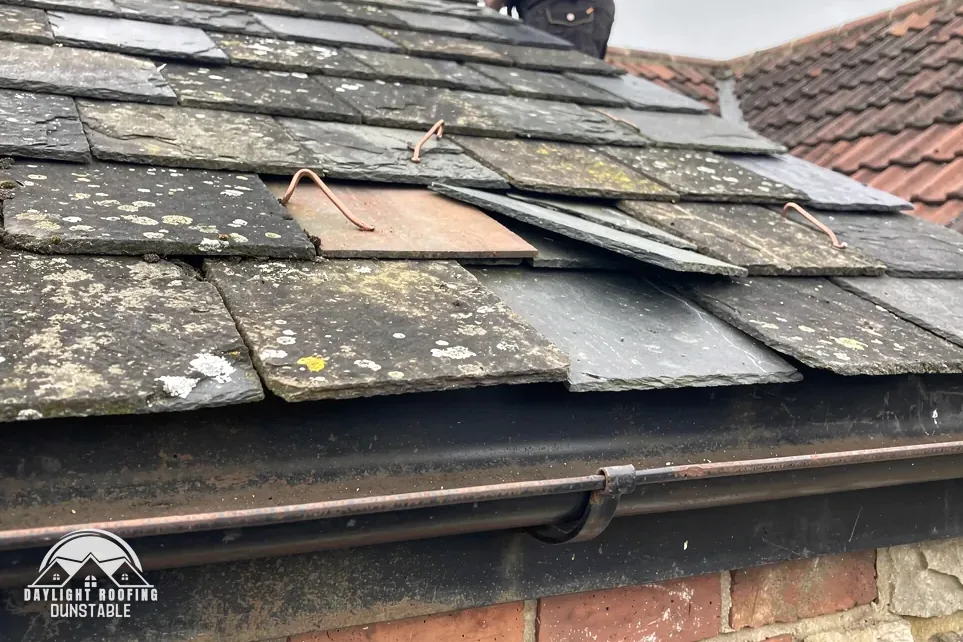
A repair suits a roof where the trouble can be pinned to particular places. On a profiled metal roof, that means a lap between two sheets that has opened up, a fastener that has worked loose or rusted through, a cracked or slipped rooflight, or a flashing at a wall or upstand that has pulled away. On a single-ply roof it means a split seam, a punctured area or a detail around a pipe or outlet that has stopped sealing.
The test of a good repair is that the covering next to it is sound enough to hold the work. Sealant smeared over a tired lap can look tidy and still give up within a season if the sheet beneath has lost its coating. The surveyor looks at the neighbouring sheets and fixings as well as at the wet patch, because a stain inside the building can sit some way from the spot where the water gets in.
- failed or open laps between sheets
- loose, missing or corroded fasteners
- damaged or cracked rooflights
- flashings that have lifted at walls and upstands
- blocked or split gutters and outlets
Repairs also buy time. If the covering is approaching the end of its life, a repair can hold a roof steady while a larger job is planned, but it does not change the age of everything around it. Telling the two situations apart is the subject of the page on signs a commercial roof is failing.
When overcladding makes sense
Overcladding means fixing a new roof sheet system over the existing one, so the building keeps a roof throughout the work and the old covering stays where it is. It can suit an older sheet roof that is leaking along its laps and fixings, but where the purlins, rafters or frame below are still sound.
Three things have to be checked before it can go ahead. The structure must be able to carry two layers, because the old covering stays on the building. The old roof must be flat and firm enough to take the new fixings. And the void between the two layers must be dealt with so that condensation does not collect there. Where the old sheets are asbestos cement, overcladding is one of the options a surveyor will weigh, and a later section sets out the HSE position on that material.
The detail around the edges needs thought too. Ridges, eaves, gutters, rooflights and the junctions with walls all have to be re-formed at a new level, which can change how rainwater leaves the roof. The page on what roof overcladding is goes through the method.
Overcladding is not a way of dodging a decision. If the deck beneath has rotted, or the insulation is saturated, covering it over buries the problem, and a fresh roof sheet will not dry it out. A finding like that sends the job back to the replacement route.
What replacement involves
Replacement removes the existing covering, and sometimes the insulation beneath it, so that the deck or the supports can be looked at and put right before the new roof goes on. It is the route that resets the roof: new covering, new insulation if the design calls for it, and new details at every edge and penetration.
On a low-slope commercial roof, the new covering may be a single-ply membrane. EPDM, TPO and PVC are the single-ply materials; GRP and built-up felt are different flat roof coverings altogether, so neither counts as single-ply. The page on single-ply membranes for commercial roofs sets out how they differ. On a profiled sheet roof, replacement means new sheets, fixings and flashings, perhaps with a new liner and insulation under them.
A full re-roof changes the fabric of the building, so we check the building control route with the council before the job starts. Building control is carried out by the council's building control team or by a registered building control approver. Insulation standards can come into play where a roof is substantially renovated, and the surveyor will say which apply to the building in question.
Replacement also takes the longest to plan. Access, the protection of what is underneath, the order in which areas are opened and closed, and the waste to be removed all need setting out before work begins. A business that cannot shut down needs that planning most.
Asbestos cement sheets change the options
Older industrial and agricultural buildings can carry roofs of asbestos cement sheeting, and the material governs what can be done. HSE says: "If the building was built or refurbished before 2000, assume that there is asbestos in it." The advice applies to the whole building, so a roof on such a building is treated as suspect until it has been tested.
HSE treats roof sheeting of asbestos cement as non-licensed work when each sheet is lifted away whole, and that holds for sheets which are weathered but not otherwise badly damaged. Where the cement has been badly damaged or broken up, by fire or flood for instance, the work becomes notifiable non-licensed work.
HSE's own words are: "AC roofs are always fragile." Nobody should step on one, and any repair or survey from above needs proper edge protection and crawling boards. That bears on the repair-or-replace decision, because work done from above on a fragile roof exposes workers in a way that work done on top of a new overclad roof does not.
Waste has its own rules. HSE's guidance says: "Use a lockable skip for asbestos", and the household exemption from consignment notes for hazardous waste is "other than asbestos waste". Any asbestos found in materials beyond cement sheets goes to a specialist asbestos firm. A separate page covers whether an asbestos cement roof is dangerous.
Who holds the duties and how VAT lands
A commercial roof job comes with duties that a household job does not. HSE defines a domestic client as "any individual who has construction work carried out on their home, or the home of a family member, that is not done as part of any business." A shop, unit, school or factory roof falls outside that definition, so the owner or tenant should expect to be treated as a commercial client under CDM 2015, with a construction phase plan drawn up for the project.
What this means for the choice is that the route changes the amount of planning behind it. A small repair and a full strip-and-replace do not carry the same planning load, even though both need the plan, and a business should ask early who is writing it and who is named as the client.
VAT is the other matter to settle early. The domestic reverse charge is a rule for supplies between VAT-registered firms that report through the Construction Industry Scheme. An end user falls outside it once it has notified its supplier in writing. Which side of that line a business sits on is a question for its accountant, and the answer decides how the invoice is shaped.
- who the client is under CDM
- whether the roof sits within a lease, and who maintains it
- whether an insurer needs to be told before work
- how the invoice will be treated for VAT
How the choice gets made on site
The survey is where the three routes are weighed. The underside of a roof shows what is happening above it, so tell the surveyor what can be seen from inside the building: stains, daylight through sheets, rusted fixings, dripping condensation, saturated insulation and sagging liners.
Four questions steer the decision. How far has the damage reached across the roof? What state is the structure in? What lies under the covering, in particular any asbestos cement? And how long does the owner need the building to stay in use during the work? A repair answers a small area; overcladding answers a tired covering over a sound frame; replacement answers a roof that has failed all the way through.
A fair quote sets the cost against the right route, not against the cheapest-looking one. A cheap repair to a roof that needs replacing is paid for twice. An expensive replacement of a roof that needed only new laps and fixings wastes the money. So we tell you plainly what the roof showed, including what else we saw on it, and the figure for the work is set out as a single total in writing.
To start with a look from the ground, send a photo to WhatsApp on 07880 284133. A photo only opens the conversation: the decision belongs on the roof, and the costs page for commercial roofing explains what moves a price.