
The short answer
Commercial roof work needs a scaffold licence only when the scaffold obstructs a road or pavement, because Highways Act 1980 s169 requires one from the highway authority. A scaffold wholly inside a private yard or site boundary does not. Trunk roads sit with National Highways instead.
What the law asks for
Section 169 of the Highways Act 1980 says that nobody may erect or retain on or over a highway any scaffolding or other structure that obstructs it unless they hold a licence. The word that matters is highway. It covers the carriageway and the footway beside it, so a unit on a high street or an industrial estate road with a public pavement in front of it is caught, while a unit set back behind its own forecourt may not be.
The permission is called a scaffold licence, and the highway authority for that road grants it. For most roads that authority is the unitary or county council. For trunk roads such as the M1, sections of the A5 and the A1(M), the authority is National Highways, so a unit that fronts one of those deals with a different body from a unit on an estate road.
Under Luton Council's published rules, no licence is needed where a scaffold "is on your private property and does not encroach onto the public highway". Authorities set their own conditions as well, such as a clear walkway of 1.2 m on the footway, which Hertfordshire County Council and Bedford Borough Council both list. A scaffold that must narrow a footway below that width is a matter for the council, not for the roofer. In practice, the distance between the building line and the pavement settles which side of the rule the scaffold falls on.
What councils charge and when it applies
Each authority publishes its own charge and process. Hertfordshire, Buckinghamshire, Milton Keynes, Luton and Bedford Borough each state their own charge for their own roads, and none of those charges is a price for a roofing job.
| Authority | Charge | Period |
|---|---|---|
| Hertfordshire County Council | £134, then £59 a week | 14 days to start |
| Buckinghamshire Council | £402.78 | 28 days |
| Milton Keynes City Council | £189 excluding VAT | Up to 1 month |
| Luton Council | £205, plus £550 deposit | Up to 28 days |
| Bedford Borough Council | £178.25 (2026) | Each month or part |
On process, Luton Council states that "for scaffolding the licence is issued to the scaffolding company", with at least 10 working days needed to process an application. Hertfordshire County Council states that "It usually takes 3 weeks to process an application." It also warns that a scaffold erected unlicensed risks a fine of up to £5,000. Council insurance minimums apply to the applicant, such as £10 million at Luton Council and £5 million on Bedford Borough Council's form. A scaffold licence is a council charge paid for the road space, so it sits apart from the cost of the roofing.
How a commercial job handles it
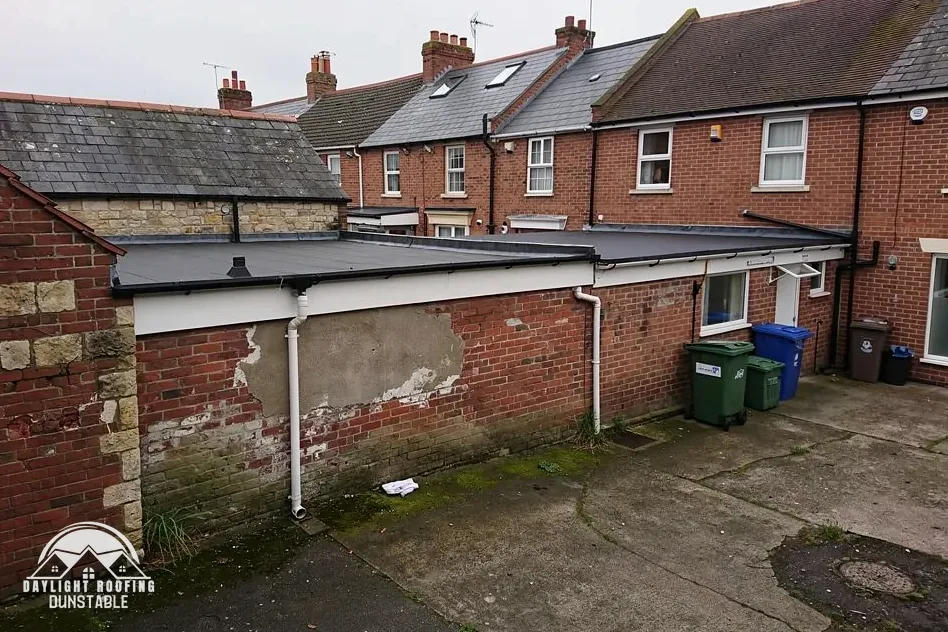
The licence is the first thing to plan on a street-front unit, because the council's processing time can be longer than the roofing programme. Whether a scaffold is needed at all comes from the survey: a low flat roof reached from a yard may need a platform on private land only, and a three-storey parade with a pavement in front needs a full licence. Early notice to the council helps, because the application has to be made before the first pole goes up.
Roads and pavements in Central Bedfordshire are licensed by Central Bedfordshire Council. We arrange the licence with our scaffolder. That covers the road and footway side only. It does not cover permission from a landlord, a neighbouring owner or a tenant, which a roof over a shared building may call for on its own terms, so tell the roofer who else has an interest in the building.
To get a roof looked at, send a photo on WhatsApp to 07880 284133 or ring 01582 935272. The commercial roofing page lists the work. Our guide to commercial roofing regulations covers the wider rules, and the commercial roofing costs page explains what drives a written price.