
The short answer
A fragile roof is a roof, or part of one, that cannot safely carry the weight of a person and may break under it. Under HSE guidance A14, AC roofs are always fragile. Other coverings can become fragile through age, corrosion or damage, so an unfamiliar roof is treated as fragile until shown otherwise.
What makes a roof fragile
Fragility is about what a surface does under load. A tile roof on timber rafters takes the weight of someone who steps on the right places. A fragile covering does not. The sheet cracks across, or the fixings pull through, and the person drops through the hole to the floor below. On a warehouse or factory that drop can be many metres onto concrete.
HSE's guidance A14 on safe working on roofs gives the firmest rule: AC roofs are always fragile. AC stands for asbestos cement, the sheeting laid over industrial units, farm buildings and garages for much of the last century. The sheets weather and turn brittle with age, and a sheet that looks sound from above can still break when stepped on.
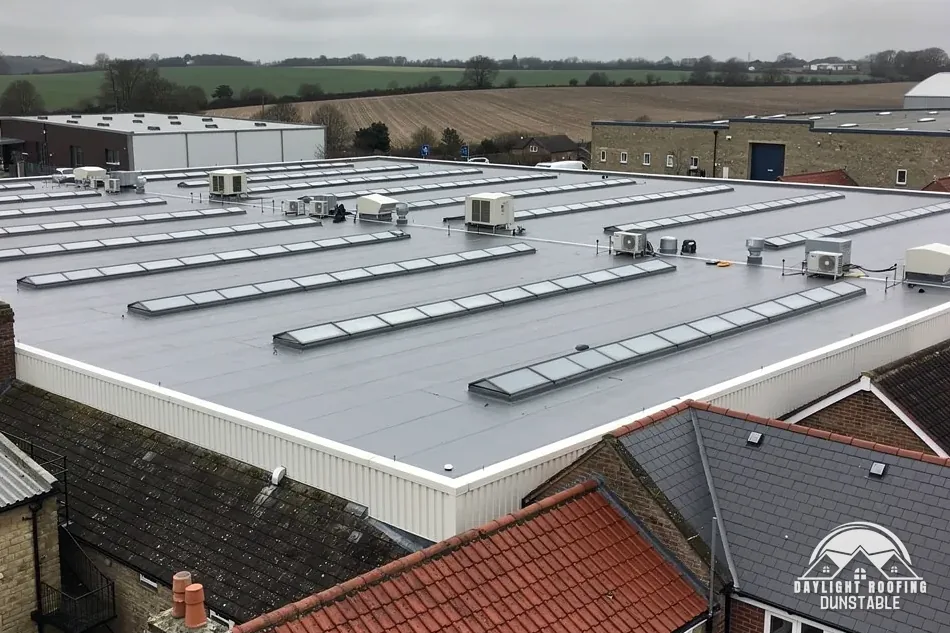
Other coverings can be fragile as well, though that depends on the material, its age and its condition. Rooflight panels are an example. A plastic or glass-reinforced panel set into a metal roof may weaken in sunlight, and from a distance it can be mistaken for the sheet beside it. Old metal sheets that are corroded around the fixings may fail underfoot, and so may the thin liner panels beneath an outer sheet. Because the condition of an unfamiliar roof cannot be judged by eye, the safe starting point is to treat it as fragile and work out the access from there.
Why the asbestos link matters
The sheets that fail underfoot are also the ones that may contain asbestos on an older building. HSE puts the starting point for older buildings in one line: "If the building was built or refurbished before 2000, assume that there is asbestos in it." Its separate guidance on asbestos cement sheeting then sets the rules for handling the material, and those rules depend on the condition of the sheets.
Lifting asbestos cement sheets carefully and keeping them whole counts as non-licensed work. Cement that has broken up, after a fire for example, moves into notifiable non-licensed work. Waste from either category goes in a lockable skip, never an open one, because a loose load can shed fibres on the way. Those are HSE's categories, and the method for a particular roof is settled before a single sheet is lifted.
- Brittle, weathered sheets on an older building may be asbestos cement, and they are fragile.
- Cracking a sheet by stepping on it creates the damage HSE warns about.
- A covering whose make-up is unknown is treated as asbestos-bearing until it is tested.
The fragile roofs and asbestos cement sheets guide follows that route in more detail, and the question of danger itself is covered on its own page.
Working safely on or near one
The rule that follows from fragility is plain: nobody walks directly on the sheets. Work is done from a platform that spreads the load and is carried by the structure, with edge protection around the perimeter and a means of arresting a fall through the surface. Equipment is chosen for the roof in question, so no single method suits every building.
Fragility is a risk for people other than roofers. A building manager, a maintenance team, an aerial installer or a gutter cleaner may each want to step onto a roof, and each meets the same danger. Warning signs at the access points and a locked hatch or ladder can keep casual visits off, and they are a matter for whoever manages the building.
The risk also shapes a commercial roof survey. Where the sheets or rooflights cannot be trusted, the roof is read from safe positions around the edge and from below, and you are told plainly what could and could not be seen. Any price for the work is given in writing after the survey, with the access method built into it. For the wider rules on commercial work, see commercial roofing regulations and the commercial roofing hub.