
The short answer
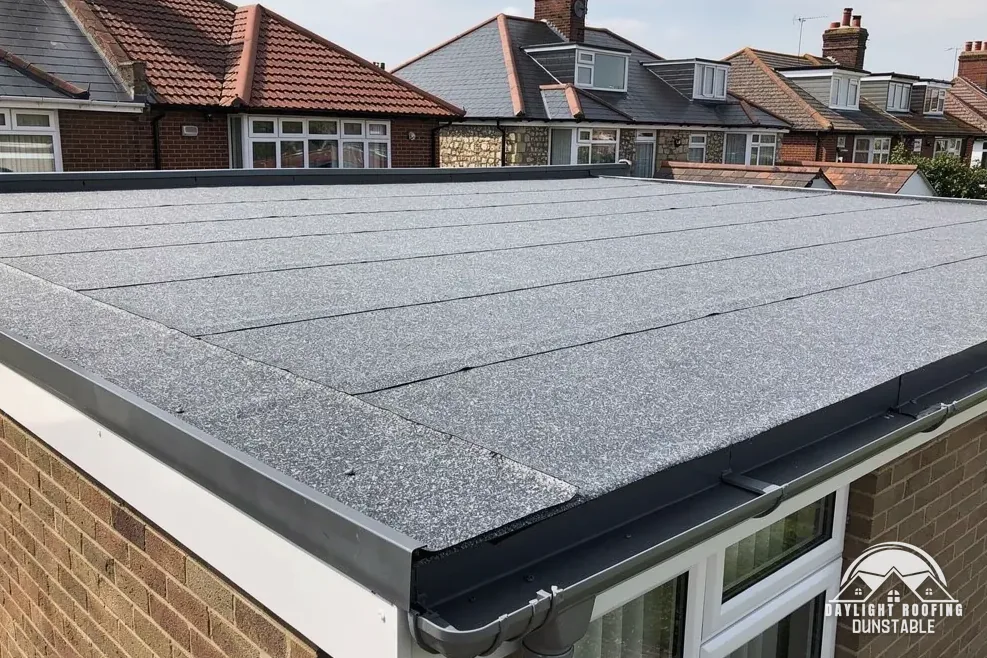
A TPO roof membrane is a single-ply waterproofing sheet made from thermoplastic polyolefin. It is supplied in rolls, laid across a roof with a gentle slope and joined at the overlaps by heat welding. TPO sits alongside EPDM in the single-ply group, and the finished roof drains to outlets or gutters.
What the material is
TPO is the abbreviation for thermoplastic polyolefin. The word thermoplastic is the useful part: the plastic softens when heated and sets again as it cools, which is what allows two sheets to be welded into one continuous layer. Polyolefin names the family of plastics the sheet is made from. The result is a flexible membrane supplied in wide rolls, in light colours and in grey.
A single-ply membrane is one layer of waterproofing, as the name says. EPDM and TPO are the standard examples. GRP and built-up felt do not belong to the group, because they are made in other ways. Single-ply sheets are laid over insulation on a deck, and the sheet is the only waterproof layer between the weather and the building.
Manufacturers publish their own data on thickness, reinforcement and compatibility, and the details differ from one product to the next. A lifespan for TPO therefore has to come from the maker of the actual sheet, with its conditions attached, and it would describe that product, not the material as a whole. A general number for TPO deserves caution until the product behind it is named.
How a TPO roof is laid
The sheet is unrolled across the roof and fixed in one of three ways. It can be mechanically fastened along the overlaps, bonded to the insulation with adhesive, or held down by a loose layer of ballast such as stone. Which method suits a roof depends on the deck, the structure and the building's exposure, and the maker's instructions for the chosen product set the details.
At every overlap the edges are joined with hot air. A welding tool softens both surfaces and a roller presses them together, which leaves a seam that is part of the sheet rather than a glued joint. The details are formed at upstands, parapets, outlets and pipes, where the membrane is turned up, welded to a preformed piece or terminated under a flashing.
| Method | How it holds |
|---|---|
| Mechanical | Fasteners through the overlaps |
| Adhered | Bonded to the insulation |
| Ballasted | Held by a loose layer of stone |
A flat roof also has to drain. BS 6229:2025 covers flat roofs with continuously supported flexible waterproof coverings, and NFRC reports that it sets "a minimum 1:80 finished fall for general roof areas and internal gutters". IKO writes: "To achieve a 1:80 fall, the code of practice says that the roof should be designed for a fall of 1:40".
What a survey reads on a TPO roof
Welded seams are the first place to look, because a seam that was not fully fused can lift or open. The survey follows each overlap and reads the upstands, the corners and the edges, where the sheet is stressed by movement. Punctures from dropped tools, foot traffic and plant servicing are read as well, along with the condition of the surface around any equipment mounted on the roof.
Ponding is a second check. Water that stays on a membrane after rain points to a hollow in the deck or a blocked outlet, and it keeps the sheet wet for longer. The outlets, gutters and any internal channels are read for blockages. Where a roof has an old covering beneath the TPO, the question of what lies under it, including asbestos, belongs in the survey too. A roof that has been walked on by several trades after the membrane went down may show scuffs and cuts that were never reported, so the whole surface is read, not only the area where the water came in.
Whether a fault means a repair, or a membrane at the close of its working life, is judged roof by roof. The single-ply membranes page covers the family, and the repair or replace page sets out the decision. The commercial roofing hub brings the rest together.