
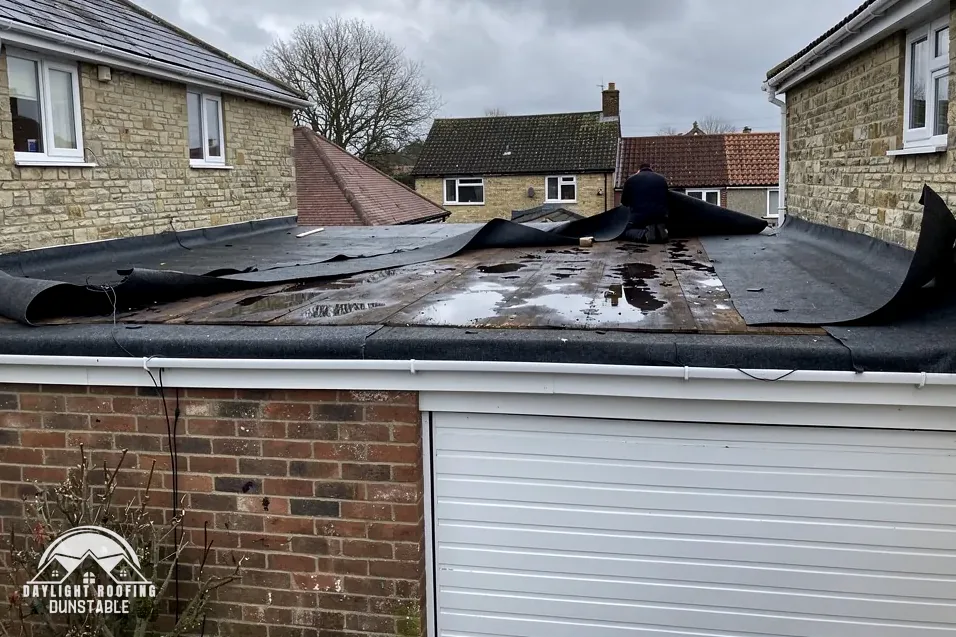
The short answer
Yes, a split, puncture or lifted seam on a flat roof can be patched as an emergency measure, provided the patch can be fixed to a clean, dry surface. A patch holds the water back for now. It does not explain why the covering failed, so the roof still needs a survey and a lasting repair.
What a patch can and cannot do
A flat roof sheds water by being sealed, not by being steep. Every join, upstand and edge relies on a continuous waterproof layer, so a single split in that layer can let a lot of rain through to the deck below. An emergency patch covers the opening with a new piece of material, bonded or sealed around its edges, so the water stops reaching the timber while the weather settles.
That is all a patch is asked to do. It does not renew the layer around it, and it does not deal with whatever opened the split in the first place. A membrane can open along a seam because the roof moved, because a surface was walked on, because water stood on it for weeks, or because the covering simply reached the end of its life. The patch sits on top of that history, and the same forces can lift it again.
For that reason a patch is a temporary measure, even when it looks neat. If it keeps a ceiling dry through one wet spell, that is a good result, but it is not evidence that the roof is sound. The page on flat roof splits and blown membranes goes through the faults that open a covering and what each one points to.
Felt, EPDM and GRP: why the surface matters
Three of the coverings laid on flat roofs are built-up felt, EPDM rubber membrane and GRP, which is glass-reinforced plastic formed as a solid shell. Each is repaired by its own method, and none of the methods works on a wet or dirty face. Adhesives, sealants and bonding compounds need a dry, clean face to grip, which is why a roof in the middle of a downpour is a poor place to start a patch.
| Covering | What a patch may involve | What the lasting job may need |
|---|---|---|
| Built-up felt | A bonded piece over the split | New layers across the failed area |
| EPDM | A glued or taped membrane patch | A new sheet where the damage has spread |
| GRP | A resin and matting repair | Recoating or a new shell if it has cracked widely |
Those rows are general, so a survey of your own roof is what settles which one applies, and which method suits the age and condition of the covering. An edge trim, a rooflight kerb or a pipe through the roof can each be the real source of a leak that looks like a membrane split, and a patch laid in the wrong place only hides the problem for a while.
After the patch: the lasting repair
Once the water is held back, the next step is a survey of the roof that reads the whole covering, not only the patched spot. A written total price follows that survey, and the work can then be planned around the roof as it actually is. The flat roofing service page sets out how replacement and repair of these coverings are approached.
Standing water is one thing a survey looks for. BS 6229:2025 sets a minimum finished fall of 1:80 for general roof areas and internal gutters, according to NFRC, and a roof that holds puddles after rain may not be draining as that standard intends. Ponding does not always mean a leak, but it loads the covering and its joins, and it can shorten the life of a patch laid beside it.
If the roof needs more than a patch, the choice between mending and replacing it is a separate decision made on the survey findings. The page on emergency and permanent roof repair explains where one stops and the other begins, and the main emergency roof repairs page covers the wider picture.