
The short answer
A tarpaulin is a short-term cover, and no fixed period applies to every roof. How long it can stay depends on how well it is fixed, how much wind and rain it meets and what lies beneath it. Check it after every windy spell, and treat it as a reason to arrange the permanent repair, not a substitute.
Why no period can be promised
Ask how long a tarpaulin will last and the reply turns on three things, none of which can be known in advance. The first is the cover itself: its thickness, its condition and whether it has been cut or chafed where it passes over an edge. The second is the fixing, meaning how it is held down, how tight it is drawn and whether the edges can flap. The third is the weather it has to sit through.
A well-fixed cover on a sheltered slope in calm weather can keep rain out for a while. The same cover on an exposed slope in a gale can be lifted or torn within hours. Because the range between those two cases is so wide, a single figure would mislead more than it helped, and any figure given by a roofer without seeing your roof should be treated with care.
There is a second reason not to rely on a time limit. A cover can look intact from the garden while water runs along a fold or under a lifted corner, so the roof beneath may be getting wet when nothing seems wrong. The page on temporary roof covers describes what a cover is for and where it falls short.
What decides whether it holds
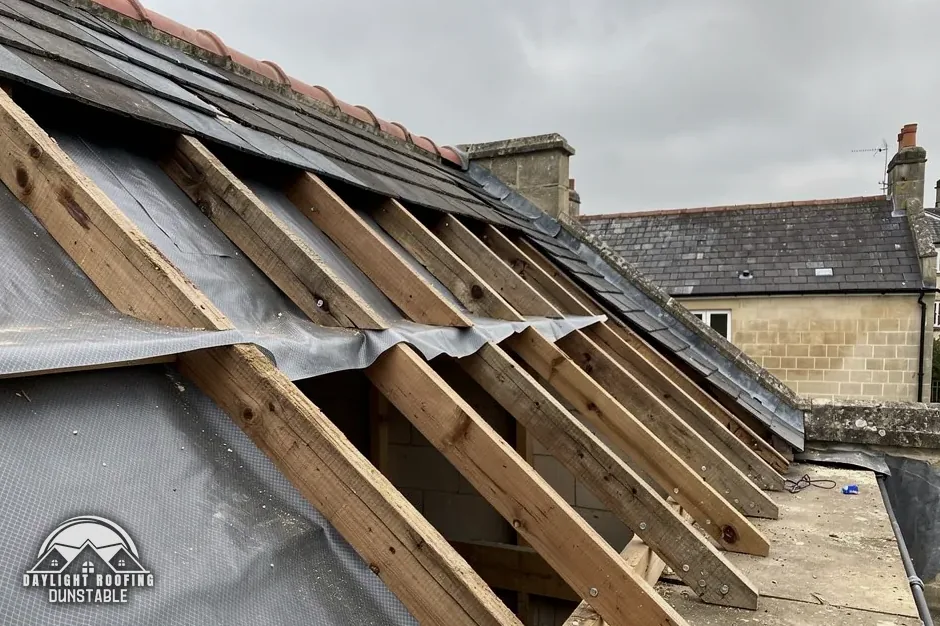
Several points together decide how long a cover keeps doing its job.
- How it is fixed: battens or fixings holding the edges down, not weights alone, and no loose flapping corners.
- Where it laps: the upper sheet should run over the lower so that rain runs off the joint rather than into it.
- The shape of the roof: a cover crossing a ridge or a valley has more places to lift than one laid over a flat slope.
- What it covers: sharp edges, broken tiles or exposed nails can cut through it.
- The weather: repeated wind, driven rain and frost all work on a temporary cover.
A permanent covering is fixed to a design that takes the exposure of the site into account. A tarpaulin has no calculation of that kind behind it, which is why it needs looking at again after bad weather and cannot be left to take care of itself.
After any strong wind, look at it from ground level. If an edge has come loose, a corner has lifted or a pool of water is sitting on it, tell the roofer rather than climbing up. A photograph sent to 07880 284133 by WhatsApp gets a look from the roofer; it may show a detail that is hard to describe from memory.
Moving from cover to repair
Because a tarpaulin is a holding step, the sensible plan is to treat its arrival as the start of a timetable, not the end of the problem. Book the survey, find out what the roof needs and ask for the lasting work to be quoted as a single total in writing. The page on what a roof make-safe is explains how the temporary step fits into the whole job.
Some things can lengthen the gap between the two. A slate, tile or length of lead that must match the existing roof may need ordering, an insurer may want to see the damage first, and a scaffold licence can add a wait of its own. The page on how quickly a roof leak should be fixed looks at that balance between waiting and acting.
Where the cover is going to stay for some time, keep an eye on the ceiling below. A new stain, a drip after rain or a musty smell near the hatch can each suggest water is getting past the cover. The main emergency roof repairs page covers what to do while the wait lasts, including how to limit harm indoors.