
The short answer
Catch the water in containers, move belongings and rugs out of its path, and stay out from under a ceiling that is bulging or near any wiring. From inside you can limit damage but not repair the roof, which has to be mended from outside. Photograph everything, then arrange a survey of the roof.
Catching the water and protecting the room
Start where the water lands. Set a bucket, a washing-up bowl or a baking tray beneath every drip, with a folded towel or an old sheet inside it so that the drops do not splash. If the drip is fast, empty the container before it fills, since a full bucket on a wet floor is heavy and easy to knock over. A wide, shallow tub catches water that travels across a ceiling and falls in several places.
Next, take belongings out of reach. Move furniture, bedding, books and electrical items to a dry room, and lift rugs and carpets that have started to soak. Cover anything too heavy to shift with plastic sheeting or a dust sheet. This is not the moment to tidy; the aim is to stop a roof problem becoming a contents problem, and a quick shift of the main items can do that.
Take photographs before anything is moved or dried. Show each stain, drip and damp patch, with a wide view of the room and close-ups of the damage. Pictures of this kind help whoever comes to survey the roof, and they matter later if an insurance claim is made. The page on what counts as a roofing emergency explains which signs mean the situation is urgent.
A bulging ceiling and the danger of water near wiring
A ceiling that sags or bulges is holding water above it, and plasterboard can give way without warning. Keep people and pets out from beneath it. Some trades describe piercing the lowest point of the bulge with a screwdriver so that the water drains into a bucket instead of coming down all at once. That step is a judgement call and carries risk, so it is only sensible if you can do it safely, from a firm footing and with the bucket in place, and not at all if there is any chance the water has reached cables or a light fitting.
Water and electricity do not mix. A stained ceiling around a light fitting, a loft cable that looks wet or a socket that is damp to the touch is a hazard in its own right. Keep away from it, and do not use switches in that area. If you are unsure whether the circuit is safe, ask a qualified electrician; the roof repair does not make an electrical fault safe. The page on turning off the electrics when a roof leaks goes into this.
Leave the ceiling alone if you are not sure. A drip into a bucket is a nuisance, but a collapsed ceiling is an injury. Keep an eye on the stain and mark its edge with a pencil and the time, which shows whether it is growing and gives the roofer a useful record.
Looking in the loft without making things worse
A look in the loft can show where water is coming in, but it needs care. Open the hatch, sweep a torch across the rafters and the felt beneath the covering, and look for dark patches on timbers, wet insulation, drips from the underlay or daylight where there should be none. Do this from the hatch or from a safe, boarded area. Never stand or kneel between the joists, because the ceiling below will not carry a person.
- Look for wet or dark patches on rafters and the underside of the roof covering.
- Check whether insulation is sodden or compressed in one area.
- Note any drips and where they fall, then place a container beneath if it is within reach of the hatch.
- Photograph what you see, and write down the date and weather.
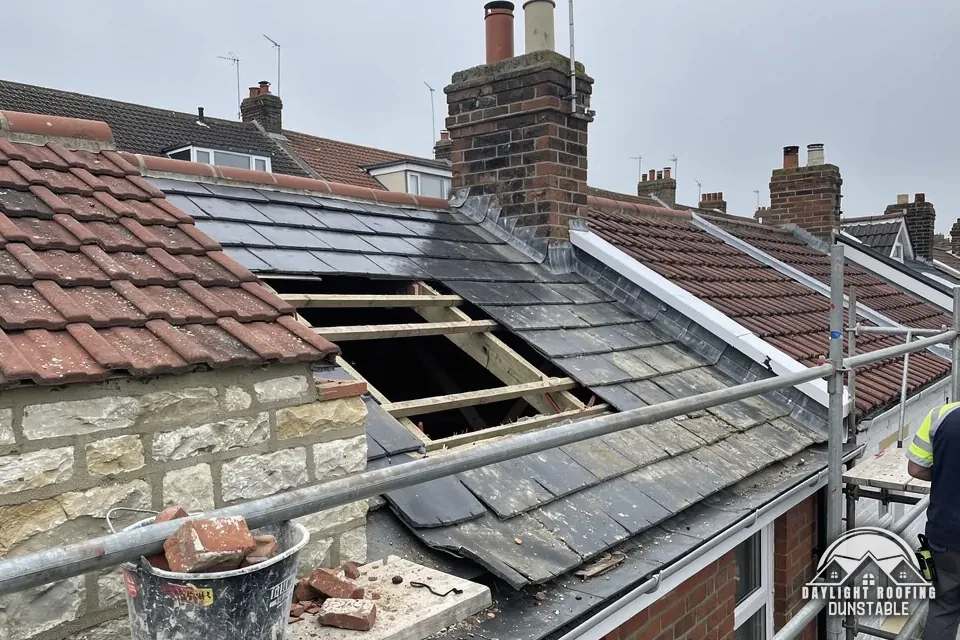
None of this repairs the roof. The opening is in the covering outside, and fixing it means working from the roof or a scaffold, with the right access. The page on temporary roof covers looks at what can be done from outside to hold the weather off. Send your photographs to 07880 284133 on WhatsApp, or ring 01582 935272, and the survey can be arranged. The emergency roof repairs page covers the rest.