
The short answer
No. After a storm a roof can be wet, loose and weakened in places you cannot see, and a fall can injure badly whatever the height. Look from the ground or a window, photograph what you see, keep clear of anything that could fall and ask a roofer to inspect the damage safely.
Why the roof is more dangerous after a storm
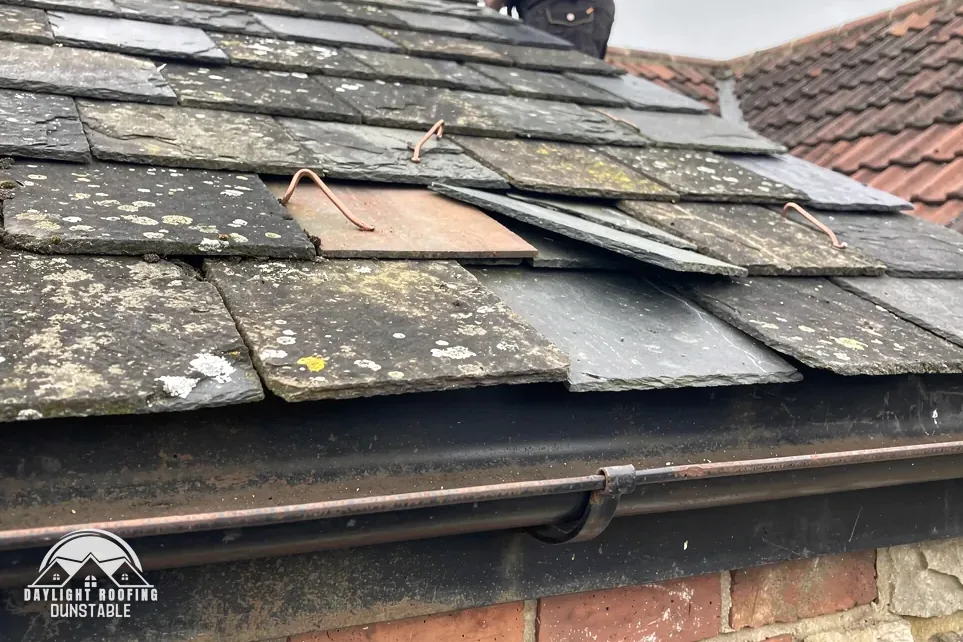
A roof that was safe to walk on last week may not be today. A gale can lift tiles without removing them, leaving a covering that looks whole but shifts underfoot. Slates can crack, ridge tiles can loosen and fixings can pull out of battens, and none of this shows until weight goes on it. Rain, frost or leaves add a slippery layer, and the angle of a pitched roof gives no second chance if a foot slides.
Access adds its own risk. A ladder footed on wet or disturbed ground can move, and a gutter that has been dragged by wind or a fallen branch will not take a person's weight. A short drop from a ladder can still end badly, and the surface below may be strewn with broken tile, glass or branches.
There are also hazards that have nothing to do with footing. A chimney stack that has shifted can drop bricks, and a tree resting on the roof may be holding the damaged part in place. Tiles and slates can slide from a slope without warning, and the area beneath a damaged edge is not a safe place to stand. The page on wind damage to roofs describes what gales can do to a covering.
What you can check from the ground
A good deal can be seen without leaving the garden. Circle the house slowly, looking up from several angles, with a pair of binoculars if you have them or the telephoto setting of a phone.
- Gaps in the line of the tiles or slates, or pieces lying on the ground, paths or cars.
- A ridge or hip that looks uneven, or a chimney stack that seems to lean.
- Gutters sagging, detached or hanging from the fascia.
- Flashings or lead lifting away from a wall or chimney.
- Branches, aerials or satellite dishes resting on the roof.
From inside, look at the ceilings and the walls beneath the roof for new stains, drips or bulges, and put your head through the loft opening with a torch, leaving your feet on the ladder. Mark anything you see with a pencil and the time. These observations help whoever surveys the roof, and a surveyor can use them to decide where to look first.
Keep children, pets and cars away from any part of the garden under a damaged edge. If something looks as though it is about to fall, treat the area as out of bounds until it has been dealt with. The page on what photos to take of roof damage shows how to record it all from a safe distance.
Fragile roofs and asbestos cement sheets
Some roofs are fragile whatever the weather. HSE guidance says "AC roofs are always fragile", meaning roofs of asbestos cement sheet, which can give way under a walker and let them fall through. Garages, outbuildings and some older commercial or farm buildings may have them. HSE also advises: "If the building was built or refurbished before 2000, assume that there is asbestos in it."
That advice is a reason to stay off any roof you cannot identify, and to avoid breaking, drilling or sweeping up pieces of damaged sheeting. Do not handle broken fragments, and keep other people away from them. Storm damage to such a roof should be left until someone competent to deal with that kind of material has looked at it; HSE explains the rules on its website.
Whatever type of roof you have, the same rule applies. Look, photograph and report, and leave the climbing to people with the equipment and training for it. Photographs can be sent to 07880 284133 by WhatsApp, and 01582 935272 is the number to ring. The emergency roof repairs page covers the next steps.