
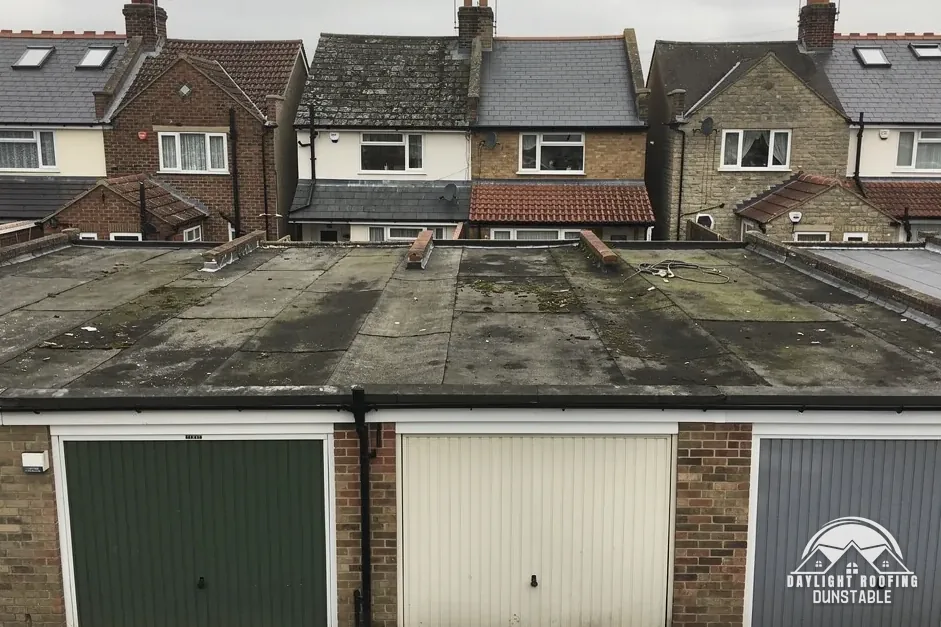
The short answer
Sometimes. A new flat roof covering can be laid over the old one only where the deck is sound, the existing layers are dry and bonded, and the falls still drain the water. A survey of the roof settles it, and Part L renovation rules still apply to the new membrane.
What has to be true for an overlay
An overlay keeps the existing layers where they are and adds a new waterproof covering on top. That saves stripping the old roof, but it also means the new covering depends on whatever lies beneath it, from the boards upward. Roofers weigh up the existing roof layer by layer before they say yes. If the old layers are sound, the idea can work. If they are not, the new membrane inherits every problem underneath.
The table sets out four conditions that are checked. Each is a question about the existing roof, which is why the answer for one house says little about the roof next door, even where the two were built alike.
| Condition | Why it matters |
|---|---|
| Sound deck | Soft or rotten boards cannot carry a second covering |
| Dry old layers | Trapped water stays trapped under the new membrane |
| Firmly bonded layers | Loose areas can lift or bubble through the new covering |
| Working falls | A roof that ponds water will pond it again |
A roof that fails any one of these is better stripped back to the deck. The overall picture for this kind of work is on the flat roofing page. Our guide to repairing or replacing a flat roof looks at that decision from the other direction.
Why old layers can limit the choice
Old felt, bitumen and insulation can hold moisture that cannot be seen from the surface. A moisture meter or a cut sample may show it, while a glance at the roof does not. Sealing damp material beneath a fresh membrane can leave the dampness no way out, and a blister or a soft patch may form later as a result.
Layers add thickness. At upstands, door thresholds, rooflight kerbs and edge trims, a second covering can leave less height for the new waterproofing to be turned up and lapped. Where there is already little room, the detail may become hard to make properly, and that alone can rule an overlay out.
The new covering also has to suit what it is laid on. EPDM, GRP and felt each come with the maker's own instructions for the surface beneath, and not every membrane can go over every old one. The comparison of EPDM, GRP and felt shows how the three coverings differ.
Weight is the other limit. The Planning Portal treats approval as necessary where the weight of the roof covering goes up by 15 per cent or more because of the new covering, with a structural engineer or surveyor to be consulted before work begins. An overlay keeps the old layers in place, so the load on the deck is something to settle before work.
The rules that still apply
A new membrane counts as renovation under Part L of the Building Regulations. AD L 2021 includes replacing the waterproof membrane on a flat roof in its list. Where more than 50% of the roof surface is renovated, para 11.3 looks for an upgrade of the element where that is feasible, and AD L 2021 para 4.13 allows a lesser upgrade if the full one would not pay back within 15 years. The threshold figure is 0.35 and the improved figure is 0.16.
The Planning Portal's test for re-roofing is separate from Part L. Less than 25 per cent of the building envelope and less than 50 per cent of the roof affected means no application is normally needed. Recovering a whole flat roof passes the 50 per cent line, and the Portal's main re-roofing page states "In most situations, this work will need Building Regulations approval." The detail is in our guide to flat roof Building Regulations.
Planning permission is a different question, since Class C is normally permitted development for re-roofing a house. A flat, a listed home or an Article 4 area may be different, and for those we check with the council. Whichever route suits the roof, an overlay or a strip-back, the price is set out in writing as one total after the survey.