
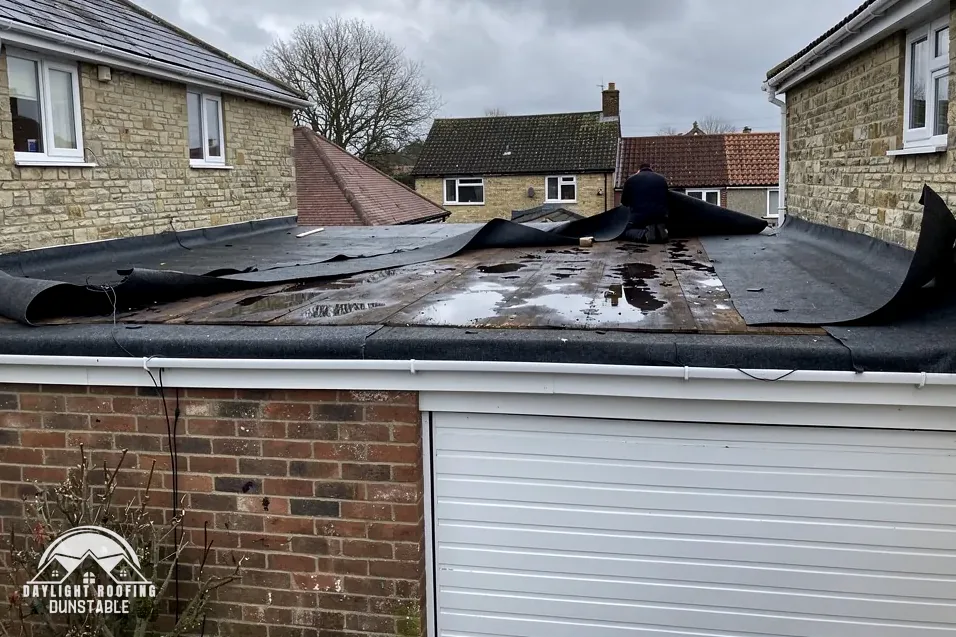
Start with where the water is going
The choice between a repair and a new covering depends on the extent of the fault, not on the fact that the roof leaks. A single opening at a single spot is one problem. Water entering across a wide area, or through a covering that has gone hard, thin and cracked, is a different one. The first question is therefore how widely the fault runs, and the second is the age and make of the covering, which decide what a repair would be made of.
Water can travel a long way inside a flat roof before it shows. It runs along boards and joists, and a stain on the ceiling marks where it came out, not where it got in. Marking the stain's edge and noting after which rain it grows are the first useful things a householder can do, and they narrow the search for the point of entry.
Finding the point of entry takes a look at the roof from above. A survey follows the water back along the covering, past the seams, up the upstands and round the outlets, and judges whether the source is one place or several. One place points towards repair. Several places, or a surface that is failing everywhere, point the other way.
Our guide to flat roof problems describes what ponding, blisters and splits look like, which is useful before a survey, because a householder who can name the fault can describe it clearly when asking for help.
When a repair is the sensible answer
A repair suits a fault that is local and a covering that is otherwise sound. A split along one lap, a small blister, a flashing that has lifted from one wall, an outlet that has silted up: each is a defined problem with a defined fix, and the rest of the covering is not in doubt.
The fix has to match the covering. A felt roof is patched with felt, a GRP roof is repaired with resin and glass fibre, and an EPDM sheet is mended with materials made for rubber. A patch of a different material stuck on top may not bond, so the repair uses what the covering is made of. The covering around a fault deserves a look too, since the movement or wear that opened one seam can be working on the next.
- one split, lap or seam that has opened
- a blister that is small and has not split
- a flashing or trim that has come away
- a blocked or loose outlet
- a deck that is dry and firm when pressed
A repair also buys time, and sometimes that is all a householder wants, for instance when a larger job is planned for later. If the covering is within its published lifespan, a repair can carry the roof for a good while longer, and the cost is smaller than a replacement. The covering around the patch keeps ageing at the same rate.
When replacement makes more sense
Replacement suits a roof where the covering across its whole area has little left to give. The signs build up together: ponding over a wide area, splits in several places, a surface that has turned brittle, blisters in groups and a ceiling that stains again after each repair.
| Sign | Points towards |
|---|---|
| One split or one lifted flashing | Repair |
| A small blister that has not split | Repair, after the cause is found |
| Ponding across a wide area | Replacement, or work on the falls |
| Splits in several places | Replacement |
| A deck that is soft or stained dark | Replacement, with new boards |
A roof that has been repaired and has then failed in a new place is telling its own story. Each patch deals with one point, and a covering that keeps opening elsewhere is worn throughout. At that stage another patch pays for time and not for a fix.
Age counts as well. HomeBuilding gives approximate lifespans of 10-15 years for felt, 25-30 years for GRP and 25-30 years for EPDM, while Less gives 10 to 20, 25 to 40 and 30 to 50 years. The two sources differ, and neither promises a result for one roof. Our guide to how long a flat roof lasts has the detail.
The deck decides it
Under every covering is a deck of boards or sheets, and the condition of that deck can overrule everything else. A covering laid on a deck that has gone soft, or that holds damp, will not hold, whatever it is made of, because it has nothing sound to bond to.
Water that has been getting in for a long time can leave boards stained, soft or crumbling at the edges. Pressing the ceiling below with a finger shows nothing about this, since only the top of the deck tells the story. That is why a suspect spot can need the covering opened before the boards are judged, and why a quote that has not looked underneath cannot say much about the boards.
Where the deck is sound and dry, a new covering can go straight over it after the old one is stripped, and the work stays as simple as it looked from the start. Where boards have gone, they are cut out and replaced, and the work grows. This is the point where a repair and a replacement can swap places on cost, since a patch on a rotted deck repairs nothing.
Damp that has been trapped under a covering also matters for what comes next. A new membrane over wet boards can lift into blisters, which is one reason flat roof work waits for dry weather.
What the Building Regulations say about a new covering
Replacing a flat roof's waterproof layer is treated as renovation under Approved Document L. When the renovated area passes 50% of the roof's surface, para 11.3 carries the whole roof to the Table 4.3 U-values wherever that is feasible: a threshold of 0.35 and an improved 0.16 W/m²K.
Para 4.13 covers roofs where the full upgrade cannot be done. When it is not feasible, or would take longer than 15 years to repay, the roof is taken as low in U-value as that payback permits. A new covering and its insulation are therefore planned together.
A repair is a different matter, since it renovates only a small part of the roof. Under the Planning Portal's guide, work needs no application normally when it affects "Less than 25 per cent of the total 'building envelope'" and "Less than 50 per cent of the roof is affected". A full replacement goes past the roof limit, and that is enough by itself to bring in approval.
Building control is the council's building control team or a registered building control approver, and we check the route with building control before work starts. Approved Document L 2026 applies from 24 March 2027, with its tables renumbered 3.2 and 3.3, so the 2021 tables apply to work today.
Putting a price on each route
Two publishers' figures give a sense of scale. Which? Trusted Traders gave £1,400 to £3,500 for a felt roof on a single 6m x 3m garage, and £1,950 to £4,000 for a rubber roof with new boards, in November 2025, and says its prices exclude VAT. Separately, MyJobQuote says that in 2026 the average flat roof replacement costs between £1,500 and £6,000.
None of these figures is for a repair, and none is our price. Our page on flat roof replacement costs gives each source with its date and basis. A repair gets the same treatment as a replacement: a survey, then one written total.
A cheaper route today is not always the cheaper route overall. Repairs that keep being redone can add up to more over several years than one replacement. The reverse can also be true: a replacement on a roof with a single local fault spends money on a covering that had life left. The survey is what separates those two situations.
Ask for the reasoning in writing. A quote for a repair should say what the fault is and what has been checked around it. A quote for a replacement should say what is being removed, what is being fitted and what the quote assumes about the deck.
How the decision gets made
The decision rests on five things: the share of the roof that is affected, what the covering is, how old it is, what condition the deck is in and whether the roof drains. A survey looks at all five on the roof itself.
A photograph sent to 07880 284133 on WhatsApp is a useful start, along with the age and covering if you know them and a note of where the stain has appeared. Your own notes help as well: the dates of the rain that brought the stain, the room it showed in and any earlier repairs, with the name of whoever made them if you know it. It lets us look at the shape of the roof before arranging a survey. The photograph cannot show the deck, which is why the survey comes next.
The outcome is either a repair or a replacement, set out in one written total price. If the answer is a repair, the written total says what the repair covers. If the answer is replacement, the quote will cover the whole roof as one job.
Whichever route is chosen, keep the notes and photographs of the faults. They show how the roof has behaved, and they help whoever works on it next.