
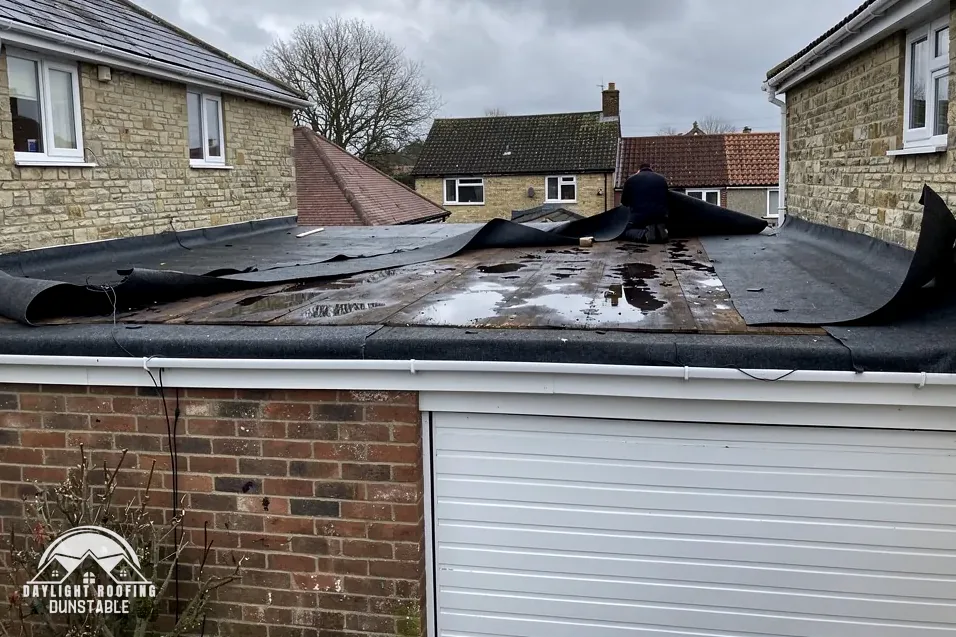
Ponding and the falls behind it
Ponding means rainwater still lying on a flat roof when the rain is over. No flat roof is truly flat: the covering sits on a deck set to a fall, a gentle slope meant to carry the rainwater off to a gutter or an outlet. A lingering pool means the fall is not working at that spot, whether from too little slope in the deck, a board that has sagged or a covering that has settled into a dip over a joist.
BS 6229:2025 is in force for flat roofs whose waterproof covering is flexible and continuously supported, which means membranes rather than lead. NFRC reports that the code sets a minimum 1:80 finished fall for general roof areas and internal gutters in its 2025 edition. A fall of 1:80 is one centimetre of drop in 80 centimetres of run. IKO reports that to achieve a 1:80 fall, the code of practice says that the roof should be designed for a fall of 1:40, so the design fall is steeper.
| Where the pool sits | What it can point to |
|---|---|
| Just short of an outlet | An outlet set proud of the covering, or a fall that stops early |
| Against a wall | An upstand that is low, or a deck that dips along the wall |
| Across the middle | A sagging board or a deck that has moved over a joist |
| In a corner | A fall that runs the wrong way into a dead end |
Look at the pool after rain rather than during it, and note where it sits, since each position points to a different cause. A photograph sent on WhatsApp to 07880 284133 gives us a first look at the roof.
Blisters under the covering
A blister is a raised bubble in the covering that can feel soft or spongy when pressed. It forms where the covering has lifted from what lies beneath, and the space under it can hold air, water vapour or water. On a felt roof the bubble is a lifted pocket between the layers. On a GRP roof it can be a lifted patch of resin, and on an EPDM roof it can be a patch where the sheet has parted from its adhesive.
Moisture can reach that space from two directions: through a small opening in the covering above, or as vapour rising from the building below. A pinhole or a failed lap is one route for rain. A steamy kitchen or bathroom with no vapour control layer in the ceiling is one route for vapour. The repairs differ: a patch stops one source of water but leaves a vapour route open, and a vapour route means the build-up of the roof needs looking at.
- a bubble that moves under a gentle press
- a ring of lifted covering around the bubble
- a bubble beside a join, an upstand or an outlet
- a cluster of small bubbles across one area
An intact blister has not necessarily let water through yet, while one that has split open gives water a direct path to the deck and then to the ceiling below. Do not cut a blister open to see inside, because a cut is a new hole in the covering. Photograph it with a coin or a tape measure beside it for scale and send the picture on WhatsApp so that it can be seen before a repair is chosen.
Splits, cracks and open joints
A split is a break running through the covering. On felt it can show as a crack across a lap or along a fold. On GRP it can be a hairline crack in the resin across a corner or a join, and on EPDM it can be a tear or an open seam. Whatever the covering, a split is a path for water, whether or not water is coming through today.
A flat roof moves. The deck, the walls it sits on and the covering itself expand and contract with the temperature, and a covering that has aged can lose its flexibility. A split can open where movement is concentrated: a corner, the join between two boards, or the line along a wall. A patch laid over the top can fail to hold, since the movement that opened the split is still there.
Published lifespans give a split some context. HomeBuilding gives approximate lifespans of 25-30 years for EPDM, 25-30 years for GRP and 10-15 years for felt. Less gives 30 to 50 years for EPDM, 25 to 40 years for GRP and 10 to 20 years for felt, depending on quality and installation. The two sources give different figures. Neither is a promise for any one roof.
Sealant or tape from a shop can bridge a split for a short while. It is a stopgap, and the covering around it still needs a look. Mark the position on a photograph, and check the ceiling below after the next rain.
Upstands, edges and flashings
An upstand is the short vertical turn-up of the covering where the roof ends against a wall, a rooflight kerb or a pipe. Water running down a wall lands on that junction, so the covering has to run up the wall, be fixed there and be sealed at its top edge by a flashing or a drip. Each junction is a place where two materials meet and move differently.
Look at the top edge of the upstand. A flashing that has pulled off the brickwork, a bead of sealant that has cracked and a covering that has slipped down the wall are all places where water can get behind the turn-up. At the roof edge, a trim or drip that has worked loose can let water run back under the covering instead of dropping clear into the gutter.
- the top edge of each turn-up against a wall
- the folded corners of the covering
- the seal around pipes and rooflight kerbs
- the drip or trim along the roof edge
Where a junction is dressed in lead, MyJobQuote says lead flashing that is correctly installed can last for over 80 years. That figure is for flashing that has been installed correctly, so a lead flashing with a lift or a split in it is a fault for a survey, whatever its age.
Outlets, gutters and drainage
A flat roof drains somewhere: to an outlet that passes down through the roof, to a gutter along one edge or to a scupper through a parapet wall. A drain blocked by leaves, moss or silt leaves the roof holding water like a shallow tray, and water that cannot leave can reach any weak point in the covering. Clearing a blocked outlet can put a pool right, and can also uncover a deeper fault.
On a roofline gutter the fall matters too. Brett Martin gives 1 mm of fall for every 600 mm of run towards the outlet. A gutter that sags between its brackets holds a pool of its own, and one that is full of debris spills over the edge and down the wall. Staining on the wall below a gutter shows where it has been overflowing.
Watch the roof drain during rain if that can be done from an upstairs window or the garden. Binoculars from the garden show an outlet clearly enough to see whether it is blocked. Keep off a flat roof that has not been checked, because a deck that has been soaked can be weaker than it looks, and a fall from even a low roof can cause serious injury.
Cold weather brings its own problems for drainage and for the covering, and they are covered in our guide to flat roof work in winter and wet weather.
What the ceiling below is telling you
Water that gets into a flat roof does not always show where it came in. It can run along a board, a joist or the underside of the deck before it drips, so a stain on the ceiling marks the place where water came out, and the opening in the covering can sit some distance away.
| What you see | What it can mean | What to do |
|---|---|---|
| A brown ring | Water has reached the plasterboard | Mark its edge in pencil and check after the next rain |
| A ceiling that bellies or feels soft | Plasterboard that has taken on water | Keep clear of it and call before touching it |
| Dark spots and a musty smell | Damp in the build-up, or condensation | Note which room it is in and send photographs |
| A stain that comes and goes | A small opening that lets water in only in some weather | Note the dates of the rain that brought it back |
Not every stain comes from rain. Warm, damp air from the rooms below can meet a cold surface inside the roof and turn to water there. That is condensation, a matter of how the roof is insulated and ventilated, not of a hole in the covering. A bellied ceiling is not a sign to push at, because plasterboard that is holding water can come down without much warning.
Sort the cause before choosing the repair, because patching a covering that is not leaking does nothing for condensation, and ventilating a roof that has a split does nothing for the split. Notes with dates and photographs make a survey faster, since they show how the stain has changed.
Repair, or replace the covering
A single split or a small blister can be a repair. Ponding across a wide area, a covering that has gone hard and cracked in several places, or a deck that has gone soft underneath points towards a new covering. Beneath the covering sit the boards, and a survey looks at those too, since a new membrane laid onto a rotted deck will not hold. Our guide on whether to repair or replace a flat roof goes through that choice in more detail.
Approved Document L lists a new waterproof membrane for a flat roof as renovation. Para 11.3 applies once more than 50% of the roof's surface is renovated, and the whole roof is then expected to meet Table 4.3 where that is feasible, which sets a 0.35 threshold and an improved U-value of 0.16 W/m²K. When the full upgrade is not workable, or would take longer than 15 years to repay, the roof is brought to the lowest U-value that the payback allows.
Stripping and relaying the whole covering affects more than half of the roof, which on its own is past the Portal's roof limit, so Building Regulations approval is part of the route for a replacement. The Planning Portal's main page says: "In most situations, this work will need Building Regulations approval." Building control is carried out by the council's building control team or by a registered building control approver.
Price ranges from published sources, dated and with their basis, are set out on flat roof replacement costs. After the survey we write one total for the whole job.