
The short answer
There is no fixed length. A flat roof replacement takes as long as the roof's area, how it is reached, the covering chosen and the state of the deck require, and wet weather can pause the work. Any timing is worked out after a survey, and a firm that gives one in advance is guessing.
What sets the length of the job
A replacement is more than laying a new membrane. The old covering and any failed insulation come off, the deck is checked and repaired, the falls are set, new insulation and a vapour layer go down if the design calls for them, and the waterproof covering is laid and finished at every edge. Each stage takes the time it takes, and the job moves at the pace of the slowest.
Size, access, the state of the deck, the covering chosen and the details at the edges can each move the time. A photograph cannot settle any of them alone, so an estimate of days begins with the survey of the roof.
| Factor | How it affects the job |
|---|---|
| Size of the roof | More area means more days at every stage |
| Access | Awkward routes slow down carrying and disposal |
| State of the deck | Rotten boards must be replaced before covering |
| Covering chosen | Each system has its own laying method |
| Details | Rooflights, upstands and outlets add work |
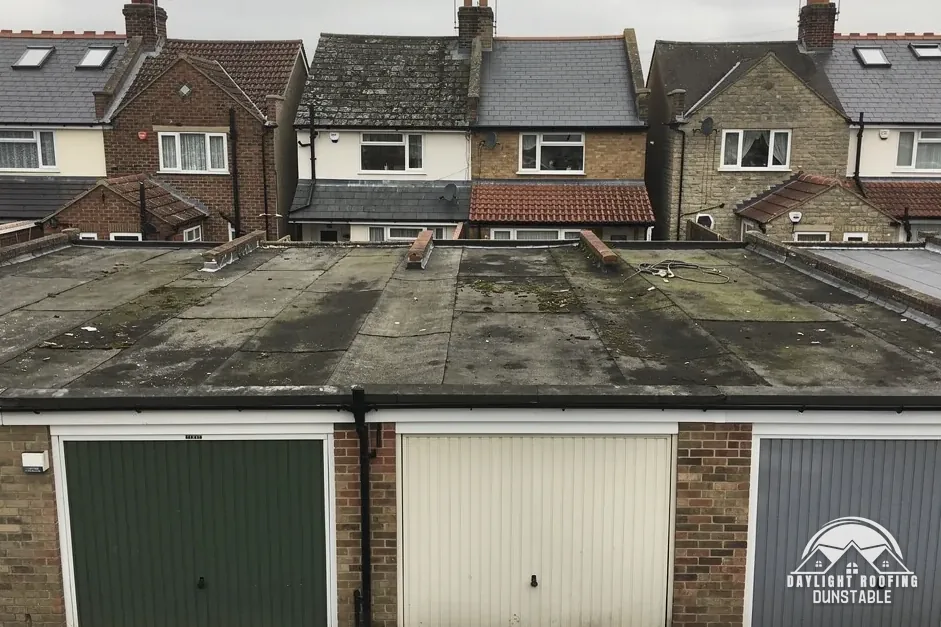
A small garage roof and a large extension roof are different jobs, even when both are called flat roof replacements. The page on flat roof replacement costs looks at the same factors from the price side.
Weather, scaffold and what holds a job up
Weather is the first thing that can stop work. Adhesives, resins and bonded joins need a dry, sound surface, and a roof stripped to the deck must not be left open to the rain. A roofer may pause for a wet spell, or cover the roof and return. The page on flat roofs in winter looks at how the season affects a plan.
Scaffold is the second. Where the scaffold would obstruct a road or pavement, section 169 of the Highways Act 1980 calls for a licence from the council that looks after the highway. For Dunstable addresses that is Central Bedfordshire Council, and we arrange the licence with our scaffolder. Luton Council's page asks for a minimum of 10 working days for each application, and Hertfordshire County Council's page says "It usually takes 3 weeks to process an application." A scaffold licence is therefore part of the lead time on a job that needs one.
What the strip-back reveals is the third. Once the old covering is off, a deck may turn out to have soft boards or damp insulation that no survey from above could show. Putting that right adds work, and it is better found at that point than covered over, a theme our page on repairing or replacing a flat roof returns to.
None of these can be settled in advance from the ground, which is why a start date follows the survey and not the other way round.
Why no date is promised first
Any firm that quotes a number of days before it has looked at the roof is guessing. A replacement is planned around the roof you have, and the plan can shift if the deck or the weather says otherwise. You get the price in writing after the survey, as a single sum for the whole job, and the plan for the days follows.
Ask any roofer what could change the timing, as well as what the timing is. The answer should name the weather, the access and the deck. A firm that can explain those, and say what happens if the boards prove to be soft once the roof is opened, is thinking about your roof rather than quoting from a template.
If a roof is leaking in the meantime, the leak and the replacement are separate questions. A temporary make-safe can slow the damage while a replacement is planned, and it is a stopgap, not the replacement itself. Call 01582 935272, or send photographs to WhatsApp on 07880 284133, and the roof is looked at before any plan is made. The flat roofing page sets out the coverings that can be laid.