
The short answer
Yes, blocked gutters can cause damp. A gutter that cannot pass its water to the downpipe overflows, and the spill can run down the wall, soak the fascia and soffit, or splash back at the base of the brickwork. Where a wall stays wet for long enough, the moisture can show as patches indoors.
How a blocked gutter wets a wall
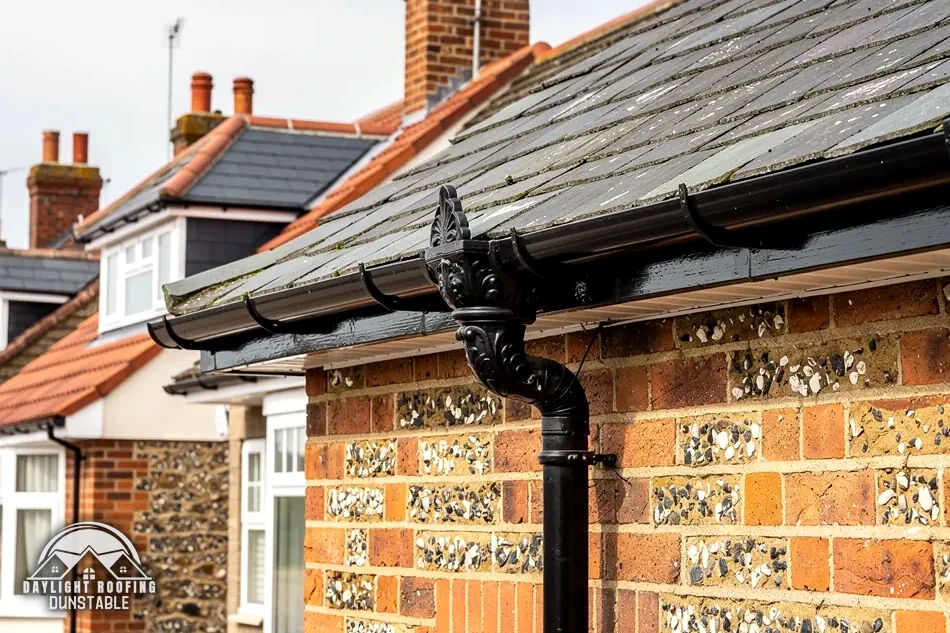
A gutter is built to carry roof water sideways to an outlet, from which a downpipe drops it to the drainage below. Leaves, moss washed off the tiles, silt and the odd ball or bird's nest can pack the outlet or the pipe under it. Once that happens the channel fills, and the water goes wherever it can. Over the front lip it falls past the wall in a curtain. Over the back it runs behind the channel into the fascia board and the eaves.
Brick and mortar are not waterproof. They take up water the way a sponge does, and a wall that is wetted from the top at every storm has little chance to dry between them. Timber at the eaves suffers in the same way: a fascia or soffit that stays wet can soften, stain and eventually rot. The wetting can also travel, since moisture in an outer leaf can reach the inner face of a wall.
Fall plays a part as well. Brett Martin gives a fall of 1 mm for every 600 mm towards the outlet. Where a length has dipped between two brackets, a pool stays in the dip and can spill over even when the outlet is perfectly clear. The correct fall for guttering page explains how the slope is set.
What to check inside and out
A look at the house from the ground, particularly while it is raining or soon after, tells you more than a look from a ladder. Binoculars bring the eaves closer without any climbing. The signs fall into two groups: marks on the outside of the house and marks that show indoors.
- Outside: water pouring over the front lip of a channel, or running down the wall behind a downpipe.
- Outside: green or dark streaks on the brickwork below a joint, a bracket or an outlet.
- Outside: stained, flaking or swollen paint on the fascia, and dark marks on the soffit.
- Outside: plants or moss growing in the channel, or a run that visibly dips.
- Inside: a tide mark or brown stain on a ceiling or wall at the eaves.
- Inside: peeling paint, a musty smell or mould high on an external wall.
A single stain is not proof that a gutter is the cause, but a stain that lines up with a spill or a stained patch of brick outside is a reason to look closer. Timber left wet for some time may feel soft under a thumbnail, though it is better to leave the testing to a survey than to scrape at old boards yourself. If you spot any of the above, the signs your gutters need work guide goes through the other warning marks on a roofline.
When damp is not the gutter
Gutters are one possible source among several, and mending the wrong one wastes money. The table sets three signs against the gutter and against other causes.
| What you see | The gutter | Something else |
|---|---|---|
| Stain at the eaves | An overflow or a leaking joint | A slipped tile or failed flashing |
| Patch low on a wall | Splash from a broken downpipe | A defect at ground level |
| Mould on a cold wall | A wet outer wall | Condensation from indoor moisture |
The causes overlap, so the survey treats the gutter, the covering above it and the wall below as one question. You are told what the survey found, plus anything else noticed on the roof, and the written quote after it gives a single total. The inside of a wall is not visible from the outside, which is why a damp specialist may be worth calling where the pattern does not fit a gutter spill. Where the gutter is the cause, the repair or replace guttering guide helps weigh a clear-out against a refit, and the whole roofline sits under the guttering, soffits and fascias service.