
The short answer
They can. HSE names asbestos insulating board among the materials used for soffit panels, and its advice for a house built or refurbished before 2000 is to assume asbestos is there. A board cannot be identified by looking at it, so an old soffit is treated as suspect and stays untouched until a test has been done.
What the rule says about age
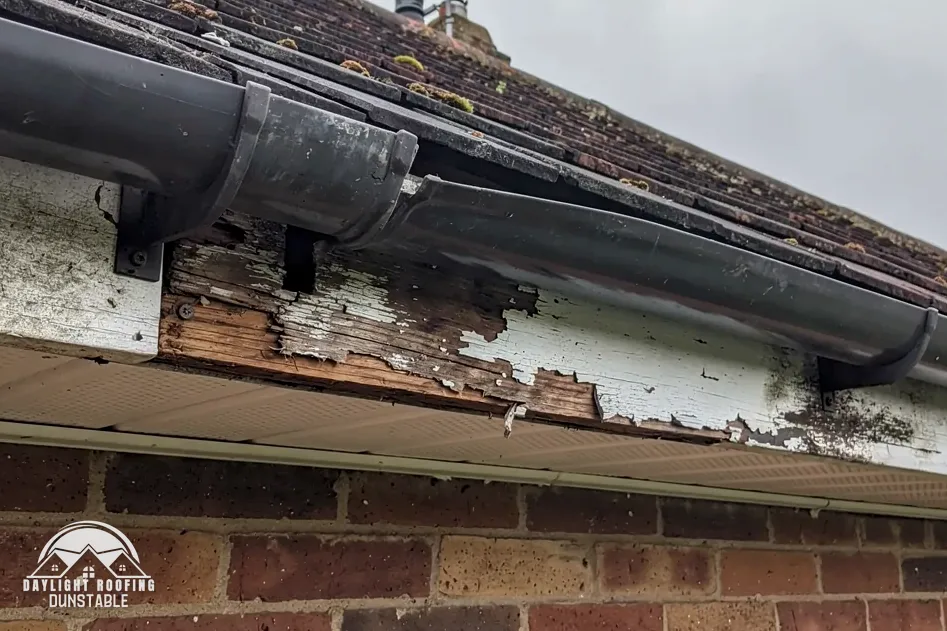
The soffit is the strip of board under the eaves, filling the gap where the wall meets the fascia. In houses from earlier decades, some soffits were cut from asbestos insulating board, shortened to AIB. HSE's list of materials that can contain asbestos names "AIB white soffit panels to underside of roof eaves" and, separately, "Damaged AIB soffit". The board is a flat sheet, and from the pavement it resembles many other flat boards.
The age rule comes from HSE: "If the building was built or refurbished before 2000, assume that there is asbestos in it." The word that matters is assume. It does not say every soffit of that age is asbestos. It tells the owner to proceed as if it might be until a test shows otherwise. The words "or refurbished" matter too, because a house built later can carry older material that was reused in an alteration, and a refurbishment before 2000 could have added a board to an older house.
For the part itself, the what is a soffit page explains what it does, and the asbestos soffits guide covers the longer picture. The wider roofline work sits under guttering, soffits and fascias.
How you can tell what a soffit is
Some soffits are plainly something else. Timber boards show a grain and open joints, and plastic panels click together with a smooth, even finish. A flat painted sheet on an older house is the one that raises the question, and from the ground the eye cannot separate it from a cement board or a harmless one. Age, paint and weathering all change how a board looks without changing what it is made of.
| Looks like | What it may be | Next step |
|---|---|---|
| Wood grain, open joints | Timber board | No asbestos question |
| Smooth plastic panels | uPVC | Check what lies behind |
| Flat painted sheet, older house | Could be AIB | Identify before any work |
Identification means having a sample taken by a competent person and analysed by a laboratory. The sample is taken with care, because breaking a board is how fibres are released. Until a result comes back, the safe course is to leave the board alone: no drilling, sawing, scrubbing or snapping off a corner to look at the edge. A roofer who spots a doubtful board on a survey tells you so, and any price for work on it follows the result of the sample.
What follows if it is asbestos
What comes next depends on the material and how sound it is. HSE treats cement sheets lifted off whole, without breaking them, as non-licensed work. Work on asbestos insulating board is a stricter matter: for all but short jobs it is licensed work, outside the reach of an ordinary tradesperson. HSE puts short-duration removal of insulating board as part of a refurbishment project in its notifiable non-licensed group, alongside cement sheeting that has been substantially damaged or broken up.
HSE's guidance for waste is "Use a lockable skip for asbestos", adding that "it is not good enough to throw sheeting over a standard skip". Household asbestos is also outside the consignment-note exemption, which covers domestic hazardous waste "other than asbestos waste". Rules at local recycling centres differ and are not covered here, so ask your council before taking any material anywhere.
MyJobQuote's average cost of an asbestos survey is around £325 in 2026, on a page last updated on 9 September 2026. That figure is an average published by MyJobQuote, not a quote for any one soffit, and the right route for a given soffit depends on its condition. Where a roofing survey turns up a board that may be AIB, the finding is passed on in plain terms, and the work waits for a result.